Phenix City Safety Plan: 7,379 Crashes, 34 Deaths and 269 Serious Injuries in 5 Years, a 50% Cut by 2036 and a $250,000 Grant Closing Out
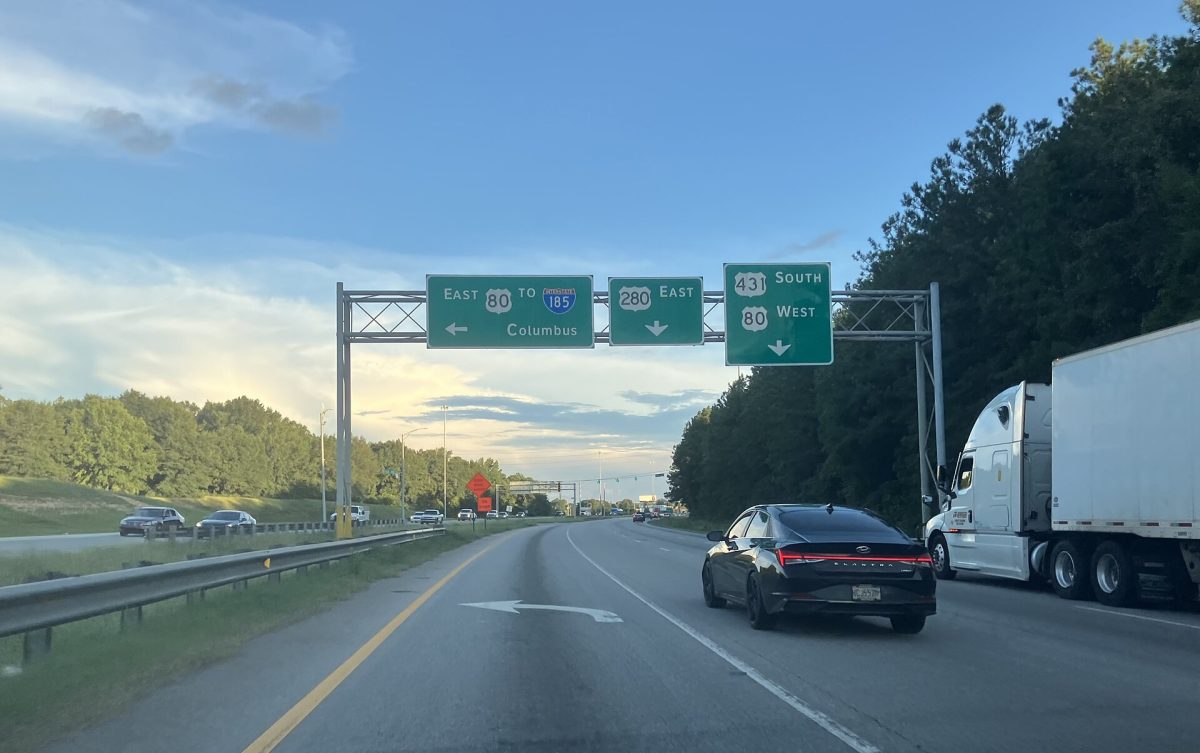
Overhead signs where U.S. 80, U.S. 231 and U.S. 280 run together in Phenix City. State routes carried 3,721 of the crashes in the city's five-year count. Photo: Mccunicano / Wikimedia Commons (CC BY-SA 4.0)
PHENIX CITY, Ala. - Phenix City is closing the books on the federal grant that paid for its first citywide road safety plan, a document that counts 7,379 crashes, 34 deaths and 269 suspected serious injuries on city streets over five years and commits the city to cutting deaths and serious injuries in half by 2036. The Phenix City Council took up an amendment to its Safe Streets and Roads for All grant agreement with the U.S. Department of Transportation and the Federal Highway Administration at its Nov. 3 meeting, according to a Nov. 4 report in The Citizen of East Alabama. The total project amount under the agreement was $250,000.
Consultant Sain Associates finished the Safety Action Plan for $213,504.55, below the $249,937 the council originally agreed to pay under Resolution 2024-244, the newspaper reported. That leaves a balance of $36,495.45, and the city must amend the agreement to give back, or de-obligate, the 80% federal share of the unspent money before the grant can be closed. Sain also submitted a separate $10,000 proposal for extra engineering drawings that Norfolk Southern requested before it will issue permits for resurfacing on 4th Avenue, which lies inside the railroad's right-of-way, according to the report.
What the plan found
The final plan, dated May 2026 and posted on the city's SS4A page, analyzed every crash reported on public roads inside the city limits from 2020 through 2024 using data from the Alabama Law Enforcement Agency and the Phenix City Police Department. Its narrative counts 7,379 crashes in that span, with 34 fatalities and 269 suspected serious injuries. A table on the city's web page puts the total at 7,502, with 3,721 on state routes, 3,681 on municipal streets and 100 on county roads.
The yearly numbers have been drifting down. The web page table shows 1,499 crashes in 2020, a peak of 1,625 in 2021, then 1,495 in 2022, 1,462 in 2023 and 1,421 in 2024. The plan's key findings say total crashes and fatal crashes are trending downward but serious injury crashes are trending upward, and that Phenix City's fatality rate matches the statewide rate while running 1.5 times higher than the rate for comparable incorporated areas in Alabama.
The worst crashes are concentrated. Most fatal and serious injury crashes, 71%, occurred on just 10 routes when all roads are counted regardless of who owns them, and the 10 worst city-maintained routes accounted for 14% of fatal and serious injury crashes, according to the plan. Motorcycle crashes were overrepresented relative to the city's population.
| Crash severity, 2020-2024 | Crashes | Federal cost estimate per crash |
|---|---|---|
| Fatal (K) | 32 | $12,500,000 |
| Suspected serious injury (A) | 210 | $1,188,200 |
| Minor injury (B) | 812 | $233,800 |
| Possible injury (C) | 749 | $111,700 |
| Property damage only (O) | 5,654 | $5,000 |
| Unknown (U) | 45 | $217,600 |
The crash counts and per-crash costs in the table come from the plan, which uses Federal Highway Administration comprehensive crash costs in 2022 dollars. The plan uses those federal cost figures to weight each crash by severity when it maps the city's High Injury Network, so that a single fatal crash counts for 2,500 fender-benders. Multiplying the counts by the per-crash costs in the plan's table produces a combined comprehensive cost of roughly $948 million for five years of crashes. The plan says that weighted map, not raw crash counts, should rank future projects.
How residents weighed in
The plan was built with a task force that included city staff, the Alabama Department of Transportation, elected officials and community members, and it met three times at the Phenix City Public Safety Building: April 29, July 9 and Oct. 15, 2025. A public survey went out through social media, postcards and a QR code printed on utility bills, and 184 people responded, according to the plan. The project team also collected paper surveys at community events, including a July 25, 2025, giveaway at Troy University's Riverfront Campus.
What it would cost to fix
The plan sorts fixes into corridor-wide systemic projects and spot projects at intersections, tagged short, medium or long term. Because the city chose to focus on streets it maintains, the state route projects were pushed to an appendix. Sain also completed road safety assessments at a handful of sample locations and attached planning-level 2026 cost estimates that include a 30% contingency.
Those sample estimates range from a few thousand dollars in paint to major rebuilds. Restriping Summerville Road at 37th Street would cost about $16,000, and adding stop-ahead markings and warning signs at Auburn Road and Dobbs Drive about $22,000, according to the plan. Adding pedestrian facilities and fresh striping at Crawford Road and 24th Avenue was estimated at $113,000, a lighting, sidewalk and access-management package on 0.2 miles of Stadium Drive between 37th Street and Summerville Road at $629,000, and shoulders, guardrail work and a possible roundabout along Riverchase Drive from Airport Road to Summerville Road at $801,000.
The plan also recommends policy changes that cost little but shape future projects. It calls for the council to formally adopt the 50% reduction goal, which the SS4A program requires, and to adopt a Complete Streets policy modeled on one the Columbus-Phenix City Metropolitan Planning Organization approved in 2018. It recommends a citywide bicycle and pedestrian master plan, a Safe Routes to School effort, a transit study and a standing safety action committee that would report progress to the council every year and update the High Injury Network map.
What comes next
The planning grant is only the first step in the federal program, which also funds demonstration projects and construction. In June 2026 the council ratified a $375,000 SS4A grant application that carried a $75,000 city match, according to a summary of that meeting. The city has not posted whether that application was funded. Questions about the plan go to the Phenix City Engineering Department, which maintains the SS4A page at phenixcityal.gov.
At the same Nov. 3 meeting, the council approved buying eight 2026 Ford Explorer patrol vehicles for the Police Department from Stivers Ford Lincoln in Montgomery under a state contract for a total not to exceed $510,080, The Citizen reported. The vehicles were bought under state contract T191L, according to the meeting agenda. The council next meets Tuesday, Nov. 17, at 9 a.m. Eastern at 1111 Broad St., after a 3 p.m. work session Monday, Nov. 16, according to the city's calendar.
Source: The Citizen of East Alabama (Nov. 4, 2026); Phenix City Council agenda (Nov. 3, 2026); Phenix City Safety Action Plan, Sain Associates (May 2026); City of Phenix City SS4A web page (updated May 29, 2026); Phenix City Council June 2, 2026 meeting summary via Govly; Phenix City events calendar (Nov. 2026)
News organizations may republish this story with credit. See our guidelines.
Know someone who'd want to read this? Email it to a friend.
Plan your weekend with Columbus Times
Get This Weekend in Columbus every Thursday: the best local events, free things to do and family fun, plus each evening's local news. Free, and you can unsubscribe anytime.
By signing up you agree to get the Columbus Times email newsletter. Unsubscribe anytime with one click.


Comments
Be respectful. No personal attacks, hate speech, spam or anyone's private information. Every comment is reviewed before it appears. Comment rules
No comments yet. Be the first to share your thoughts.