Tuskegee Airmen Site by the Numbers: 2 Hangars, Almost 1,000 Pilots and 1,578 Combat Missions 50 Miles From Columbus
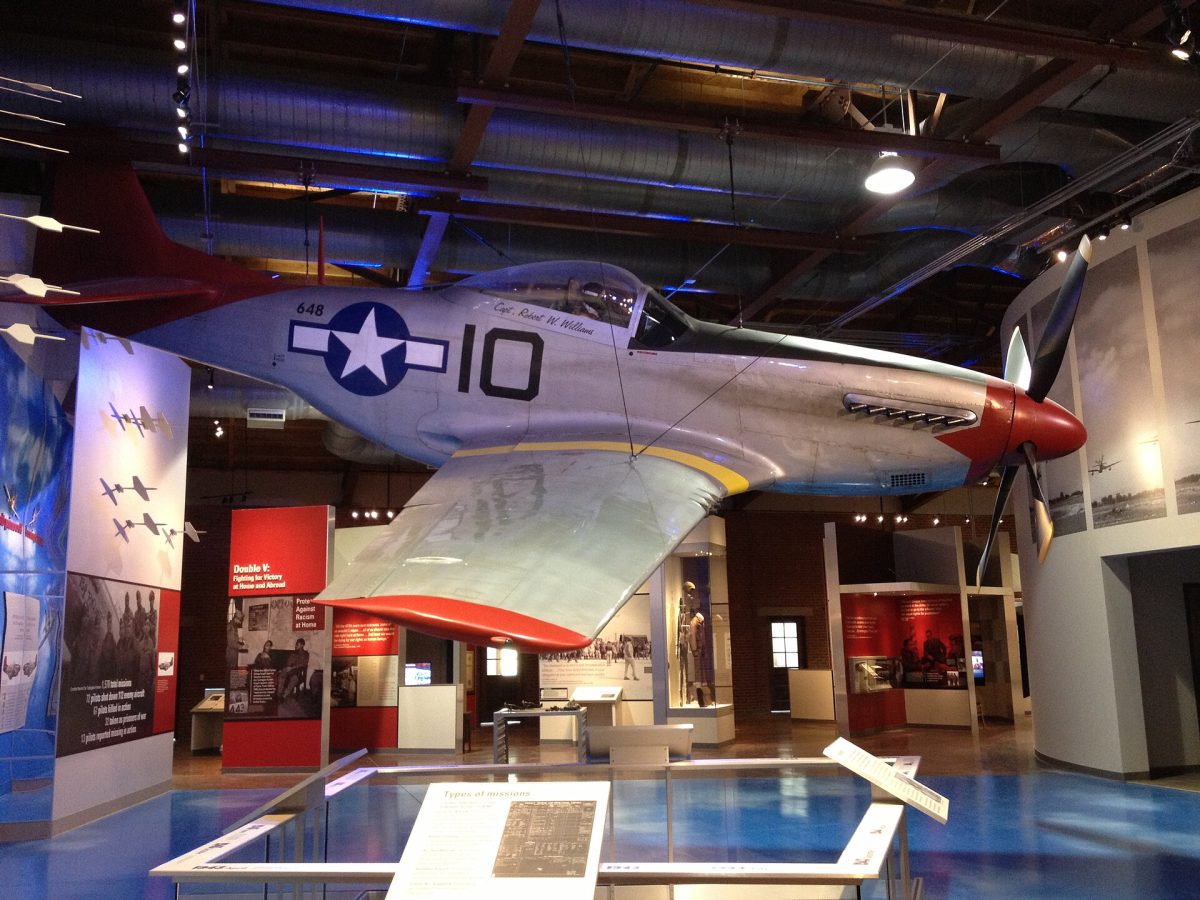
A full-size reproduction of a red-tailed P-51 Mustang fighter on display at Tuskegee Airmen National Historic Site (file photo). Photo: National Park Service / Wikimedia Commons (Public domain)
COLUMBUS, Ga. - About 50 miles west of Columbus, off Interstate 85 in Tuskegee, Ala., a small airfield preserves the place where America's first Black military pilots learned to fly. Moton Field was the only primary flight training facility for African American pilot candidates in the U.S. Army Air Corps during World War II, according to the National Park Service. Today two hangar museums and a cluster of wartime buildings make up Tuskegee Airmen National Historic Site, which charges no admission and is open six days a week.
The figures below come from the National Park Service, which runs the site, and from its published history of the Tuskegee Airmen. Some totals, such as the number of support workers, vary between Park Service publications, and those differences are noted. Here is the Tuskegee Airmen site by the numbers.
The numbers at a glance
| Number | What it means |
|---|---|
| 1 | Moton Field was the only primary flight school for Black Army Air Corps pilot candidates in World War II |
| 55 acres | Size of Kennedy Field, the small airfield where Tuskegee's civilian pilot training began |
| 1941 | Year the Army awarded Tuskegee Institute the contract to run a primary flight school |
| Almost 1,000 | Aviators trained as America's first African American military pilots |
| More than 10,000 | Military and civilian men and women in support roles, by one Park Service count |
| 1,578 | Combat missions the Tuskegee Airmen completed by the end of the war |
| 1998 | Year Congress established the national historic site |
| 2 | Hangar museums open to visitors |
| $0 | Admission |
Before Moton Field: 55 acres and a first lady's flight
The story starts with the Civilian Pilot Training Program, which President Franklin D. Roosevelt created to train young Americans as pilots ahead of a possible war. Black students were not originally included, but pressure from the Black press, Black aviators, civil rights groups and supportive lawmakers expanded the program to six Black colleges, according to the Park Service. When Tuskegee Institute was approved, G.L. Washington, its director of mechanical industries, leased and upgraded a small, 55-acre private airfield called Kennedy Field, about 5 miles south of campus.
Kennedy Field's most famous day came on March 29, 1941, when first lady Eleanor Roosevelt visited. Chief flight instructor Charles A. Anderson, who had established civilian pilot training at the institute in 1939, took her on a flight over the Tuskegee countryside. She became an outspoken supporter of Tuskegee's flying program, and the Park Service displays a J-3 Piper Cub of the type she flew in.
1941: A Black college builds an Army airfield
In 1941, the Army Air Corps awarded Tuskegee Institute a contract to operate a primary flight school at Moton Field, according to the Park Service. That made Tuskegee one of very few American institutions, and the only African American one, to own, develop and control facilities for military flight instruction. The school's students and faculty designed and built the field and named it for Robert Russa Moton, the institute's second president.
The first military class of cadets began training at Kennedy Field in August 1941, and primary flight training moved to the newly completed Moton Field in September 1941. Cadets first flew the PT-17 Stearman biplane, and the Park Service notes that the future "Red Tails" started out flying trainers with striped tails. After primary training at Moton Field, cadets moved on to basic and advanced training at Tuskegee Army Air Field.
Almost 1,000 pilots, and thousands more on the ground
The Park Service says almost 1,000 aviators were trained as America's first African American military pilots. More than 10,000 military and civilian African American men and women served in support roles, according to the site's statement of significance, while a separate Park Service lesson plan puts the support total at more than 15,000. The airmen were not only pilots: they were also mechanics, radio operators, parachute riggers, navigators, bombardiers, meteorologists, control tower operators, cooks and medical staff.
Women worked alongside the men as mechanics, gate guards, control tower operators, fuselage technicians, secretaries and clerks. Three permanent female parachute riggers trained hundreds of cadets to pack and maintain parachutes, according to the Park Service. Gertrude Anderson took over operation of Kennedy Field after its director was transferred to Tuskegee Army Air Field.
1,578 combat missions
The Army created the 99th Pursuit Squadron in 1941, and it later combined with the 100th, 301st and 302nd squadrons to form the 332nd Fighter Group. By the end of the war, the Tuskegee Airmen had completed 1,578 combat missions, and some received the highest honors the Army Air Forces gave, according to a Park Service lesson plan. They saw considerable action over North Africa and Europe, earning more combat opportunities as their record grew.
Lt. Col. Benjamin O. Davis Jr., who graduated with the first class at the Tuskegee Army Flying School in March 1942, addressed the fourth graduating class a few months later. "I would say that, at this time, this school has graduated pilots who can fly no better and no worse than the graduates of other Air Forces schools," Davis said, according to a July 11, 1942, report in The Jackson Advocate that the Park Service republished. He told the new pilots they had "the added burden of proving to all concerned that as military pilots you are as good as any in the world."
From Freeman Field to Executive Order 9981
The Park Service credits the airmen's performance with helping pave the way for desegregation of the military, which began with President Harry S. Truman's Executive Order 9981 in 1948. Members of the 477th Bombardment Group staged a nonviolent demonstration to desegregate the officers' club at Freeman Field, Ind., a protest the Park Service says set a pattern for later civil rights direct action. The agency calls the airmen's story "a powerful and seminal metaphor for the struggle of African American freedom in America."
Congress established Tuskegee Airmen National Historic Site in 1998 through Public Law 105-355. The Park Service's frequently asked questions page cites an estimate from Tuskegee Airmen Inc. that fewer than 200 pilots and support personnel remain. The park does not arrange speakers, and it directs groups that want to hear from an airman to Tuskegee Airmen Inc.
2 hangars: What visitors see
Hangar No. 1 focuses on support personnel such as parachute riggers, mechanics, office staff and civilian workers. It houses two training planes: a PT-17 Stearman of the type cadets flew at Moton Field and a J-3 Piper Cub like the one Eleanor Roosevelt rode in. Visitors can also see a restored Link Trainer, an early flight simulator.
Hangar No. 2, a reconstruction, tells the stories of the bomber and fighter pilots during and after the war. It holds a full-size replica of a red-tailed P-51 Mustang flown by 1st Lt. Robert W. Williams and nicknamed "Duchess Arlene." Other buildings on the grounds include the Skyway Club, and both hangars cover the segregation and discrimination the airmen faced.
Visiting from Columbus
The hangars are open 9 a.m. to 4:30 p.m. Monday through Saturday, and the grounds, trails and parking areas are open daily from sunrise to sunset. The site is closed Sundays, New Year's Day, Thanksgiving Day and Dec. 25, and no entrance pass is required. Tuskegee is on Central time, so the hangars open at 10 a.m. and close at 5:30 p.m. Columbus time.
The Park Service warns that most GPS systems do not direct drivers to the park, and it tells visitors to take I-85 Exit 38, between Auburn and Montgomery. Groups of 10 or more are asked to let the park know they are coming. Tuskegee Institute National Historic Site, on the Tuskegee University campus, is nearby.
More information
Directions, hours and virtual tour information are on the Tuskegee Airmen National Historic Site page of the National Park Service website. The park's frequently asked questions cover the aircraft on display and how to reach the airmen's national organization. The Park Service's history of the Civilian Pilot Training Program explains how flight training at Tuskegee began.
Source: National Park Service, Tuskegee Airmen National Historic Site (history, significance, FAQs, hours, fees); National Park Service, 'The Tuskegee Airmen: Training and Stateside Experiences' (Teaching with Historic Places)
News organizations may republish this story with credit. See our guidelines.
Know someone who'd want to read this? Email it to a friend.
Plan your weekend with Columbus Times
Get This Weekend in Columbus every Thursday: the best local events, free things to do and family fun, plus each evening's local news. Free, and you can unsubscribe anytime.
By signing up you agree to get the Columbus Times email newsletter. Unsubscribe anytime with one click.


Comments
Be respectful. No personal attacks, hate speech, spam or anyone's private information. Every comment is reviewed before it appears. Comment rules
No comments yet. Be the first to share your thoughts.