Andersonville by the Numbers: 45,000 Prisoners, Nearly 13,000 Deaths and a 26.5-Acre Stockade 60 Miles From Columbus
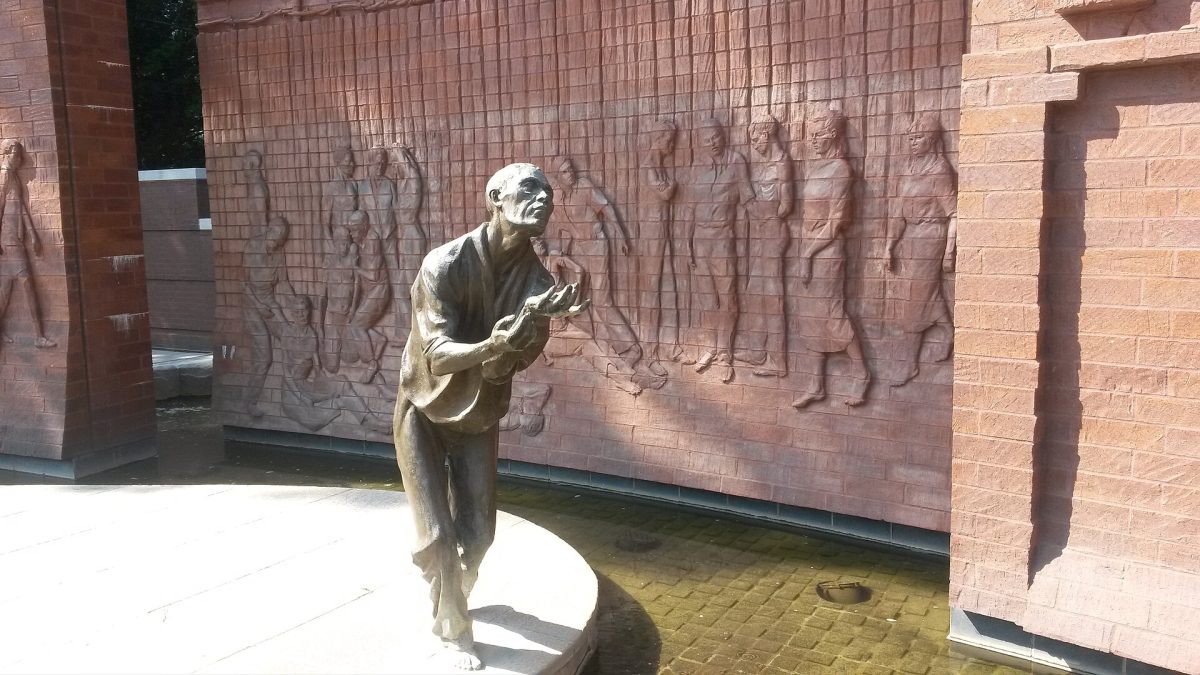
A sculpture of a prisoner of war at the memorial courtyard of the National Prisoner of War Museum in Andersonville (file photo). Photo: MandaLynne62 / Wikimedia Commons (CC BY-SA 3.0)
COLUMBUS, Ga. - About 60 miles southeast of Columbus by road, double rows of white posts outline a 26.5-acre field in Macon County where nearly 13,000 Union soldiers died in 14 months. Camp Sumter, better known as Andersonville, was the largest and most famous of the Civil War's 150 military prisons and, in the words of the National Park Service, "the deadliest landscape of the Civil War." Today the prison site, a national cemetery that is still active and the only museum devoted solely to American prisoners of war make up Andersonville National Historic Site, which charges no admission.
The figures below come from the National Park Service and the New Georgia Encyclopedia. Prison population counts vary slightly between sources because they were taken at different points in 1864, and those differences are noted. Here is Andersonville by the numbers.
The numbers at a glance
| Number | What it means |
|---|---|
| 150 | Military prisons of the Civil War; Andersonville was the largest |
| 14 months | Time the prison operated, from February 1864 to May 1865 |
| 10,000 | Prisoners the camp was planned to hold |
| More than 32,000 | Prisoners held at its most crowded |
| 45,000 | Union soldiers imprisoned there in all |
| Nearly 13,000 | Prisoners who died there |
| 26.5 acres | Size of the prison site after it was enlarged |
| At least 80 | Escape tunnels prisoners tried to dig |
| About 20,000 | Burials in Andersonville National Cemetery today |
| $0 | Admission to the park and museum |
February 1864: A prison built for 10,000
In February 1864, the Confederacy set up a prison in Macon County to relieve crowding among the Union prisoners held in and around Richmond, Va., according to the New Georgia Encyclopedia. Its official name was Camp Sumter, but it quickly became known as Andersonville, after the railroad station in neighboring Sumter County beside which it sat. Officials picked the site for its remoteness from coastal raids, and local Black laborers, enslaved and free, were forced to build a stockade and trench enclosing a little more than 16 acres, with a small creek called Stockade Branch running through the middle.
The camp was planned for 10,000 prisoners, but when prisoner exchanges broke down, its population swelled past 30,000. The Park Service says that at its most crowded it held more than 32,000 men, while the encyclopedia puts the August 1864 peak at more than 33,000. By the summer of 1864, the encyclopedia notes, the prison held so many men that it would have been the fifth-largest city in the Confederacy.
Nearly 13,000 deaths in 14 months
Of the 45,000 Union soldiers held at Andersonville, nearly 13,000 died, giving it the highest mortality rate of any Civil War prison. The encyclopedia says most died of malnutrition, while the creek that supplied drinking and bathing water was polluted by sewage and garbage. Prisoners, many of them nearly naked, also suffered from insects, filth and disease.
In the summer of 1864, camp administrators used the labor of Union prisoners and enslaved workers to build a hospital, a bakery and some barracks and to extend the stockade by about 10 acres. That expansion produced the 26.5-acre site visitors see outlined today. The number of prisoners still overwhelmed the effort.
The dead line, raiders and 80 tunnels
Guards kept prisoners back with a "dead line," a marked strip of ground bordering the stockade walls where any prisoner who stepped in could be shot. Cannons, guard towers, dogs and a second wall also helped prevent escapes, and inmates tried to dig at least 80 tunnels, nearly all of which were exposed by informants. Few prisoners escaped successfully, and most who did got away from work details outside the walls.
Inside, gangs of prisoners known as raiders robbed fellow inmates, and prisoners hanged six raider leaders on July 11, 1864. Capt. Henry Wirz, a Swiss-born physician, took charge of the prison in late March 1864. After the war he was tried by a federal military court and hanged in Washington on Nov. 10, 1865.
From 33,000 to 1,500, then closing
As Union Gen. William T. Sherman's army moved deeper into Georgia, Confederate officials moved most prisoners to other camps, including Camp Lawton near Millen and a camp in Columbia, S.C. By November 1864, only about 1,500 men remained at Andersonville. Transfers back in December raised the number to about 5,000, where it stayed until the prison closed in early May 1865.
About 20,000 graves: Andersonville National Cemetery
The first burials, beginning in February 1864, were trench burials of prisoners who died in the camp, and nearly 13,000 soldiers were buried there in 14 months, according to the Park Service. Clara Barton, founder of the American Red Cross, worked to have all the graves identified and marked, and the site was preserved as a national cemetery soon after the prison closed. Today the cemetery holds about 20,000 burials, including veterans of the Spanish-American War, both world wars, Korea, Vietnam and more recent conflicts.
Andersonville is one of 14 national cemeteries run by the National Park Service, and it remains open for burials of eligible veterans and their families. It will not expand beyond the boundary the Army set in 1878, so burials will continue only until that space is full. Park staff and volunteers place a flag at every grave once a year, over the Memorial Day holiday.
1970 and 1998: A memorial to all prisoners of war
Andersonville was named a National Historic Site in 1970, and it is the only park in the National Park System that serves as a memorial to all American prisoners of war. Congress directed the park "to provide an understanding of the overall prisoner of war story of the Civil War, to interpret the role of prisoner of war camps in history, to commemorate the sacrifice of Americans who lost their lives in such camps, and to preserve the monuments located within the site." Former prisoners of war worked with the park to create the National Prisoner of War Museum.
Construction of the museum began in 1996, and it was dedicated on April 9, 1998. Its exhibits cover American prisoners of war from the Revolutionary War to the present, arranged by themes such as capture, living conditions, communications, privation, morale and escape. Two films run on the hour and half-hour: a 28-minute film on the Andersonville prison and a 27-minute film on the American prisoner of war experience.
Touring the prison site
A tour road circles the prison site, with pull-offs and exhibits at the Wisconsin Monument, the North Gate, Providence Spring, the Star Fort and the reconstructed northeast corner of the stockade. Two sections of the stockade wall, the north gate and the northeast corner, have been rebuilt. A free one-hour audio driving tour of the prison site and cemetery can be borrowed at the museum desk or accessed online.
The museum lobby has a public database where visitors can look up former Union prisoners. Some of the museum's galleries are kept dim to protect artifacts, and the Park Service notes the building can be very cold in summer. The museum is fully accessible, but the uneven ground at the prison site and cemetery is harder to navigate.
Visiting from Columbus
The park grounds are open daily from 8 a.m. to 5 p.m., and the National Prisoner of War Museum is open from 9:30 a.m. to 4:30 p.m. The park and museum close only on Thanksgiving Day, Dec. 25 and New Year's Day, when the cemetery can still be reached through its entrance gate. There is no entrance fee, but groups of 15 or more who want a ranger program must reserve at least two weeks ahead.
The park has no food service, lodging or ATM, and the Park Service points visitors to Americus, about 10 miles south, and Montezuma, about 10 miles north. The town of Andersonville sits directly across Georgia Highway 49 from the park exit. Andersonville is also a stop on the Georgia World War II Heritage Trail, a 10-site trail launched in February 2021.
More information
Hours, the audio tour and visitor guidelines are on the Andersonville National Historic Site page of the National Park Service website. Burial records can be searched through the VA's Nationwide Gravesite Locator. The New Georgia Encyclopedia's Andersonville Prison article covers the prison's full history.
Source: National Park Service, Andersonville National Historic Site (Camp Sumter history, places, FAQs, hours, cemetery, museum); New Georgia Encyclopedia (Andersonville Prison)
News organizations may republish this story with credit. See our guidelines.
Know someone who'd want to read this? Email it to a friend.
Plan your weekend with Columbus Times
Get This Weekend in Columbus every Thursday: the best local events, free things to do and family fun, plus each evening's local news. Free, and you can unsubscribe anytime.
By signing up you agree to get the Columbus Times email newsletter. Unsubscribe anytime with one click.

Comments
Be respectful. No personal attacks, hate speech, spam or anyone's private information. Every comment is reviewed before it appears. Comment rules
No comments yet. Be the first to share your thoughts.