The Columbus Museum by the Numbers: 9 Acres, 86,000 Square Feet, a $30 Million Makeover and Free Admission
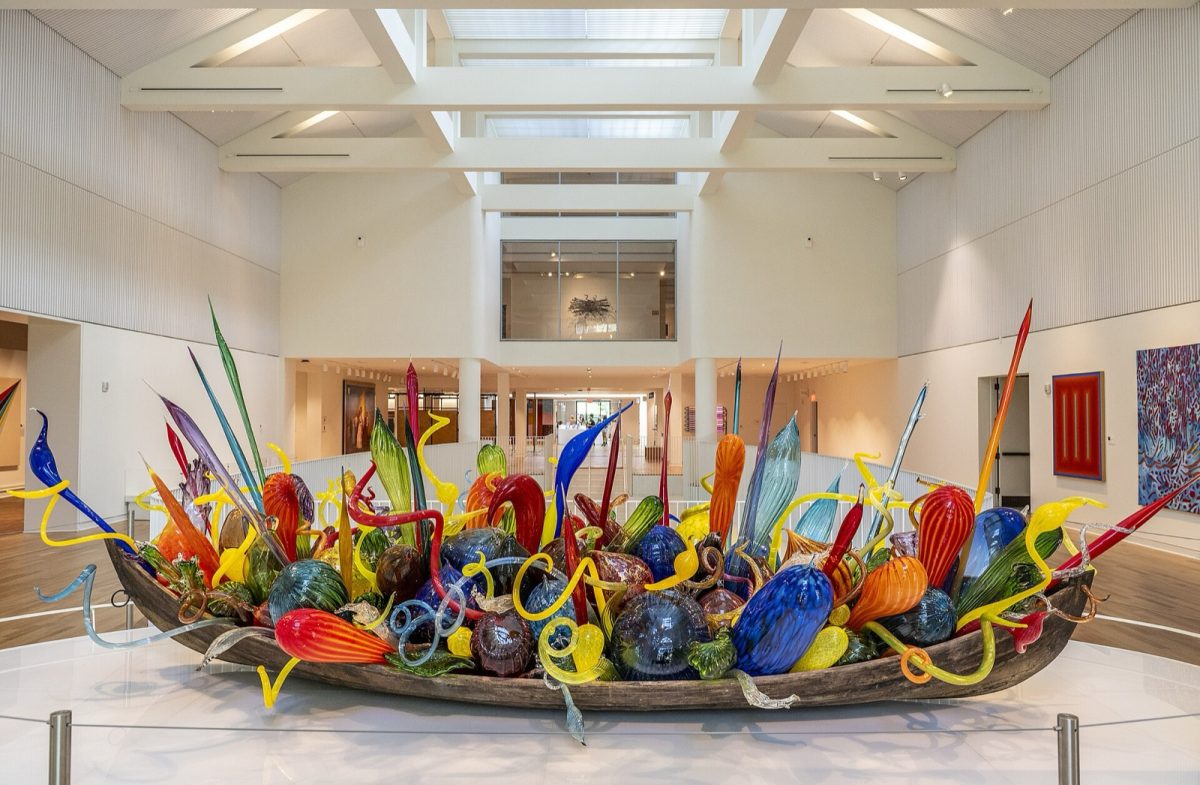
A colorful glass sculpture in the lobby of the Columbus Museum (file photo). Photo: Thecolumbusmuseum / Wikimedia Commons (CC BY 4.0)
COLUMBUS, Ga. - The Columbus Museum sits on nine acres in the Wynnton neighborhood, occupies 86,000 square feet and completed a $30 million renovation in 2024. Admission is free, making its collections of American art and Chattahoochee Valley history accessible without a ticket charge. Here is the museum by the numbers, from its grounds and building to its hours and history.
Now known as COMU, the museum at 1251 Wynnton Road traces its beginnings to a donated estate and a 1953 public opening. Its history includes a major expansion, a renewed focus on American art and regional history, and a transformation that introduced redesigned galleries and public spaces. Here is a look at the Columbus Museum through the numbers that tell its story.
1941: The Year the Museum Was Chartered
The Columbus Museum was chartered in 1941, more than a decade before it welcomed its first visitors. Its development centered on the former estate of Columbus business leader and philanthropist W.C. Bradley, whose family donated the property to the people of Columbus after his death in 1947. The donation established the physical home for an institution that would eventually become one of the Southeast's largest museums.
The property included a Mediterranean Revival house constructed in 1912. Workers remodeled the house for museum use while preserving its role as the central building on the estate. That residence remains part of the museum's architectural history.
9 Acres: The Estate That Became a Museum
The museum occupies the nine-acre estate that once belonged to Bradley. Its grounds include the Bradley Olmsted Garden, which the Olmsted Brothers firm designed for Bradley during the 1920s. The landscape features naturalistic plantings, winding paths, a pool house and a grotto.
The National Park Service describes the garden as one of the Olmsted Brothers firm's most significant residential landscape designs in Georgia. The museum's recent renovation included restoration work in the garden, connecting the historic landscape with the updated museum buildings. The grounds remain an important part of the museum's identity alongside its indoor exhibitions.
1953: The Year the Doors Opened
The museum opened to the public March 29, 1953, under the name Columbus Museum of Arts and Crafts. Its original schedule allowed visitors inside from 10 a.m. to 5 p.m. six days each week. According to the museum, that schedule was nearly identical to the hours it maintains today.
The museum identifies 1953 as its founding year and describes itself as one of the largest museums in the Southeast. Over the following decades, its collecting mission developed around American art and the cultural history of the Chattahoochee Valley. Those two subjects continue to define the institution.
86,000 Square Feet: The Result of a Major Expansion
A capital campaign during the 1980s led to a major expansion completed in 1989. The project increased the museum's space from approximately 32,000 square feet to 86,000 square feet. That expansion established the larger physical footprint associated with the museum today.
Three years later, in 1992, the museum formally narrowed its collecting priorities to American fine and decorative art and cultural history. The decision reinforced the relationship between its national art holdings and its regional history collections. Together, those areas give the museum a focus that reaches beyond Columbus while maintaining its connection to the Chattahoochee Valley.
2 Collecting Areas: American Art and Regional History
The museum organizes its collections around two subjects: American art and the history and material culture of the Chattahoochee Valley. Its regional history holdings cover archaeological and Indigenous history, settlement, the Civil War and Reconstruction, industry, textile manufacturing and the civil rights movement. These subjects document different periods of life and change across the region.
Its American art collection includes work by William Merritt Chase, Robert Henri, Gilbert Stuart, Stuart Davis, Lee Krasner and Alice Neel. Other represented artists include Romare Bearden, Alma Thomas, Benny Andrews, Sam Gilliam and Amy Sherald. The collection brings together artists associated with different periods and approaches to American art.
2014: A Fund Supporting African American Art
The museum established its Fund for African American Art in 2014 to support collecting in that area. One acquisition through the fund was Amy Sherald's 2017 painting, "What's different about Alice is that she has the most incisive way of telling the truth." The painting later traveled to the exhibition "Amy Sherald: American Sublime."
That exhibition appeared at the San Francisco Museum of Modern Art, the Whitney Museum of American Art, the Baltimore Museum of Art and the High Museum of Art. In 2018, the Alma Thomas Society began actively collecting as another part of the museum's collecting efforts. These initiatives added to the institution's work with American art.
$30 Million: The Museum's Transformation
The museum closed in October 2022 for its first major renovation since the 1989 expansion. The project formed part of the "Reimagining The Columbus Museum" capital campaign and represented a $30 million transformation. After the extensive work, the museum reopened May 4, 2024.
The renovation redesigned art and history galleries, exhibitions and public spaces. Improvements included a new entrance plaza, a garden terrace and cafe, upgraded collection storage, and a redesigned children's gallery with an interactive children's garden. The project also included restoration work in the historic Bradley Olmsted Garden.
2025: National Recognition and Reaccreditation
The museum received several forms of recognition following its reopening. USA Today's 10Best Readers' Choice Awards named it Best New Museum for 2025, and the American Alliance of Museums reaccredited the institution that year. The museum also received recognition for specific elements of its renovation and exhibition work.
The 2024 renovation earned a Historic Columbus Preservation Award. The reinstallation of the history gallery received a Georgia Association of Museums Exhibition Award. These honors recognized both preservation work and the museum's presentation of regional history.
3 Floors: Accessibility Throughout the Museum
The museum provides accessibility features for visitors with mobility challenges. Its east entrance offers accessible entry, and an elevator connects the upper and lower levels. Accessible restrooms are available on all three floors.
The museum also maintains visitor guidelines covering belongings, photography and food. Bags larger than 11 by 15 by 6 inches must be placed in lockers, while personal photographs are permitted without flash or unauthorized tripods, lights and selfie sticks. Food and drinks are restricted to garden areas, and service animals are welcome while pets are not.
$0 Admission: Visitor Information
| Day | Hours |
|---|---|
| Monday | Closed |
| Tuesday | 10 a.m. to 5 p.m. |
| Wednesday | 10 a.m. to 5 p.m. |
| Thursday | 10 a.m. to 8 p.m. |
| Friday | 10 a.m. to 5 p.m. |
| Saturday | 10 a.m. to 5 p.m. |
| Sunday | 1 to 5 p.m. |
Visitors can explore the museum's American art and regional history collections without paying admission. Thursday offers extended hours until 8 p.m., compared with the 5 p.m. closing time on most other operating days. The museum's free-admission policy also supports its educational relationship with the community.
2 Student Programs: Connecting Schools and Museums
The museum maintains a longstanding partnership with the Muscogee County School District through school visits and teacher programs. Its Teen Exhibition Council provides high school juniors and seniors with hands-on experience in curatorial work, marketing and education. These programs connect the museum's collections with learning opportunities beyond ordinary gallery visits.
The educational work complements the museum's two collecting areas and its emphasis on local history. Students can encounter the region's past alongside examples of American art. The programs also introduce participants to the work involved in developing exhibitions and museum education.
How We Did This
This guide uses information from The Columbus Museum's official website, including its "About Us" and "Know Before You Go" pages, reviewed Oct. 27, 2026. Historical details, collection information and additional background also come from Wikipedia's "Columbus Museum" article, reviewed the same day. Visitor hours, admission policies and accessibility information follow the museum's published guidance, and no unverified attendance totals or collection-size estimates were included.
Source: The Columbus Museum (columbusmuseum.com); Wikipedia
News organizations may republish this story with credit. See our guidelines.
Know someone who'd want to read this? Email it to a friend.
Own a Columbus business? 60,000+ page views a month. Ads from $125/month. See ad options Follow Columbus Times on FacebookLocal news, events and people, in your feed every day.Most read this week
- Georgia Spent $165.7 Million on Medicaid Work Requirement Program, but Only 18,527 Were Enrolled After 3 Years
- 8 Columbus Restaurants Got a C on Their Health Inspection in 2026, the Most of Any Year Since 2022. Here's Every One
- The Night Fight on the Chattahoochee: How Columbus Became the Site of What Many Call the Last Battle of the Civil War
- The 10 Best Mexican Restaurants in Columbus, Ga., Ranked by Diners
- Columbus' Top-Rated Barbecue: 12 BBQ Joints Ranked by Google Stars and Health Scores
More stories
 Arts & Culture Ma Rainey's Columbus Story: 10 Milestones in the Life of the 'Mother of the Blues'
 Arts & Culture Columbus' Hidden 9-Acre Garden: The 1920s Olmsted Design, a 1947 Gift and the History Behind The Columbus Museum
 Arts & Culture 12 Overlooked Places to Visit in Columbus, GA, Including an 8-Museum Collection and a 7-Acre Art Wonderland
 Arts & Culture From Washington Heights to war and back: Salvador 'Matalian' Mendez
Comments
Be respectful. No personal attacks, hate speech, spam or anyone's private information. Every comment is reviewed before it appears. Comment rules
No comments yet. Be the first to share your thoughts.