Columbus' Hidden 9-Acre Garden: The 1920s Olmsted Design, a 1947 Gift and the History Behind The Columbus Museum
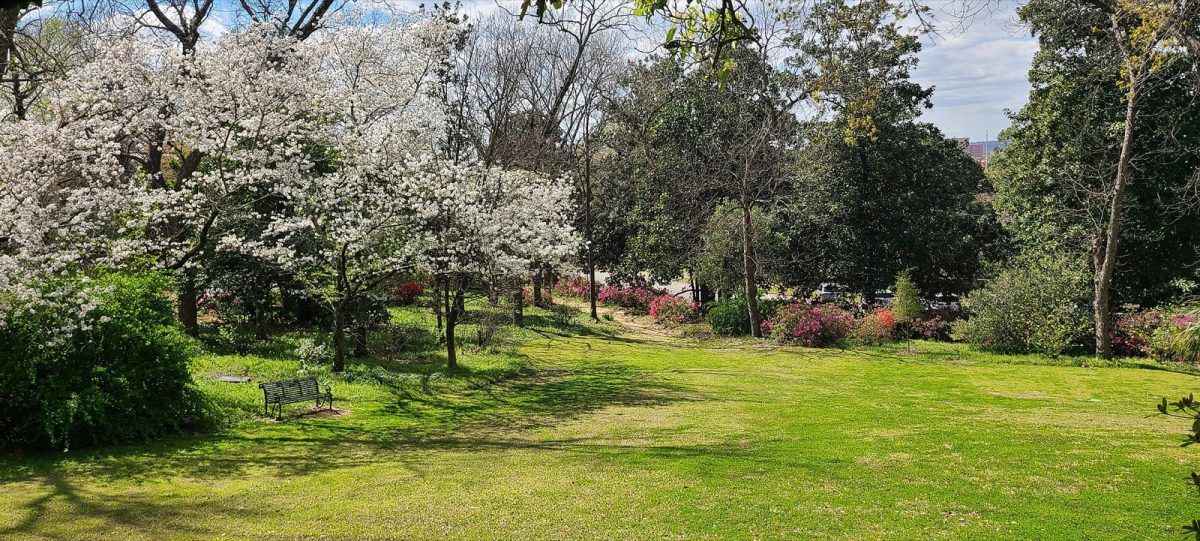
The Bradley Olmsted Garden at The Columbus Museum is free to visit during museum hours. Photo: The Columbus Museum / Wikimedia Commons (CC BY 4.0)
Columbus, Georgia, has a nine-acre historic garden designed in the 1920s by the Olmsted Brothers, the landscape architecture firm associated with one of America's most influential landscape-design families. The Bradley Olmsted Garden, located at The Columbus Museum on Wynnton Road, was once part of industrialist W.C. Bradley's private estate, but today the public can explore its winding paths, historic grotto and surviving landscape features for free.
The garden's history reaches back more than a century. It includes a prominent Columbus businessman, an ambitious landscape architect, a hillside transformed with waterfalls and stone paths, and a family donation in 1947 that helped establish one of the city's most important cultural institutions.
The site also has a distinction that extends beyond Columbus. Of the 13 residential projects undertaken by the Olmsted firm in Georgia, the Bradley Garden is widely recognized as the firm's most substantial and significant residential project in the state, according to The Columbus Museum and the National Park Service.
Despite that history, the garden is easy to overlook because it is part of a museum best known for its art and historical collections. Its grounds tell a separate story about how Columbus developed, how one family used its property and how a private landscape eventually became a public attraction.
A historic garden hiding behind a museum
The Bradley Olmsted Garden is part of The Columbus Museum at 1251 Wynnton Road. Visitors can walk through a landscape that combines surviving historic plantings with newer additions intended to remain consistent with the original design.
The museum describes winding nature trails leading to features that date to the garden's development in the 1920s. Those include a pool house and a grotto, two remnants of a property that was designed to provide several distinct outdoor experiences.
The garden's appearance is rooted in a naturalistic approach to landscape architecture. Instead of treating the entire property as a formal arrangement of symmetrical lawns and flower beds, the designers used the existing hillside, vegetation, rocks and water features to shape the landscape.
Its setting was especially important. The property occupied part of Wynn's Hill, east of downtown Columbus, where the terrain rises above the surrounding area before descending into a wooded slope.
That geography gave the designers opportunities that a completely level site would not have offered. The hillside could accommodate winding paths, changes in elevation, water features and a series of landscaped areas connected by walking routes.
The National Park Service identifies the property as the W.C. Bradley Estate in its Frederick Law Olmsted National Historic Site records. Its historical account also confirms the garden's relationship to the Olmsted Brothers and the participation of landscape architect William B. Marquis.
Before W.C. Bradley, there was another Columbus family
The story begins with lawyer Brick Stonewall Miller and his wife, Mary. According to research published by Historic Columbus, the Millers purchased property on Wynnton Road in 1912 and established a Mediterranean Revival residence they called Hill Haven.
The Columbus Museum dates the original house to 1912, while Historic Columbus places construction in the following year after the property purchase. Both accounts agree that the residence preceded Bradley's ownership and was built for the Miller family.
The mansion was designed by Atlanta architect A. Ten Eyck Brown, according to Historic Columbus. It occupied a prominent position on the hillside and became the center of a property that would later undergo substantial landscaping.
The Millers also hired landscape architect William Bell Marquis to develop plans for their grounds. At the time, Marquis worked for the P.J. Berckmans Company, a landscape and horticultural business in Augusta, Georgia.
His early plans considered the unusual topography of the property. The residence occupied a relatively level area near the top of the hill, while much of the surrounding land dropped away into a wooded ravine.
Historic Columbus reports that some early planting work was completed, but the larger landscape plan was not fully carried out during the Millers' ownership. Certain features that later defined the garden would not emerge until Bradley acquired the estate.
The change in ownership in 1925 set the stage for the landscape's transformation. It also reunited Marquis with a property on which he had already completed design work.
W.C. Bradley buys the property in 1925
William Clark Bradley was a major figure in Columbus' commercial and industrial history. The National Register documentation identifies him as president of Columbus Bank and Trust Company and chairman of the boards of several major businesses, including Coca-Cola, Eagle and Phenix Mills, Columbus Iron Works and the W.C. Bradley Company.
Historic Columbus reports that Bradley acquired the Miller residence in 1925 through an exchange involving his downtown home. The organization also documents his acquisition of adjacent property, including land associated with an earlier trolley line, expanding the estate to approximately 13 acres.
Bradley renamed the property Sunset Terrace. Historic Columbus attributes the name to the views from the elevated grounds toward Columbus and the Alabama hills beyond the Chattahoochee River.
The house and grounds became a significant private residential property. Bradley wanted to develop a larger garden that could accommodate family gatherings and guests, according to the National Park Service.
To accomplish that, he contacted Marquis, the architect who had prepared the earlier landscape plans for Miller. By then, Marquis was associated with the Olmsted Brothers firm.
The arrangement gave the property a direct connection to a nationally influential landscape architecture practice. It also allowed Marquis to return to an existing design with a new owner's goals and greater opportunity to develop the grounds.
Bradley's interest extended well beyond simply commissioning the work. Both the museum and the National Park Service describe his frequent correspondence with Marquis and his close participation in planning the garden.
How did the Olmsted Brothers become involved in Columbus?
The Olmsted name is closely associated with Frederick Law Olmsted, whose work helped shape American landscape architecture. The practice continued through the Olmsted Brothers firm, which carried his design principles into later projects throughout the country.
Frederick Law Olmsted died in 1903, before the Bradley Garden was developed in the 1920s. That means he did not personally design the Columbus property, an important distinction when discussing the garden's history.
The Bradley project was associated with William B. Marquis, who had joined the Olmsted organization after his earlier work in Georgia. Marquis brought familiarity with the property, its steep terrain and the original design concepts.
The National Park Service describes how Bradley sought Marquis' help in developing the larger garden. It also identifies the resulting landscape as an example of the more naturalistic garden designs that became popular during the 1920s.
The project was unusual in scale within Georgia. The museum states that the Olmsted firm worked on 13 residential projects in the state, including other Columbus properties, but that the Bradley Garden is widely recognized as its most significant and substantial.
Historic Columbus identifies other local residential designs connected with the firm, including properties associated with Edward W. Swift, Claude Scarbrough and D. Abbott Turner. This shows that the Bradley project was not the firm's only involvement in the city.
The Bradley property, however, became the clearest local example of the firm's ability to integrate formal residential landscaping with a natural hillside environment.
What made the garden's original design special?
Much of the garden's historical significance comes from the way its designers used the land itself. Rather than completely reshaping the property into a uniform formal garden, Marquis developed different areas according to their terrain and relationship to the house.
Historic Columbus documents formal plantings near the residence, including ornamental shrubs, clipped hedges and a square garden with a central fountain. Other areas were designed to appear more natural, with winding paths, large rocks and plantings placed throughout the hillside.
The slope allowed the creation of a ravine garden where water played an important role. Historical accounts describe a spring-fed grotto, a series of small cascades and a fishpond crossed by a rustic wooden bridge.
Historic Columbus identifies 10 cascades in the original water feature. Those cascades formed part of a larger landscape arrangement intended to connect the higher ground around the house with the lower areas of the property.
The design also included rock steps and walking paths that followed the hillside. Visitors could move between formal garden spaces and more heavily planted wooded areas rather than experiencing the property from only one viewpoint.
The National Register nomination describes the garden's surviving landscape as heavily wooded and naturalistic. It specifically documents a granite fountain within a hillside grotto, a rock-lined stream, and native trees and shrubs.
These details are significant because they explain why the property is more than an ordinary landscaped lawn. The garden was created as an integrated design, combining architecture, planted areas, water features and the site's natural terrain.
The people who built and maintained Sunset Terrace
Although Bradley and Marquis are central to the garden's historical identity, the landscape required extensive labor and ongoing maintenance. Historic Columbus identifies Percy Huxley, a gardener from Massachusetts, as the superintendent responsible for overseeing much of the work.
Huxley lived in a cottage on the estate's northern side, according to the preservation organization's research. He supervised workers involved in developing the garden between 1925 and 1928.
Historic Columbus suggests that some workers likely came from the Bottoms, a nearby working-class African American neighborhood. The organization presents this as a historical likelihood rather than a complete documented roster of employees.
That distinction matters because surviving accounts tend to identify the property owner and professional designers more precisely than the laborers who carried out the work. Their contributions were nevertheless necessary to transform the plans into a functioning landscape.
The garden's development involved installing plantings, managing the hillside and constructing the water features and stonework. Each of those activities required ongoing physical work in addition to the professional design process.
Historic Columbus reports that Huxley left when the garden was completed in 1928. He was followed by Columbus resident Azor Grantham, who served as head gardener for many years.
The garden's history therefore includes more than a famous design firm. It also reflects the involvement of local workers and gardeners whose maintenance helped sustain the property over time.
The grotto, fishpond and swimming pool
Water was one of the most distinctive parts of the Bradley landscape. The historical plans used natural springs and constructed features to create a network of fountains, cascades and ponds along the hillside.
Historic Columbus describes a stone grotto with a granite fountain near the upper portion of the ravine. Water then descended through the landscaped slope toward a larger fishpond, which was crossed by a wooden bridge.
The organization also documents the use of gunite, a concrete-and-sand mixture applied over reinforcing material, in constructing the fishpond. Its historical account identifies the feature as an early example of the technique in Georgia.
A separate swimming pool was also incorporated into the property's development. The museum's current visitor page identifies the surviving pool house as one of the historic features visitors can encounter in the garden.
Not all of the original water features remain in their 1920s form. Historic Columbus documents changes to the property after its conversion to a public institution, including alterations affecting the former swimming pool area.
That is why the garden should not be described as a completely unchanged 1928 landscape. It retains important original elements while also reflecting later renovations, additions and changes in use.
The grotto has remained especially important to the property's historical identity. Both the museum and the National Register documentation identify it as a defining feature of the garden's original design.
A 1947 donation changes the property's future
The major turning point came in 1947, the year W.C. Bradley died. His family donated property associated with the estate to the people of Columbus for cultural and educational purposes.
The Columbus Museum identifies the gift as a nine-acre site that included the garden and the Mediterranean Revival residence originally built for Brick Stonewall Miller. The donation created the foundation for the institution that occupies the property today.
Historic Columbus identifies Bradley's daughter Elizabeth and his son-in-law D.A. Turner as the family members involved in the donation. The preservation organization also explains that the original larger estate was subsequently divided for multiple public uses.
The land's transformation represented a significant change in purpose. What had been a privately maintained residential landscape became part of a property intended to serve Columbus residents through education, history and the arts.
The original house was adapted for museum use. According to Historic Columbus, the Columbus Museum of Arts and Crafts opened to the public in 1953.
Other portions of the former estate supported additional institutions. Historic Columbus documents the Bradley Memorial Library and administrative offices for the local school district on property associated with the earlier grounds.
The current garden is therefore connected to a broader story of public reuse. The family donation preserved an important landscape while also allowing a private residential site to serve a public cultural mission.
From a private mansion to an 89,000-square-foot museum
The Columbus Museum has changed substantially since its early years in the former Bradley residence. According to its official history, the institution eventually expanded into an 89,000-square-foot facility.
The original Mediterranean Revival home became part of a much larger museum complex. The Bradley Olmsted Garden remained connected to the institution, providing an outdoor historical landscape alongside its indoor collections and programs.
The museum also completed a major renovation in 2024. Its current garden page confirms that the work was completed and identifies the garden as an important part of the museum's visitor experience.
The grounds have undergone their own changes over time. Historic Columbus documents substantial landscape improvements associated with the museum's expansion in the late 1980s, including work by Atlanta landscape architect Julia Orme Martin.
Later improvements included a terrace added in 2013 to provide access to the garden's meadow. Before the 2024 renovation, preservation plans also called for improvements to accessibility and the restoration of historic landscape features.
These interventions illustrate an ongoing challenge with historic gardens. Unlike a building whose walls can remain largely unchanged, a garden is made up of living plants, pathways, water systems and outdoor structures that require continued care.
The museum's current garden page says several original plantings survive alongside newer additions selected to complement the historic design. The resulting landscape represents both the original Olmsted Brothers design and the continuing work necessary to maintain it.
Why the National Park Service recognizes the property
The Bradley Garden is part of the Wynn's Hill-Overlook-Oak Circle Historic District, which is listed on the National Register of Historic Places. The district's federal nomination documents the Bradley property and its relationship to the historical development of Wynnton.
The National Register record describes the original house, its landscape and the role of the Olmsted Brothers firm. It also identifies the property's granite fountain, rock-lined stream and wooded garden features.
Separately, the National Park Service includes the W.C. Bradley Estate among the designed landscapes associated with the Olmsted practice. The federal agency recognizes the property as a significant example of the firm's work in Georgia.
National Register recognition does not mean that every original garden feature has survived or that the landscape has remained unchanged. The historical designation acknowledges the property's documented significance and surviving characteristics.
For Columbus, the connection is particularly notable because the garden was not designed as a public park. It began as a private estate landscape and later became accessible through its transformation into a museum property.
How to visit the Bradley Olmsted Garden in 2026
The Bradley Olmsted Garden is open during The Columbus Museum's regular operating hours. Admission to the museum is free, and the museum's visitor information identifies no separate admission charge for the garden.
Bradley Olmsted Garden at The Columbus Museum
1251 Wynnton Road, Columbus, GA 31906
Admission: Free
706-748-2562
Official garden and visitor information
| Day | Museum and garden hours |
|---|---|
| Monday | Closed |
| Tuesday | 10 a.m. to 5 p.m. |
| Wednesday | 10 a.m. to 5 p.m. |
| Thursday | 10 a.m. to 8 p.m. |
| Friday | 10 a.m. to 5 p.m. |
| Saturday | 10 a.m. to 5 p.m. |
| Sunday | 1 to 5 p.m. |
Source: The Columbus Museum's current Know Before You Go page. The museum also closes on holidays.
Visitors can use the garden as part of a broader museum visit, combining the outdoor landscape with the institution's art and historical collections. The museum describes the grounds as an attraction for people interested in gardens, native plants and the Olmsted Brothers' design work.
The historic pool house and grotto are among the features identified on the official garden page. Visitors should remember that the property is a preserved landscape with historic features rather than a modern recreational park.
The museum encourages visitors to explore its grounds during operating hours. Because the garden contains outdoor paths and areas affected by terrain, visitors with specific accessibility needs should check the museum's current information before arriving.
A piece of Columbus history still serving the public
The Bradley Olmsted Garden represents an unusual connection between Columbus' industrial history and American landscape architecture. It began as the grounds of a prominent private residence, became one of the Olmsted firm's most significant Georgia projects and eventually entered public use through a family donation.
Its importance lies partly in the surviving physical features: the wooded hillside, pathways, grotto and remnants of the original landscape arrangement. But its history also reflects the people and institutions that shaped Columbus during the first half of the 20th century.
Today, the garden has a different purpose from the one W.C. Bradley envisioned in the 1920s. Instead of serving one family, it is part of a free cultural institution available to residents and visitors.
Nearly eight decades after the 1947 donation, the former estate remains an example of how a privately commissioned landscape can become a lasting public resource. Its connection to the Olmsted Brothers gives Columbus a nationally significant design history within a garden that local residents can still visit.
How we did this
Columbus Times reviewed The Columbus Museum's official Bradley Olmsted Garden page and current visitor information, the National Park Service's W.C. Bradley Estate history, the federal National Register nomination for the Wynn's Hill-Overlook-Oak Circle Historic District, and historical research published by Historic Columbus.
The museum's previously identified historical PDF could not be opened reliably, so no facts were attributed exclusively to that document. Where accounts differed, including the original house's construction date and the size of the larger estate compared with the donated museum property, the distinctions were preserved rather than silently reconciled.
Source: The Columbus Museum; National Park Service; Historic Columbus; National Register of Historic Places

News organizations may republish this story with credit. See our guidelines.
Know someone who'd want to read this? Email it to a friend.
Own a Columbus business? 60,000+ page views a month. Ads from $125/month. See ad optionsPlan your weekend with Columbus Times
Get This Weekend in Columbus every Thursday: the best local events, free things to do and family fun, plus each evening's local news. Free, and you can unsubscribe anytime.
Most read this week
- 8 Columbus Restaurants Got a C on Their Health Inspection in 2026, the Most of Any Year Since 2022. Here's Every One
- Georgia's 3 Amendments: Which Will Pass, Who's Against Them, and What Happens If They Fail
- The Night Fight on the Chattahoochee: How Columbus Became the Site of What Many Call the Last Battle of the Civil War
- The 10 Best Mexican Restaurants in Columbus, Ga., Ranked by Diners
- Georgia's 3 Constitutional Amendments on the Nov. 3 Ballot, Explained in Plain English
More stories
 Education Columbus Students Pay $225 Per Credit Hour at Phenix City College: 12 Tuition Questions Answered for 2026-27
 Local Columbus Airport's 6 Biggest Milestones: From Early Airmail Service to a $24 Million Runway Rebuild
 Finance Columbus Water Bills Rose $7 to $9 a Month in 2026: What Residents Pay at 3,000, 4,500 and 6,000 Gallons
 Health Georgia Spent $165.7 Million on Medicaid Work Requirement Program, but Only 18,527 Were Enrolled After 3 Years
Comments
Be respectful. No personal attacks, hate speech, spam or anyone's private information. Every comment is reviewed before it appears. Comment rules
No comments yet. Be the first to share your thoughts.