Fort Benning's 250-Foot Jump Towers: How World's Fair Parachute Towers Trained America's First Paratroopers
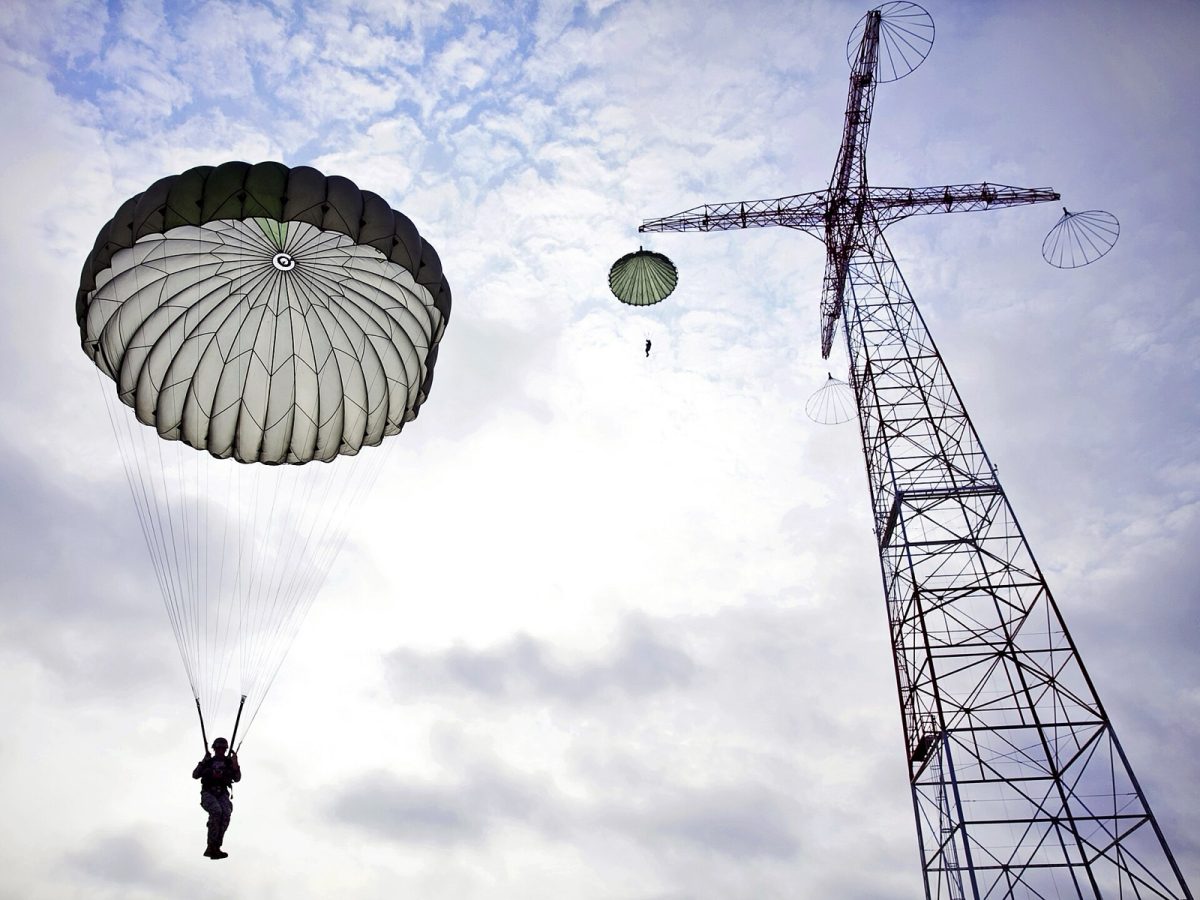
A soldier is dropped from a 250-foot tower under a T-10 parachute during Airborne School at Fort Benning, August 2013 (U.S. Army photo). Photo: The U.S. Army / Wikimedia Commons (public domain)
COLUMBUS, Ga. - The 250-foot parachute jump towers at Fort Benning trace their history to parachute drop towers from the 1939 New York World's Fair, where the Army's first paratroopers trained before the Army bought towers of its own for Georgia. The towers helped America's first Army airborne soldiers prepare for parachute jumps at a time when military parachute training was still being developed. Three of the original four towers remain in use at Fort Benning today.
The towers became part of a training program that began with a small group of volunteers in 1940. Those soldiers helped establish a new form of Army training, beginning with experimental jumps and eventually contributing to the development of the U.S. Army Airborne School. Their work laid the foundation for the training that military personnel still receive at Fort Benning.
Chapter 1: The Army's First Airborne Volunteers
The story began in 1940 when the War Department approved the formation of a test platoon of Airborne Infantry under the Army's Infantry Board. The Army selected volunteers from Fort Benning's 29th Infantry Regiment to participate in the experimental program. The purpose was to develop and test the training needed to prepare soldiers for parachute operations.
First Lt. William T. Ryder volunteered to lead the platoon, with Lt. James A. Bassett serving as his assistant. The Army selected 48 enlisted men from a group of 200 volunteers. These soldiers became the foundation of the Army's first experimental airborne training program.
Their initial facilities were modest compared with the training operation that would eventually develop at Fort Benning. The volunteers lived in tents near Lawson Army Airfield and used an abandoned hangar for training and parachute packing. The Army was building its parachute program while the volunteers learned the skills needed to make military jumps.
The platoon did not have the benefit of a long-established training system. Its members were participating in a new program that would help determine how the Army prepared future paratroopers. The training methods developed during this period would become part of the history of military airborne instruction.
Chapter 2: The World's Fair Connection
One of the most important developments came when Lt. Col. William C. Lee recommended sending the platoon to the Safe Parachute Company in Hightstown, New Jersey. The company had parachute drop towers associated with the 1939 New York World's Fair. Lee believed the equipment could help the volunteers prepare for airborne operations.
Just 18 days after the platoon's formation, the soldiers traveled to New Jersey for additional training. They spent one week practicing on the 250-foot free towers. The experience proved especially effective because it allowed the volunteers to practice parachute descents under conditions that added realism to their preparation.
The towers offered something that the Army could not duplicate through ordinary ground training. They gave soldiers an experience closer to an actual parachute descent without requiring them to leave an airplane. The exercises also demonstrated to the men that their parachutes would work.
The results impressed the Army enough to purchase two of the towers and move them to Fort Benning. The Army erected them on what is now Eubanks Field and later added two more. Three of those original four towers remain in use, preserving a physical connection between the early airborne experiment and the military training conducted at Fort Benning today.
Chapter 3: Learning to Land Before Leaving an Airplane
The towers were only one part of the training program. Soldiers also practiced parachute landings by jumping from physical training platforms and from the backs of moving trucks. These exercises helped the volunteers prepare for the landing portion of a parachute jump.
The combination of ground exercises and tower training gave the experimental platoon several ways to practice before making its first aircraft jump. Each exercise addressed part of the process that soldiers would need to complete during parachute operations. The tower provided descent experience, while the other equipment allowed trainees to practice landing techniques.
This early approach remains recognizable in the structure of the modern Basic Airborne Course. The school continues to separate training into stages that prepare students before they make actual parachute jumps. Ground instruction, tower exercises and aircraft jumps remain central parts of the program.
Chapter 4: The First Official Army Parachute Jump
On Aug. 16, 1940, less than 45 days after the experimental platoon formed, the volunteers reached a major milestone. The platoon made its first parachute jump from a Douglas B-18 Bolo bomber over Lawson Field. The event marked an important moment in the Army's development of airborne training.
First Lt. Ryder became the first officer to make an official U.S. Army paratrooper jump. Pvt. William N. "Red" King became the first enlisted man to accomplish the same distinction. Their jumps connected the experimental training program at Fort Benning to the beginning of official Army parachute operations.
The platoon continued its progress that month. On Aug. 29, 1940, its members completed the first platoon mass jump in the United States. The achievement demonstrated that the experimental program had advanced beyond individual training jumps.
The volunteers' work soon contributed to the formation of additional airborne units. Members of the original test platoon formed the cadre of the 501st Parachute Battalion, the Army's first parachute combat unit. The 502nd Parachute Infantry Battalion followed on July 1, 1941.
Chapter 5: From Experimental Platoon to Airborne School
As the Army expanded its airborne training, Fort Benning became the center of a more organized operation. A centralized training facility was established at the post on May 15, 1942. That development built upon the experiments conducted by the original test platoon.
The school went through several names and organizational changes as its role developed. It became The Airborne School on Jan. 1, 1946, and was also known as the Airborne Department. From the 1960s until October 1985, it operated under the designation 4th Student Battalion (Airborne).
In October 1985, the organization became the 1st Battalion, 507th Parachute Infantry Regiment. Since April 2014, the school has been part of the Airborne and Ranger Training Brigade. Today, the 1st Battalion (Airborne), 507th Infantry, U.S. Army Infantry School, runs the Basic Airborne Course at Fort Benning.
The school trains more than one branch of the military. Its Basic Airborne Course is open to personnel from all Department of Defense branches, ROTC and allied military personnel. What began with volunteers from a single infantry regiment developed into a training program serving a much broader military community.
Chapter 6: How Soldiers Train Today
Modern airborne training begins with Ground Week, when students learn proper parachute landing techniques. Instruction covers the T-10D round parachute and the T-11 square parachute. Students must also pass jump tests and the Army fitness test using the standard for ages 17 through 21.
Ground Week is an important screening point in the course. Most students who fail to complete the program are eliminated during this stage. Those who successfully complete the requirements move into the next phase of training.
Tower Week introduces additional equipment and exercises designed to prepare students for aircraft jumps. Trainees use the 34-foot tower, swing-landing trainer and suspended harness, with occasional training on the 250-foot tower. They also practice exiting through a mock aircraft door and learn procedures for parachute malfunctions.
The continued use of the 250-foot tower connects current training directly to the Army's earliest parachute experiments. Although it is only occasionally used during Tower Week, the equipment remains part of the school's training resources. Its history reaches back to the original volunteers who trained in New Jersey before the Army brought the towers to Fort Benning.
Chapter 7: Five Jumps and Graduation
Jump Week is the final stage of the Basic Airborne Course. Students complete five parachute jumps, normally including at least one nighttime jump. This phase puts the preparation from Ground Week and Tower Week into practice.
The school's instructors are known as "Black Hats." Students address their instructors as "Sergeant Airborne" throughout the training program. These terms are part of the school's established training environment.
Graduation normally takes place at 9 a.m. Friday during Jump Week. The ceremony is held at the south end of Eubanks Field on the Airborne Walk, although weather delays can move the ceremony to Fryar Drop Zone. Guests and family members may attend.
Chapter 8: A Lasting Connection to Columbus
The parachute towers are more than historical equipment at Fort Benning. They connect today's airborne training program with the Army's experiments in 1940 and the World's Fair towers the first volunteers trained on in New Jersey. Their continued use makes them a lasting part of the installation's military history.
The program that began with 48 enlisted volunteers has undergone major changes in organization, training and participation. Yet the basic sequence of learning landings, practicing parachute techniques and completing aircraft jumps still reflects the approach developed during the early years. The towers remain a reminder of how that training system took shape.
For Columbus and Fort Benning, the story connects a nationally significant military training program to a local installation. The first official Army paratrooper jumps took place over Lawson Field, and the centralized airborne training facility grew at Fort Benning. Today, three original towers still stand in service at the place where the Army's experimental airborne program developed into an established school.
How we did this
This history feature is based on the Wikipedia article "United States Army Airborne School," reviewed Oct. 26, 2026. The source provides the history of the experimental test platoon, the New York World's Fair parachute towers, the first official Army jumps and the development of the school at Fort Benning. It also describes the modern Basic Airborne Course, its training phases and its graduation procedures.
Source: Wikipedia: United States Army Airborne School
News organizations may republish this story with credit. See our guidelines.
Know someone who'd want to read this? Email it to a friend.
Own a Columbus business? 60,000+ page views a month. Ads from $125/month. See ad options Follow Columbus Times on FacebookLocal news, events and people, in your feed every day.Most read this week
- Georgia Spent $165.7 Million on Medicaid Work Requirement Program, but Only 18,527 Were Enrolled After 3 Years
- 8 Columbus Restaurants Got a C on Their Health Inspection in 2026, the Most of Any Year Since 2022. Here's Every One
- The Night Fight on the Chattahoochee: How Columbus Became the Site of What Many Call the Last Battle of the Civil War
- The 10 Best Mexican Restaurants in Columbus, Ga., Ranked by Diners
- Columbus' Top-Rated Barbecue: 12 BBQ Joints Ranked by Google Stars and Health Scores
More stories
 Local Georgia's Hands-Free Driving Law: 12 Questions About $50 to $150 Fines, Points and What You Can Still Do
 Local Columbus Has 17,377 Veterans: 1 in 8 Adults Served, and They Earn $19,000 More Than Neighbors
 Local The Eagle and Phenix Mills: How a Columbus Factory Burned in 1865 and Became One of the South's Largest
 Local Eufaula Day Trip From Columbus: 47 Miles, 738 Historic Buildings, 2 House Museums and a 640-Mile Shoreline
Comments
Be respectful. No personal attacks, hate speech, spam or anyone's private information. Every comment is reviewed before it appears. Comment rules
No comments yet. Be the first to share your thoughts.