The Eagle and Phenix Mills: How a Columbus Factory Burned in 1865 and Became One of the South's Largest
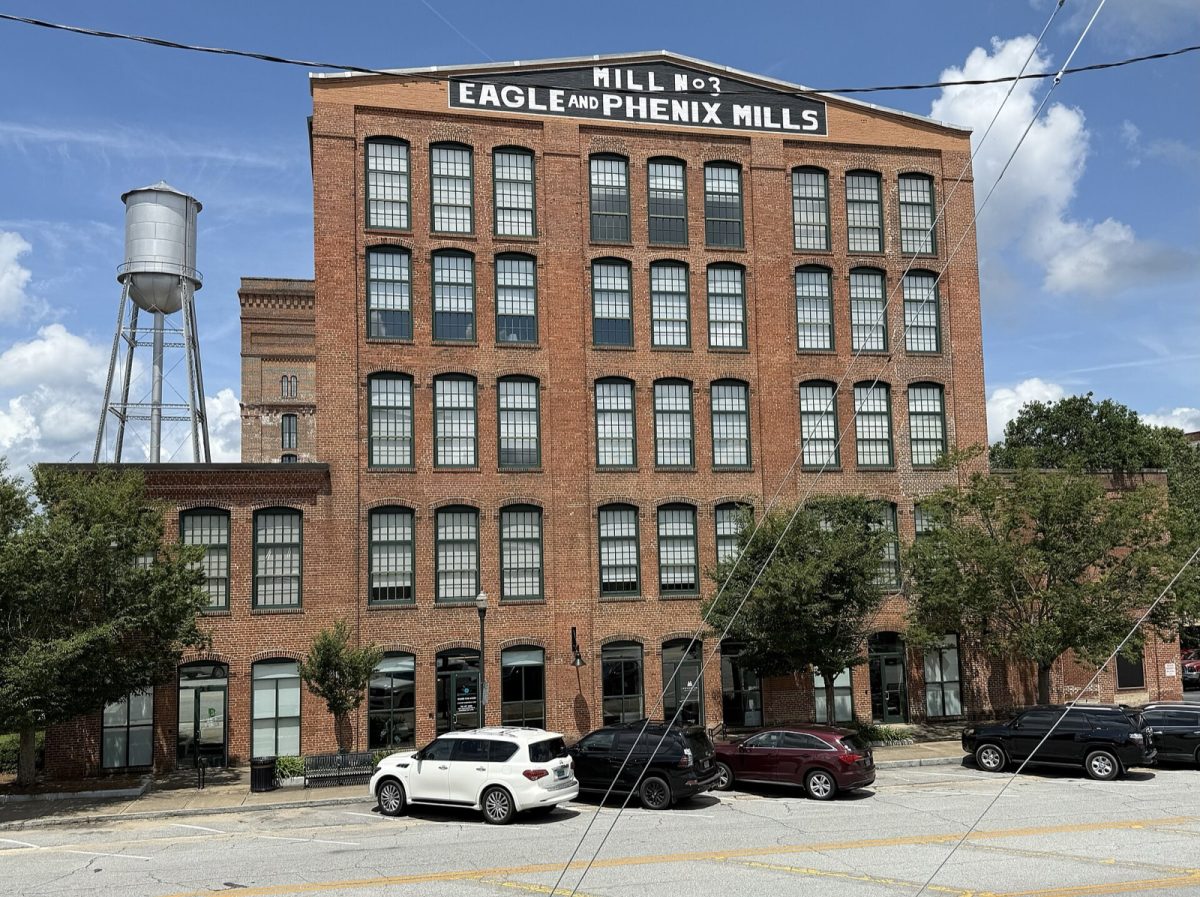
Mill No. 3 of the Eagle and Phenix Mills along the Chattahoochee River in Columbus (file photo). Photo: Farragutful / Wikimedia Commons (CC BY-SA 4.0)
COLUMBUS, Ga. - Union troops burned the Eagle Mill during the destruction of Columbus' industries in April 1865, but the factory returned under a new name and grew into one of the South's largest textile operations. By 1880, the Eagle and Phenix Manufacturing Company had expanded to approximately 45,000 spindles, four times its earlier size, helping establish Columbus as a major Southern manufacturing center. Its story stretches from the city's earliest water-powered industries through the Civil War, rapid industrial expansion, labor disputes and the eventual redevelopment of its historic riverfront.
1828: A City Built Around the River
Columbus owes much of its industrial history to the Chattahoochee River. The city sits at the fall line, where the river drops approximately 125 feet over 2.5 miles. That change in elevation provided the waterpower that attracted manufacturers long before the Eagle and Phenix became a household name in the city's industrial history.
Georgia created Columbus in 1828 as a trading town at the Falls of the Chattahoochee. By the end of that year, the river was already powering City Mills, a grist mill. Local leaders soon began dividing the riverfront into sites intended for additional industrial development.
The town council divided part of the waterfront into 19 water lots, each measuring 72 feet wide. Officials sold those lots for a nominal amount to Josephus Echols and John H. Howard, requiring them to construct a dam and race capable of powering the properties. That land eventually became home to the Eagle and Phenix Mills and Muscogee Manufacturing Mills No. 1 and 2.
1850-1860: William Young Builds a Textile Business
The Eagle Mill began in 1850 or 1851, depending on the historical source. Historian John S. Lupold's National Historic Landmark nomination dates its organization to 1850, while the New Georgia Encyclopedia identifies 1851 as the opening of William H. Young's Eagle Manufacturing Company. Young was a New Yorker who had made a fortune as a commission merchant in Florida before entering the Columbus textile industry.
Young expanded his manufacturing interests in 1860 by acquiring the struggling Howard Factory. Together, the operations employed approximately 500 workers who operated 11,300 spindles and 282 looms. The combined enterprise ranked as Georgia's second-largest textile operation at the time.
Columbus had already developed a reputation that extended beyond Georgia. Frederick Law Olmsted visited in 1860 and described the city as "the largest manufacturing town, south of Richmond, in the Slave States." His assessment reflected the industrial importance Columbus had achieved before the Civil War interrupted its growth.
April 1865: War Reaches the Mills
During the Civil War, Columbus became an important manufacturing supplier to the Confederacy. Its industries produced textiles, military uniforms, caps, tents, rubber cloth, gun carriages, cannon and shot. Local manufacturing also supplied steam engines and gunboats.
On Easter Sunday, April 16, 1865, Union Gen. James H. Wilson's raiders attacked Columbus at night. Wilson commanded approximately 13,500 cavalrymen during the operation. The battle marked a turning point for the city's industrial development.
The following day, Wilson's troops burned Columbus' industries. According to the 1978 National Historic Landmark nomination, the destruction extended to every industry except the grist mills. The Eagle Mill was among the manufacturing operations destroyed, leaving the city to rebuild much of the industrial system it had developed over previous decades.
1865-1867: A Factory Rises From the Ashes
Rebuilding began almost immediately after the destruction. Many of the same investors, managers and workers participated in restoring Columbus' industrial operations. According to the New Georgia Encyclopedia, textile mills had returned to production by December 1865.
In 1867, William Young began Mill No. 1 of the reorganized Eagle and Phenix Manufacturing Company. The new operation occupied the site where the original Eagle Mill had stood. Its name recalls the phoenix, the mythical bird said to rise from its own ashes, an appropriate symbol for a business rebuilding after wartime destruction.
The restored company began another period of expansion that surpassed its earlier development. Its first mill contained approximately 10,000 spindles and 135 looms. Those numbers provided the foundation for a manufacturing operation that would grow dramatically during the following decade.
1871-1880: One of the South's Largest Mills
The company's second mill opened in 1871 with 15,000 spindles and 350 looms. A third mill followed in 1878, containing 20,000 spindles and 800 looms. According to Lupold's nomination, Mill No. 3 was probably the largest single factory in the South in 1878.
The National Historic Landmark nomination states that Eagle and Phenix "probably expanded more rapidly than any other mill in the South in the 1870s." In approximately 10 years, including five years during a depression, the company quadrupled in size. By 1880, its operations included approximately 45,000 spindles.
The company's products also demonstrated the breadth of its manufacturing operation. Eagle and Phenix produced 110 different varieties of woolen and cotton goods. Its reputation reached visitors and manufacturers who compared the Columbus operation with other leading textile centers.
Writer Edward King toured the South in 1873 and 1874 for Scribner's Monthly. He wrote that no Southern mill town excelled Graniteville, South Carolina, "unless it be that of the Eagle and Phenix Company at Columbus, Georgia." An English manufacturer offered another assessment, calling Mill No. 3 "as perfect in all its appointments as any establishment in the world."
Engineering Helped Drive Expansion
Company engineer John Hill played an important role in the mills' development. He designed Mill No. 3 and installed direct-current arc lighting in 1880. During the early 1880s, he also engineered a masonry dam, which the Eagle and Phenix Dam account dates to 1882.
Hill developed an automatic sprinkler system, and his company later became part of the Grinnell Sprinkler Company. His engineering work also extended beyond Columbus to the King Mill in Augusta. That factory resembled the Eagle and Phenix Mill No. 3 that Hill had designed.
The company's influence extended into other Southern manufacturing ventures. Eagle and Phenix officer N. J. Bussey helped organize the Atlanta Cotton Mill in 1876. The expansion and engineering achievements in Columbus also received attention from Southern newspapers and the Textile Record during the 1880s.
1896: Labor Disputes and Financial Trouble
The company's rapid expansion eventually slowed. Eagle and Phenix reached its peak by the 1890s and built no additional large mills after 1878. During that decade, an Atlanta group gained control of the business.
In March 1896, some Eagle and Phenix weavers went on strike and organized the first Southern local of the National Union of Textile Workers. One of the company's weavers, Prince William Greene, later served as president of the national union from 1897 through 1900. The labor activity became another significant chapter in the company's history.
Financial problems followed, and Eagle and Phenix entered receivership in June 1896. Former company officer G. Gunby Jordan revived the operation and introduced new powerhouses and electric power transmission. Jordan was also a major investor in the Bibb Company.
The mills remained under local ownership after Jordan, with W. C. Bradley succeeding him. That locally controlled period continued until Reeves Brothers Inc. purchased the company in 1947. The ownership changes marked another transition for an industrial operation established nearly a century earlier.
1978-2012: Historic Recognition and Riverfront Changes
The industrial structures continued to demonstrate the company's earlier engineering accomplishments. In 1978, Eagle and Phenix powerhouses still contained nine turbines installed in 1899 and 1900, along with generators installed beginning in 1907. The complex included three main mills arranged perpendicular to the Chattahoochee River.
On June 2, 1978, the Columbus Historic Riverfront Industrial District received National Historic Landmark designation. The district covered five industrial complexes along the east bank between 8th Street and 38th Street. Those sites included City Mills, Eagle and Phenix Mills, Columbus Iron Works, Muscogee Manufacturing and the Bibb Manufacturing Company.
Another chapter began in 2003 when redevelopment started at the Pillowtex factories on the historic Eagle and Phenix property. The river itself underwent a major change in March 2012, when the City of Columbus-owned Eagle and Phenix Dam was breached. That project restored natural river flow and created an urban whitewater course.
The Eagle and Phenix story reflects more than the rise of a single factory. It connects Columbus' earliest water-powered manufacturing, the destruction of 1865, the extraordinary expansion of the 1870s and the industrial changes that followed. The surviving history of the mills also explains why this section of the Chattahoochee River became central to Columbus' development.
How We Did This
This history feature draws primarily from historian John S. Lupold's Feb. 10, 1978, National Register of Historic Places and National Historic Landmark nomination for the Columbus Historic Riverfront Industrial District, prepared for the National Park Service. Additional historical facts come from the New Georgia Encyclopedia articles "Columbus" and "Textile Industry," along with the Wikipedia articles "Eagle & Phenix Dam" and "Columbus Historic Riverfront Industrial District." Where historical sources differ on the original Eagle Mill's opening date, the article identifies both 1850 and 1851 rather than selecting one as definitive.
Source: National Park Service NHL nomination, Columbus Historic Riverfront Industrial District (1978); New Georgia Encyclopedia
News organizations may republish this story with credit. See our guidelines.
Know someone who'd want to read this? Email it to a friend.
Own a Columbus business? 60,000+ page views a month. Ads from $125/month. See ad options Follow Columbus Times on FacebookLocal news, events and people, in your feed every day.Most read this week
- Georgia Spent $165.7 Million on Medicaid Work Requirement Program, but Only 18,527 Were Enrolled After 3 Years
- 8 Columbus Restaurants Got a C on Their Health Inspection in 2026, the Most of Any Year Since 2022. Here's Every One
- The Night Fight on the Chattahoochee: How Columbus Became the Site of What Many Call the Last Battle of the Civil War
- The 10 Best Mexican Restaurants in Columbus, Ga., Ranked by Diners
- Columbus' Top-Rated Barbecue: 12 BBQ Joints Ranked by Google Stars and Health Scores
More stories
 Local Fly From Columbus or Drive to Atlanta? $9-a-Day Parking, 1 Airline and What Each Trip Really Costs
 Local Uptown Columbus Parking in 2026: 5 Free Decks, the 2-Hour Broadway Rule and How to Avoid a Ticket
 Local 12 Famous People From Columbus, Ga.: A Hall of Fame Slugger, a Grammy-Winning Bluesman and America's First Black Military Pilot
 Local Phenix City's 1954 Turning Point: The Murder of Albert Patterson, 734 Indictments and a Hollywood Movie
Comments
Be respectful. No personal attacks, hate speech, spam or anyone's private information. Every comment is reviewed before it appears. Comment rules
No comments yet. Be the first to share your thoughts.