Georgia's Hands-Free Driving Law: 12 Questions About $50 to $150 Fines, Points and What You Can Still Do
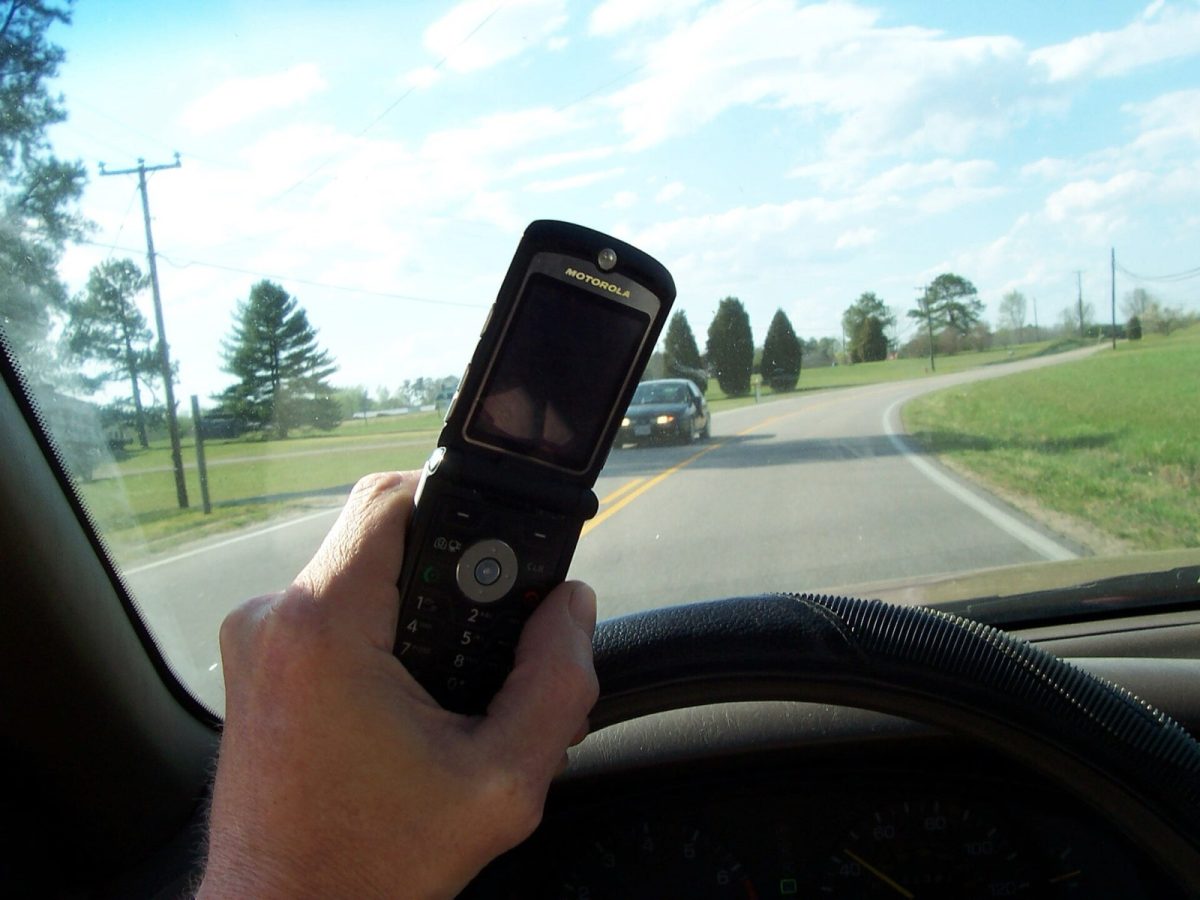
A driver holds a cell phone behind the wheel (file photo). Photo: Ed Brown / Wikimedia Commons (CC BY-SA 2.5)
COLUMBUS, Ga. - Georgia drivers who violate the state's hands-free driving law can face fines ranging from $50 to $150 and receive up to three points on their driver's license. The law prohibits holding a phone while driving, reading or sending text messages, and watching videos, but it allows certain hands-free activities. Drivers can still use GPS navigation, make hands-free calls and listen to music under specific conditions.
The Hands-Free Georgia Act took effect July 1, 2018, after Gov. Nathan Deal signed it on May 2, 2018. The law appears in Georgia Code section 40-6-241 and requires drivers to exercise due care while operating a vehicle. Here are answers to 12 common questions about what the law allows, what it prohibits and how penalties work.
1. Can I hold my phone while driving in Georgia?
No. Georgia law prohibits drivers from physically holding or supporting a wireless telecommunications device or stand-alone electronic device with any part of their body while operating a vehicle on a road. This restriction applies even when a driver is simply talking on the phone rather than texting. That means a phone resting on a shoulder or in a lap during a call is also off limits.
The law does allow drivers to make voice calls using hands-free technology. An earpiece, headphone device or wrist-worn device such as a smartwatch may be used for voice communication. Drivers must avoid handling the phone or supporting it against their bodies while driving.
2. Can I text or read messages while driving?
No. The law prohibits writing, sending or reading text-based communications while operating a vehicle. This includes text messages, instant messages, emails and internet data. The ban applies whether the phone is in a hand or sitting in a mount.
The restriction also covers social media content and other text displayed on a phone. Using hands-free technology does not give drivers permission to manually read or compose messages. However, the law allows voice-to-text communication when the device automatically converts spoken words into text.
3. Can I use GPS navigation on my phone?
Yes. Georgia's hands-free law specifically allows navigation and GPS use, including navigation-related information displayed on a device. Drivers may view navigation data without violating the law's general restriction against watching videos. A dashboard or vent mount lets drivers follow directions without holding the phone.
The permission to use GPS does not eliminate the restriction against physically holding a phone. Drivers must still operate their vehicles with due care and avoid actions that distract from safe driving. Using a phone for navigation is permitted, but holding that phone while driving remains prohibited.
4. Can I listen to Spotify or other streaming music?
Yes. The Governor's Office of Highway Safety says drivers may listen to streaming music as long as the music does not display video on the phone screen. Drivers cannot touch their phones to start or program a music application while traveling on the road. Picking a playlist or podcast is a task to finish before shifting into drive.
The agency advises drivers to set up their music applications before getting on the road. Music controlled through the vehicle's radio is allowed under the agency's guidance. The distinction is between listening to music and physically operating a phone while driving.
5. Can I watch or record videos while driving?
No. Georgia law prohibits drivers from watching videos or movies while operating a vehicle. The exception covers navigation-related video or information used for GPS purposes. Streaming a show or a game on a phone screen while driving is not allowed.
Drivers also cannot record or broadcast video while driving. However, the law permits devices used only to continuously record or broadcast video inside or outside the vehicle, such as a continuously running dashboard camera. This exception does not create permission to hold a phone and manually record video while driving.
6. How much is the fine for violating the law?
The maximum fine depends on the driver's previous convictions within a 24-month period. A first conviction carries a fine of no more than $50, a second conviction within 24 months carries a fine of no more than $100, and a third or subsequent conviction within that period carries a fine of no more than $150. The 24 months are measured from the dates of earlier convictions to the date of the current one.
| Conviction | Maximum fine | License points |
|---|---|---|
| First, with no conviction in previous 24 months | $50 | 1 |
| Second within 24 months | $100 | 2 |
| Third or more within 24 months | $150 | 3 |
Each violation is a separate misdemeanor offense under the law. The statute also prohibits adding prosecution costs, extra fees or surcharges to these fines. The listed amounts are maximum fines rather than mandatory amounts for every conviction.
7. Will I get points on my driver's license?
Yes. Georgia's hands-free law assigns one point for a first violation, two points for a second violation and three points for a third violation. The point penalties increase along with the maximum fines for repeat convictions. Those points go on the driver's Georgia license record.
The law treats each violation as a separate offense. Drivers with multiple convictions during the applicable 24-month period may face the higher penalties specified in the statute. The financial penalty and the license points are separate consequences of a conviction.
8. Is there a way to avoid a first-time conviction?
Yes, under a specific provision for a first charge involving holding a phone. A person appearing in court for that first charge can show the court a hands-free device or proof that the person purchased one. Under the statute, a person who satisfies this provision shall not be guilty.
The court also requires the person to affirm that they have not previously used this first-time provision. The opportunity applies to the specified first charge involving holding a phone, rather than automatically excusing every type of distracted-driving offense. Drivers should understand the exact conditions before relying on this provision.
9. Can I use my phone during an emergency?
Yes. The law provides exceptions for reporting a traffic accident, medical emergency, fire, crime, potential crime or road condition that creates an immediate and serious hazard. These exceptions recognize specific circumstances in which communication may be necessary. Calling for help after a crash or to report a dangerous road condition is covered by these exceptions.
The law also exempts utility workers responding to utility emergencies. Law enforcement officers, firefighters, emergency medical services personnel, ambulance drivers and similar first responders receive exceptions while performing their duties. These exceptions do not create a general exemption for ordinary personal phone use while driving.
10. What if my vehicle is parked or stopped?
The law includes an exception for someone inside a vehicle that is lawfully parked. That means the restrictions described in the hands-free provisions do not apply in the same way when the vehicle meets the law's parked-vehicle exception. Drivers who need to handle their phones should pull off the road and park before using them.
The law's stated exception concerns vehicles that are lawfully parked. Drivers should not assume that temporarily stopping during a trip provides the same exception. Pulling off the road and parking is the appropriate way to handle a phone when hands-free use is insufficient.
11. Are commercial drivers and school bus drivers subject to different rules?
Yes. Commercial drivers have additional restrictions under Georgia's law. They cannot use more than a single button to start or end a voice call, and they cannot reach for a device in a manner that takes them out of their seated driving position or properly fastened safety belt. The goal is to keep a commercial driver seated, belted and focused on the road.
School bus drivers also face specific restrictions. They cannot use a phone or two-way radio while loading or unloading passengers. While a school bus is moving, a driver cannot use a phone unless it functions like a two-way radio for communication with school or public safety officials.
12. Does the law apply to smartwatches, radios and other electronic devices?
The law covers more than ordinary cell phones. Its definition of a wireless telecommunications device includes portable phones, text-messaging devices, personal digital assistants, stand-alone computers, GPS receivers and similar portable wireless devices. However, it specifically permits wrist-worn devices such as smartwatches for voice communication.
Several types of equipment fall outside the law's definition of a wireless telecommunications device. These include radios, CB radios, commercial two-way radios, amateur radios, subscription-based emergency communication devices, prescribed medical devices and in-vehicle security, navigation or remote diagnostic systems. Drivers must still exercise due care and avoid actions that distract from operating their vehicles safely.
Where can drivers get more information?
The Georgia Governor's Office of Highway Safety provides information about the Hands-Free Georgia Act and makes free informational brochures available. Drivers can contact the agency at (404) 656-6996 or visit gahighwaysafety.org for information about the law. The agency also posts the text of Georgia Code section 40-6-241.
How we did this
The Columbus Times reviewed the Georgia Governor's Office of Highway Safety's Hands-Free Law information and the text of the Hands-Free Georgia Act, Georgia Code section 40-6-241, posted on the agency's website. The source information was checked Oct. 25, 2026, and includes the law's restrictions, exceptions, fines and license-point penalties. This article provides general information about Georgia law and does not constitute legal advice.
Source: Georgia Governor's Office of Highway Safety; O.C.G.A. 40-6-241 (Hands-Free Georgia Act)

News organizations may republish this story with credit. See our guidelines.
Know someone who'd want to read this? Email it to a friend.
Own a Columbus business? 60,000+ page views a month. Ads from $125/month. See ad options Follow Columbus Times on FacebookLocal news, events and people, in your feed every day.Most read this week
- Georgia Spent $165.7 Million on Medicaid Work Requirement Program, but Only 18,527 Were Enrolled After 3 Years
- 8 Columbus Restaurants Got a C on Their Health Inspection in 2026, the Most of Any Year Since 2022. Here's Every One
- The Night Fight on the Chattahoochee: How Columbus Became the Site of What Many Call the Last Battle of the Civil War
- The 10 Best Mexican Restaurants in Columbus, Ga., Ranked by Diners
- Columbus' Top-Rated Barbecue: 12 BBQ Joints Ranked by Google Stars and Health Scores
More stories
 Local Eufaula Day Trip From Columbus: 47 Miles, 738 Historic Buildings, 2 House Museums and a 640-Mile Shoreline
 Local West Point Lake by the Numbers: 25,900 Acres, 525 Miles of Shoreline and 4 Corps Campgrounds Upriver From Columbus
 Local Fly From Columbus or Drive to Atlanta? $9-a-Day Parking, 1 Airline and What Each Trip Really Costs
 Local Uptown Columbus Parking in 2026: 5 Free Decks, the 2-Hour Broadway Rule and How to Avoid a Ticket
Comments
Be respectful. No personal attacks, hate speech, spam or anyone's private information. Every comment is reviewed before it appears. Comment rules
No comments yet. Be the first to share your thoughts.