Where Does Columbus’s Trash Actually Go? Inside the Landfill Handling 73,000 Tons a Year
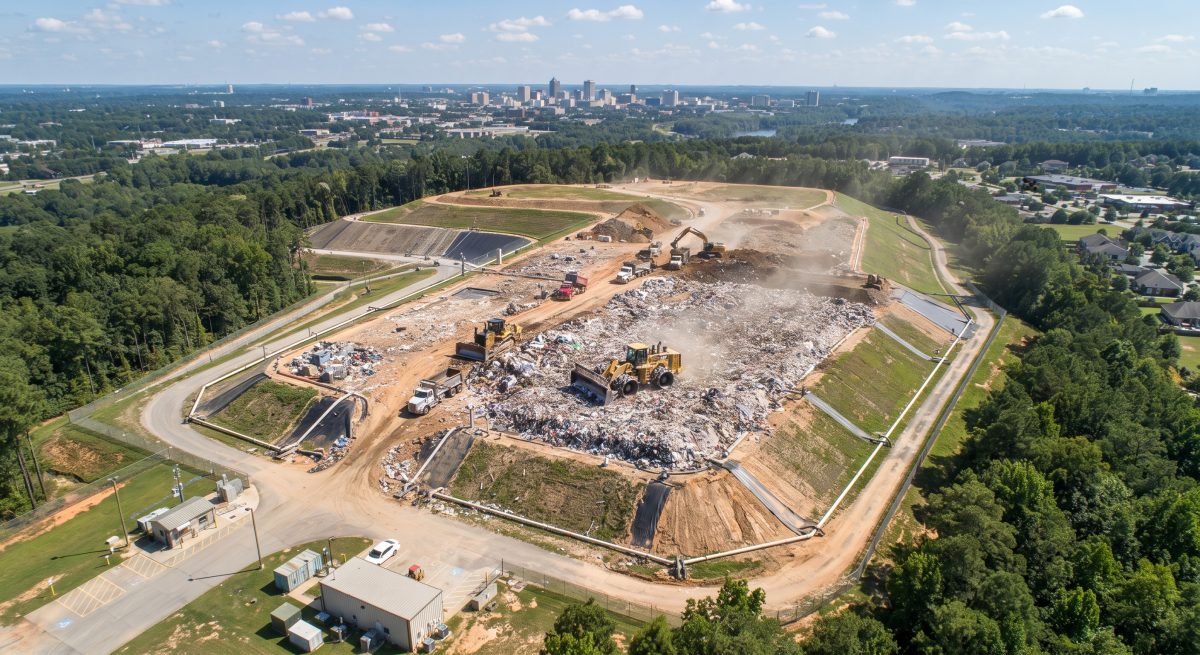
Heavy equipment operates at the city-run Pine Grove Municipal Landfill in Columbus, managing thousands of tons of residential and commercial waste under strict environmental oversight by the Columbus Consolidated Government
Every week, garbage trucks travel through Columbus neighborhoods collecting thousands of bags of household trash. Once those trucks disappear down the street, most residents probably give little thought to what happens next. But nearly everything thrown into a Columbus garbage cart eventually ends up at one location on the city’s eastern side.
That location is Pine Grove Municipal Landfill, a city-operated facility at 7900 Pine Grove Way. The landfill received more than 73,000 tons of waste during fiscal year 2018, according to Columbus’s official solid waste management plan. Although that figure is historical rather than a current annual total, it illustrates the enormous amount of garbage the city must manage.
Most Household Garbage Ends Up at Pine Grove
Columbus operates its own municipal landfill instead of relying entirely on private waste disposal companies. Pine Grove accepts household garbage, construction debris and other permitted waste generated within Muscogee County. The facility serves as the primary destination for ordinary residential trash collected by the city’s sanitation crews.
The landfill property covers more than 343 acres, according to the city’s 2019–2028 solid waste management plan. Approximately 91.5 acres were permitted for municipal solid waste disposal when that plan was prepared, with another 22.2 acres designated for construction and demolition debris. The property includes designated disposal areas and supporting infrastructure needed to manage waste safely.
The city’s historical records show that more than three-quarters of the material entering Pine Grove came from residential garbage collection. Government operations, commercial haulers, industrial sources and direct deliveries accounted for the remainder. That means household waste has historically represented the largest portion of the landfill’s workload.
What Happens After Garbage Arrives?
Garbage arriving at Pine Grove is deposited into designated landfill areas, where heavy equipment spreads and compacts the material. The waste is then covered with dirt or other approved material to reduce exposure, odors and problems associated with pests. This process continues as additional waste arrives and disposal areas gradually fill.
Unlike older, unlined dumps, Pine Grove is an engineered landfill designed to limit environmental contamination. City records describe a double-lined facility with systems that collect contaminated liquid, known as leachate, from beneath the garbage. The collected liquid is directed into the sanitary sewer system for further management.
Decomposing garbage also produces landfill gas, including methane, which requires environmental oversight. Georgia’s Environmental Protection Division regulates landfill operations, and the city must comply with applicable monitoring and disposal requirements. Even after a disposal area closes, environmental responsibilities can continue for years.
What Happens to Recycling?
Not everything collected from Columbus homes is supposed to end up buried underground. The city operates a Recycling and Sustainability Center at 8001 Pine Grove Way, near the municipal landfill. The facility opened in 2013 and processes recyclable materials collected through the city’s recycling program.
Residents can place accepted paper, cardboard, plastic containers, and aluminum and tin cans into their blue recycling carts. These materials are transported to the recycling center, where they are separated by material type for further processing. Whether an individual item ultimately becomes a new product depends on factors including contamination, processing requirements and available recycling markets.
The distinction matters because recycling reduces the amount of material requiring landfill disposal. Columbus’s solid waste management plan reported 385 tons of recyclables processed through its system during fiscal year 2018, alongside additional materials diverted at landfill facilities. Increasing the amount of usable material recovered could help preserve landfill capacity over time.
Yard Waste and Construction Debris Follow Different Rules
Columbus also operates Granite Bluff Inert Landfill at 7589 River Road. This facility handles certain materials such as grass clippings, leaves, uncontaminated soil, bricks, rocks and concrete without reinforcing steel. Unlike ordinary household garbage, these materials are managed under different disposal requirements.
However, not every type of yard debris belongs at Granite Bluff. Since May 2019, the facility has stopped accepting limbs, stumps, trees, shrubs and land-clearing debris, which are instead processed at Pine Grove. Residents separating yard waste must therefore follow the city’s collection and disposal guidelines.
Construction debris also requires special handling. The city does not collect most construction and demolition materials through regular curbside service, meaning property owners or contractors must arrange appropriate disposal. Materials such as lumber, roofing shingles, carpeting and certain plumbing fixtures generally must be delivered to an approved facility.
How Much Does Garbage Disposal Cost?
Although residents typically encounter the sanitation system through curbside collection, operating a landfill involves substantial expenses. Equipment, employee wages, environmental monitoring, transportation and landfill maintenance all contribute to the cost of waste management. As available landfill space decreases, expanding existing facilities or finding new disposal locations can create additional financial pressure.
Columbus currently lists a disposal charge of $85 per ton for household garbage delivered directly to Pine Grove. The landfill requires proof of Muscogee County residency or documentation showing that waste originated from an eligible local job site. Its regular operating hours are Monday through Friday, with limited Saturday availability.
The direct-disposal fee is separate from the charges residents may pay for municipal curbside sanitation services.
How Long Can Columbus Keep Using Pine Grove?
Landfill capacity is one of the most important long-term questions facing Columbus. A city planning document adopted in 2023 indicated that Pine Grove’s municipal solid waste facility had six planned phases, with the first three full and the fourth in use at the time. The document also described a construction-and-demolition landfill expansion intended to significantly extend capacity for that category of waste.
That does not establish how many years of municipal garbage capacity remain as of October 2026. The city’s older planning documents projected decades of use, but those estimates depend on future disposal volumes, construction, permitting and available space. A current capacity assessment would be needed to determine the landfill’s remaining operating life.
For residents, the larger issue is what happens when local landfill space eventually runs out. Sending garbage to more distant facilities could increase transportation and disposal expenses, while developing additional landfill capacity would require land, funding and regulatory approval. Reducing unnecessary waste and recovering recyclable materials can help delay those decisions.
What Residents Should Know
Columbus residents can help reduce waste entering the landfill by placing accepted recyclables in blue carts, separating yard debris and keeping prohibited materials out of regular garbage. The city also provides special disposal opportunities for materials that should not enter the ordinary waste stream. Its next advertised household hazardous waste recycling event is scheduled for October 24, 2026, from 8 a.m. until noon at the Recycling and Sustainability Center.
For most Columbus households, garbage collection ends when a sanitation truck empties the cart. For the city, that moment is only the beginning of a costly disposal process involving heavy equipment, environmental safeguards and long-term planning. What residents throw away today ultimately affects how much landfill capacity Columbus will have tomorrow.
Source: Columbus Consolidated Government Department of Public Works; Columbus Solid Waste Management Plan (2019–2028); Georgia Environmental Protection Divisi

News organizations may republish this story with credit. See our guidelines.
Know someone who'd want to read this? Email it to a friend.
Own a Columbus business? 60,000+ page views a month. Ads from $125/month. See ad optionsPlan your weekend with Columbus Times
Get This Weekend in Columbus every Thursday: the best local events, free things to do and family fun, plus each evening's local news. Free, and you can unsubscribe anytime.
Most read this week
- Georgia's 3 Amendments: Which Will Pass, Who's Against Them, and What Happens If They Fail
- Georgia's 3 Constitutional Amendments on the Nov. 3 Ballot, Explained in Plain English
- Early Voting in Columbus Starts Oct. 13: Every Site, the Hours, and What's on Your Ballot
- USDA Awards $3.3 Billion Loan for Georgia Power Plant to Meet Rising Electricity Demand
- Georgia Election Forecast 2026: Who Is Projected to Win Every Major Race?
More stories
 Local 180 School Days: Muscogee County Schools' 2026–27 Calendar, With Every Day Off and Break
 Local Columbus’ 10 Highest-Paid Government Employees Earn Up to $192,476 a Year
 Local Columbus Has More Than $1.2 Billion in Public Infrastructure Projects. Here Are the Most Expensive
 Local Columbus Electric Bills Average $239 a Month. How Does That Compare With Other Georgia Cities?
Comments
Be respectful. No personal attacks, hate speech, spam or anyone's private information. Every comment is reviewed before it appears. Comment rules
No comments yet. Be the first to share your thoughts.