10 Columbus Street Names and the Surprising History Behind Them
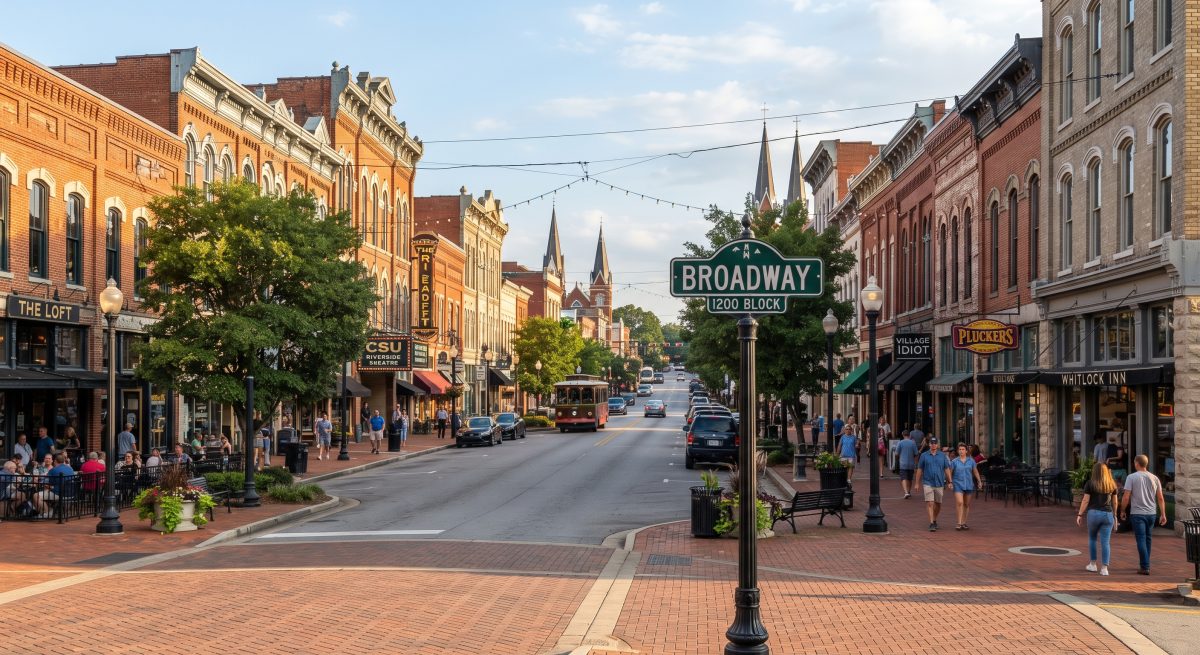
Looking down the historic 1200 block of Broadway in downtown Columbus, showcasing its original wide avenue design and Victorian-era brick storefronts.
10 Columbus Street Names and the Surprising History Behind Them
Thousands of Columbus residents travel Veterans Parkway, Manchester Expressway and Macon Road every day without giving their names much thought. Yet many of the city’s busiest streets preserve stories about military history, early settlements, prominent residents and communities that existed long before modern Columbus developed. Some names are nearly 200 years old, while others commemorate events and people from the 20th century.
Columbus was founded in 1828 along the Chattahoochee River, and its road network has expanded dramatically since then. Early routes connected settlements and trading centers, while later roads reflected suburban growth, military installations and the automobile. Here are the stories behind 10 familiar Columbus streets, including a few historical connections residents may not know.
1. Veterans Parkway — A Tribute to Military Service
Veterans Parkway is one of Columbus’s busiest north-south corridors, connecting downtown with commercial districts and neighborhoods farther north. The name honors military veterans, reflecting the city’s longstanding relationship with the U.S. Army and nearby Fort Benning, now Fort Moore.
The corridor previously carried several names along different sections, including Fourth Avenue, Hamilton Road and North Expressway. The Veterans Parkway name was adopted in the 1990s, creating a more unified identity for the route. Its military connection is especially meaningful in a community where generations of service members and their families have lived.
2. Manchester Expressway — A Connection to Another Georgia Town
Manchester Expressway takes its name from Manchester, a community northeast of Columbus in Meriwether County. Before modern expressways, roads connecting regional towns were essential for commerce, agriculture and travel. The corridor was previously known as Columbus-Manchester Road, reflecting that regional connection.
Manchester itself has an interesting history. Founded as a railroad community in 1907 and incorporated in 1909, the town was named after Manchester, England, an important industrial center. The Columbus expressway therefore carries a name connected to both Georgia’s railroad history and a famous English manufacturing city.
3. Macon Road — A Historic Route Toward Central Georgia
Macon Road reflects the longstanding transportation connection between Columbus and Macon, Georgia. Before interstate highways, roads linking regional cities helped move agricultural products, commercial goods and travelers across the state. Macon Road developed into one of Columbus’s important east-west transportation corridors.
The road also played a significant role in the city’s residential expansion. Historic records show that the nearby Wynnton community developed along the regional highway toward Macon during the 19th century. Today, the corridor is associated with shopping centers, neighborhoods, schools and businesses rather than the rural estates that once characterized portions of the area.
4. Wynnton Road — Named for One of Columbus’s Earliest Suburbs
Wynnton Road preserves the name of a community that developed outside Columbus’s original city limits. During the 1830s, wealthy residents began purchasing land east of downtown, building substantial country estates along the elevated landscape. Colonel William L. Wynn purchased approximately 100 acres in 1834, helping establish the historical connection between the Wynn name and the surrounding area.
Wynnton eventually became one of Columbus’s earliest suburban communities. Historic homes, including the Wynn House and Dinglewood, remain reminders of that period. The area was incorporated into Columbus in 1925, but its historic identity survives in the road name and surrounding neighborhoods.
5. Victory Drive — Named After World War II
Victory Drive has one of the city’s most clearly documented naming histories. On August 15, 1945, the Muscogee County Commission voted unanimously to rename the boulevard connecting Columbus with Fort Benning in celebration of Japan’s surrender and the end of World War II.
The decision recognized the contributions of military personnel who trained at Fort Benning and served during the war. A historical marker along Victory Drive commemorates the decision and the importance of the military installation to the community. More than 80 years later, the road continues to carry that tribute through southern Columbus.
6. J.R. Allen Parkway — Honoring a Mayor Who Died in Office
J.R. Allen Parkway honors James R. Allen, who served as mayor of Columbus from 1969 until his death in February 1973. Allen supported the consolidation of Columbus and Muscogee County governments and became the first mayor of the consolidated government. He died in a plane crash while serving in office.
In 1987, the Georgia General Assembly officially designated the North Columbus Bypass as J.R. Allen Parkway. The resolution recognized Allen’s contributions to local government and his efforts to strengthen community pride. Today, the parkway serves as a major east-west transportation route and a permanent memorial to his public service.
7. Warm Springs Road — A Link to Georgia’s Historic Resort Community
Warm Springs Road carries the name of Warm Springs, Georgia, a Meriwether County community famous for its mineral springs and association with President Franklin D. Roosevelt. The road developed from an older transportation corridor connecting Columbus with communities to the northeast. Historical research identifies portions of the Talbotton-Warm Springs corridor as part of an earlier Federal Road or stagecoach route.
Historic Columbus records indicate that Warm Springs Road first appeared in the city directory in 1942. During the following decades, surrounding residential subdivisions expanded as Columbus grew beyond its original boundaries. The street’s name continues to preserve a connection to the wider region’s geography and history.
8. Talbotton Road — A Reminder of Early Regional Travel
Talbotton Road takes its name from Talbotton, the county seat of neighboring Talbot County. Long before modern highways, this corridor helped connect Columbus with settlements and communities throughout west-central Georgia. Archaeological research identifies the Talbotton-Warm Springs route as one of the city’s oldest transportation corridors.
During the 19th century, substantial homes and estates appeared along sections of the road. Later development brought textile mills, businesses and residential neighborhoods to the surrounding area. What began as an important regional travel route eventually became part of Columbus’s expanding urban street network.
9. Cusseta Road — A Name With Muscogee Creek Roots
Cusseta Road carries a name connected to the region’s Indigenous history. Cusseta, also known as Kasihta, was an important town of the Muscogee Creek people, whose communities existed throughout the Chattahoochee Valley long before Columbus was established.
The name also survives in Cusseta, Georgia, the county seat of Chattahoochee County. The historic Muscogee town was associated with the region’s early political and cultural life, including the period before the forced removal of Creek communities during the 1830s. Cusseta Road therefore preserves a connection to a history much older than the modern city itself.
10. Broadway — A Street Dating Back to Columbus’s Founding
Broadway, historically known as Broad Street, traces its origins to Columbus’s original 1828 street plan. Early records show that Broad Street was designed wider than the city’s other streets running parallel to the Chattahoochee River. An 1828 newspaper account described it as 164 feet wide, compared with 132 feet for most of those surrounding streets.
The unusually broad roadway became a central feature of downtown Columbus. Over nearly two centuries, the street has witnessed commercial growth, changing transportation systems, economic challenges and downtown revitalization. Today, Broadway remains one of the city’s most recognizable destinations, with restaurants, shops, entertainment venues and historic buildings.
The History Hidden in Everyday Columbus
Street names often survive long after the people, settlements and circumstances that inspired them have disappeared. Columbus’s roads reflect nearly two centuries of development, from early trading routes and military history to suburban expansion and local political leadership. Even ordinary commutes can reveal something about how the community became what it is today.
Some names commemorate individuals, while others describe destinations or preserve the identities of earlier communities. Together, they provide a historical record that residents encounter almost every day. The next time you drive across Columbus, consider how much local history is preserved on the street signs around you.
Source: 10 Columbus Street Names and the Surprising History Behind Them

News organizations may republish this story with credit. See our guidelines.
Know someone who'd want to read this? Email it to a friend.
Own a Columbus business? 60,000+ page views a month. Ads from $125/month. See ad optionsPlan your weekend with Columbus Times
Get This Weekend in Columbus every Thursday: the best local events, free things to do and family fun, plus each evening's local news. Free, and you can unsubscribe anytime.
Most read this week
- Georgia's 3 Amendments: Which Will Pass, Who's Against Them, and What Happens If They Fail
- Georgia's 3 Constitutional Amendments on the Nov. 3 Ballot, Explained in Plain English
- Early Voting in Columbus Starts Oct. 13: Every Site, the Hours, and What's on Your Ballot
- USDA Awards $3.3 Billion Loan for Georgia Power Plant to Meet Rising Electricity Demand
- Georgia Election Forecast 2026: Who Is Projected to Win Every Major Race?
More stories
 Local Columbus’ 10 Highest-Paid Government Employees Earn Up to $192,476 a Year
 Local Columbus Has More Than $1.2 Billion in Public Infrastructure Projects. Here Are the Most Expensive
 Local Columbus Electric Bills Average $239 a Month. How Does That Compare With Other Georgia Cities?
 Local How Much Do Columbus Police Officers, Firefighters and Teachers Really Earn?
Comments
Be respectful. No personal attacks, hate speech, spam or anyone's private information. Every comment is reviewed before it appears. Comment rules
No comments yet. Be the first to share your thoughts.