Georgia Election Forecast 2026: Who Is Projected to Win Every Major Race?
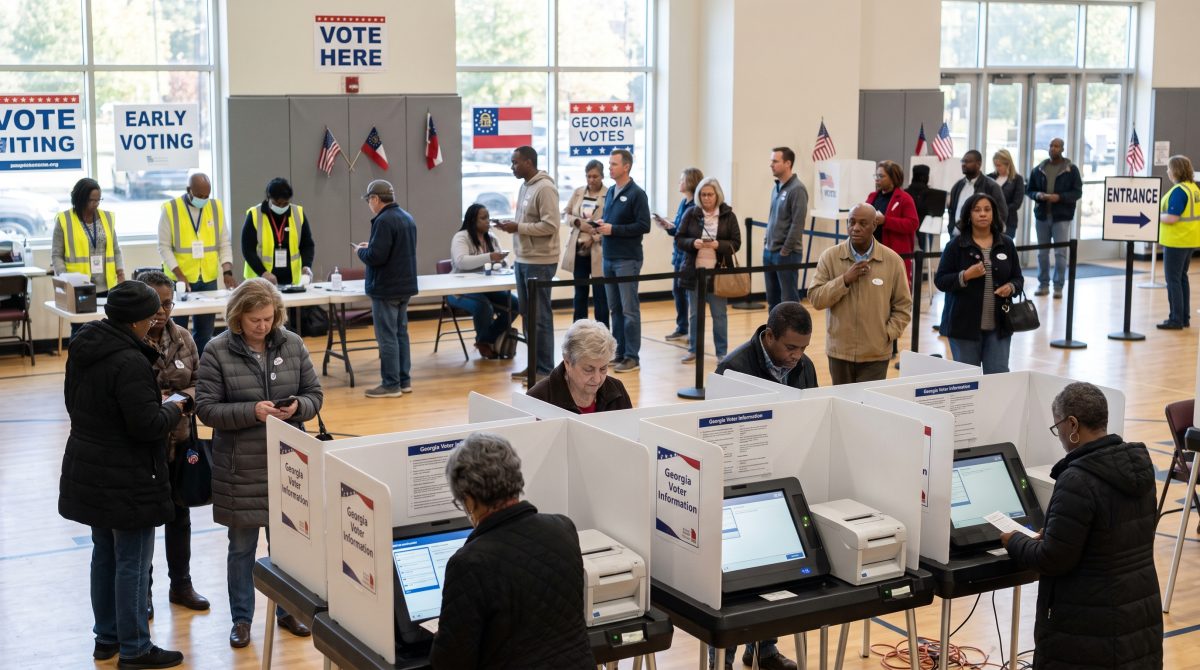
Georgia voters are preparing to decide a series of elections that will shape the state’s political leadership and could influence control of Congress in Washington.
The November 3, 2026, general election includes contests for governor, the U.S. Senate, all 14 U.S. House districts, lieutenant governor, attorney general, secretary of state and several other statewide offices. State legislative seats, judicial contests and local races will also appear on ballots in relevant districts and communities. (Georgia.gov)
But which candidates are actually projected to win?
Current forecasts suggest a divided picture. Republican Rick Jackson has a narrow advantage in the governor’s race, while Democratic U.S. Sen. Jon Ossoff is favored to defeat Republican challenger Mike Collins. Republicans are projected to win more of Georgia’s congressional districts than Democrats, although several contests warrant closer attention.
These projections are based on polling, statistical models and, in some cases, prediction-market prices. They are not official election results, and different forecasting systems can produce different conclusions.
Here is a breakdown of the major races and what the available evidence suggests as of October 14, 2026.
1. Georgia Governor: Rick Jackson vs. Keisha Lance Bottoms
Forecast: Toss-up, with a slight Republican advantage in some models.
Georgia’s open gubernatorial contest is one of the most closely watched elections in the state. Republican Rick Jackson and Democrat Keisha Lance Bottoms are competing to succeed Republican Gov. Brian Kemp, who cannot run again because of term limits.
The race is competitive enough that a relatively small change in voter preferences or turnout could determine the outcome.
A forecast published by Call the Map on October 8 gave Jackson a narrow advantage of approximately 1.2 percentage points and estimated a 57% chance that he would win, including the possibility of a runoff. A separate market-based forecast also placed Jackson ahead, with approximately 54% implied odds compared with 46% for Bottoms. (Call the Map)
Polling has also shown a close contest. An Atlanta Journal-Constitution report published September 17 described a Rasmussen Reports poll that placed Jackson at 48% and Bottoms at 45%, a difference within the poll’s margin of error. (ajc)
Those figures do not establish that Jackson will win. Rather, they indicate that he has a modest advantage in some forecasts while Bottoms remains competitive.
What could decide the race?
Turnout in the Atlanta metropolitan area, support among independent voters, enthusiasm among each party’s base and voter participation across suburban and rural Georgia could all influence the outcome.
Georgia also requires a majority winner in certain elections, including governor. If no candidate receives a majority in November, the contest could proceed to a December 1 runoff. (Call the Map)
Bottom line: Jackson has a narrow advantage in some current projections, but the governor’s race remains too close to call confidently.
2. U.S. Senate: Jon Ossoff vs. Mike Collins
Forecast: Democrat Jon Ossoff favored.
The Senate contest is one of the most consequential races in Georgia because it could help determine which party controls the chamber in 2027.
Democratic incumbent Jon Ossoff is seeking another term against Republican U.S. Rep. Mike Collins.
Unlike the governor’s race, the Senate contest has generally produced more favorable projections for the Democratic incumbent.
Call the Map’s October 8 forecast projected Ossoff to win by approximately 8.7 percentage points and gave him a 97% chance of winning when a potential runoff was included. A separate polling model projected an even larger advantage. (Call the Map)
The fundraising picture has also favored Ossoff. Reuters reported October 12 that Ossoff had raised approximately $98 million through June 30 and entered July with nearly $43 million in campaign funds. Collins had raised approximately $7.4 million and reported $2.1 million on hand. (Reuters)
Campaign fundraising does not guarantee electoral success, but the disparity provides Ossoff with substantial resources for advertising, voter outreach and organizing.
Collins would need to overcome the polling disadvantage and persuade enough voters that he offers a preferable alternative to the incumbent.
Bottom line: Ossoff is the clear favorite in the available forecasts, although an upset remains possible.
3. Georgia’s 14 U.S. House Races
Forecast: Republicans favored to win nine seats; Democrats favored to win five.
All 14 of Georgia’s congressional districts are up for election in 2026.
Current district-level forecasts suggest Republicans are favored to retain nine seats, while Democrats are favored to win five. That would leave the overall congressional delegation unchanged from the current projected partisan split of nine Republicans and five Democrats. (Call the Map)
The following table summarizes the projected winners in each district according to Call the Map’s October 8 forecast.
Congressional district Democratic candidate Republican candidate Projected favorite District 1 Amanda Hollowell Jim Kingston Republican District 2 Sanford Bishop Matt Day Democrat District 3 Maura Keller Brian Jack Republican District 4 Hank Johnson John Salvesen Democrat District 5 Nikema Williams John Salvesen Democrat District 6 Lucy McBath Kevin Martin Democrat District 7 Anthony Kozycki Rich McCormick Republican District 8 Kelly Esti Austin Scott Republican District 9 Caitlyn Gegen Andrew Clyde Republican District 10 Pamela DeLancy Houston Gaines Republican District 11 Chris Harden John Cowan Republican District 12 Ceretta Smith Rick Allen Republican District 13 Jasmine Clark Jonathan Chavez Democrat District 14 Shawn Harris Clay Fuller Republican
Source: Call the Map’s Georgia congressional forecast, October 8, 2026. Candidate names and district assignments should be checked against the final certified ballot before publication. (Call the Map)
Which House races deserve the most attention?
Districts 1, 7, 10 and 11 are worth monitoring because the forecast identifies them as less secure than many of the other seats.
District 1, which includes southeastern Georgia, is projected to favor Republican Jim Kingston over Democrat Amanda Hollowell.
District 7 is projected to favor Republican incumbent Rich McCormick over Democrat Anthony Kozycki.
District 10 is projected to favor Republican Houston Gaines over Democrat Pamela DeLancy.
District 11 is projected to favor Republican John Cowan over Democrat Chris Harden.
Although Republicans are favored in each of those contests, a forecast is not a guarantee. Campaign developments, candidate quality, turnout and changes in voter sentiment can alter the outlook.
The broader national environment may also matter. If Democrats perform better than expected in competitive districts nationwide, some Georgia races could become more competitive than current models suggest.
Bottom line: Republicans are favored to retain control of most Georgia congressional districts, but individual races could still produce surprises.
4. Lieutenant Governor: Greg Dolezal vs. Josh McLaurin
Forecast: Competitive; no sufficiently strong consensus to declare a reliable winner.
Georgia’s lieutenant governor’s race features Republican Greg Dolezal and Democrat Josh McLaurin.
The office is important because the lieutenant governor presides over the Georgia Senate and can influence legislative priorities, committee assignments and the progression of legislation.
Available prediction-market estimates have placed both candidates in competitive positions, with some market snapshots favoring McLaurin and others indicating a close contest.
A market-based snapshot published by ElectionsGA showed McLaurin with an implied probability of approximately 57%, while Dolezal’s displayed figure was approximately 52%. Those numbers should not be interpreted as a clean, mutually exclusive 100% forecast, because the displayed prices may reflect separate market contracts and differing market conditions. (ElectionsGA)
That distinction matters when using prediction markets to evaluate an election. Market prices are not the same as polling percentages, and they should not be treated as a definitive measure of the electorate’s preferences.
Bottom line: The race is competitive, and the available figures do not justify a confident prediction of the winner.
5. Attorney General: Tanya Miller vs. Brian Strickland
Forecast: Competitive; no clear winner established.
The attorney general is Georgia’s chief legal officer and represents the state in significant legal matters.
Democrat Tanya Miller and Republican Brian Strickland are competing for the position.
A market-based snapshot from ElectionsGA placed Miller at approximately 51% and Strickland at 47%, suggesting a close contest rather than a decisive advantage for either candidate. (ElectionsGA)
Those figures are market-implied estimates, not a scientific poll of Georgia voters. Without a sufficiently robust and consistent set of polling and forecasting evidence, it would be premature to describe either candidate as a certain winner.
Bottom line: The attorney general’s race remains competitive, with no sufficiently strong evidence to make a confident call.
6. Secretary of State: Penny Brown Reynolds vs. Tim Fleming
Forecast: Competitive; the available market estimate slightly favors the Democrat.
Georgia’s secretary of state oversees important election-administration functions, including voter registration and election-related processes.
Democrat Penny Brown Reynolds is challenging Republican Tim Fleming.
ElectionsGA’s market-based snapshot placed Brown Reynolds at approximately 53% and Fleming at 43%. That indicates a modest advantage for Brown Reynolds in that particular market snapshot, but it does not establish that she will win. (ElectionsGA)
The race warrants careful monitoring as additional polling, campaign developments and voter information become available.
Bottom line: Brown Reynolds has a slight advantage in the cited market estimate, but the evidence is not sufficient to treat the outcome as settled.
7. Other Statewide Races: What Can Be Predicted?
Georgia voters will also elect officials responsible for public education, agriculture, insurance regulation, labor and other statewide functions.
These races can have significant consequences for public policy, employment, consumer protections and state services.
However, the availability of reliable forecasts varies considerably by contest. A prediction-market price for one candidate is not automatically equivalent to a well-supported electoral forecast, and some races lack enough independent polling to justify naming a likely winner.
For an unbiased assessment, these contests should be classified as follows:
- Projected winner: A candidate has a meaningful advantage across credible polling or forecasting models.
- Lean: One candidate has an advantage, but the race remains competitive.
- Toss-up: Available evidence does not establish a reliable favorite.
- Insufficient data: There is not enough credible evidence to make a responsible projection.
Without stronger, race-specific evidence, it would be misleading to assign definitive winners to every statewide contest simply to complete a list.
The same caution applies to judicial races, state legislative elections and local contests. These elections can be important to residents, but their outcomes cannot reliably be inferred from statewide partisan trends alone.
8. Could Georgia Determine Control of the U.S. Senate?
Yes. Georgia’s Senate race is one of the contests that could help determine which party controls the chamber after the midterm elections.
Ossoff’s seat is a Democratic-held seat that the party is seeking to retain. Republicans, meanwhile, need to defend their own competitive seats while attempting to defeat Democratic incumbents.
Reuters reported October 12 that Democrats had a path to regaining control of the Senate, with Georgia among the states central to that effort. (Reuters)
If Ossoff wins, Democrats would retain an important seat in their effort to gain a Senate majority. If Collins wins, Republicans would improve their position.
The outcome will depend on more than Georgia alone, but the state’s Senate contest could have consequences extending well beyond its borders.
9. What Could Change These Forecasts Before Election Day?
Election forecasts are snapshots, not final results. Several developments could change the outlook between now and November 3.
New polling: A series of credible polls showing a sustained shift in voter preferences could change the projected winner or move a race into a different category.
Turnout: Differences in participation among rural voters, suburban residents, younger voters and voters in metropolitan Atlanta could affect the results.
Campaign spending: Advertising and voter-organizing efforts can influence which candidates reach undecided voters and motivate supporters to cast ballots.
National political conditions: Public attitudes toward the president, the economy and national political issues can influence midterm elections, although the effects differ from race to race.
Runoffs: Georgia’s majority requirement means some contests may continue beyond November if no candidate receives the required share of the vote.
For these reasons, the most responsible way to discuss projections is to distinguish between a candidate who is favored and one who is virtually certain to win. Even a candidate with a high modeled probability can lose.
10. When Is Election Day in Georgia?
Georgia’s general election is scheduled for Tuesday, November 3, 2026.
Early voting began October 13. The state lists October 23 as the deadline to request an absentee ballot and October 30 as the final day of advance in-person voting. Polls are scheduled to be open from 7 a.m. to 7 p.m. on Election Day. (Georgia.gov)
Voters should check the official state election website for current deadlines, voting locations and ballot information.
The official Georgia 2026 General Election guide provides voting information and links to the state’s voter resources.
The Bottom Line: Who Is Projected to Win Georgia’s Major Elections?
As of October 14, the available forecasts point to three broad conclusions.
First, the governor’s race is highly competitive, with Republican Rick Jackson holding a narrow advantage in some models but Democrat Keisha Lance Bottoms remaining within striking distance.
Second, Democrat Jon Ossoff is favored to win reelection to the U.S. Senate against Republican Mike Collins.
Third, Republicans are projected to win nine of Georgia’s 14 congressional districts, compared with five for Democrats.
The remaining statewide contests are more difficult to assess with confidence. Some market estimates indicate close races, but there is not enough consistent evidence to label every contest decisively.
For voters, the important distinction is between a projection and a result. Forecasts can help identify the races most likely to shape Georgia’s political future, but only the votes cast and officially counted will determine the winners.
News organizations may republish this story with credit. See our guidelines.
Know someone who'd want to read this? Email it to a friend.
Own a Columbus business? Reach 40,000+ monthly readers. Ads from $125/month. See ad optionsPlan your weekend with Columbus Times
Get This Weekend in Columbus every Thursday: the best local events, free things to do and family fun, plus each evening's local news. Free, and you can unsubscribe anytime.
More stories
 Politics Georgia's 3 Amendments: Which Will Pass, Who's Against Them, and What Happens If They Fail
 Politics 550,000 Georgians Dropped Marketplace Coverage This Year: Doctors, Ossoff and Collins Split Over Who's to Blame
 Politics Which of Georgia's 3 Amendments Is Most Likely to Pass? What the Votes, Supporters and History Say
 Politics Georgia Governor's Race: Bottoms vs. Jackson on Taxes, Schools, Health Care and Jobs, in Their Own Words