Georgia's 3 Amendments: Which Will Pass, Who's Against Them, and What Happens If They Fail
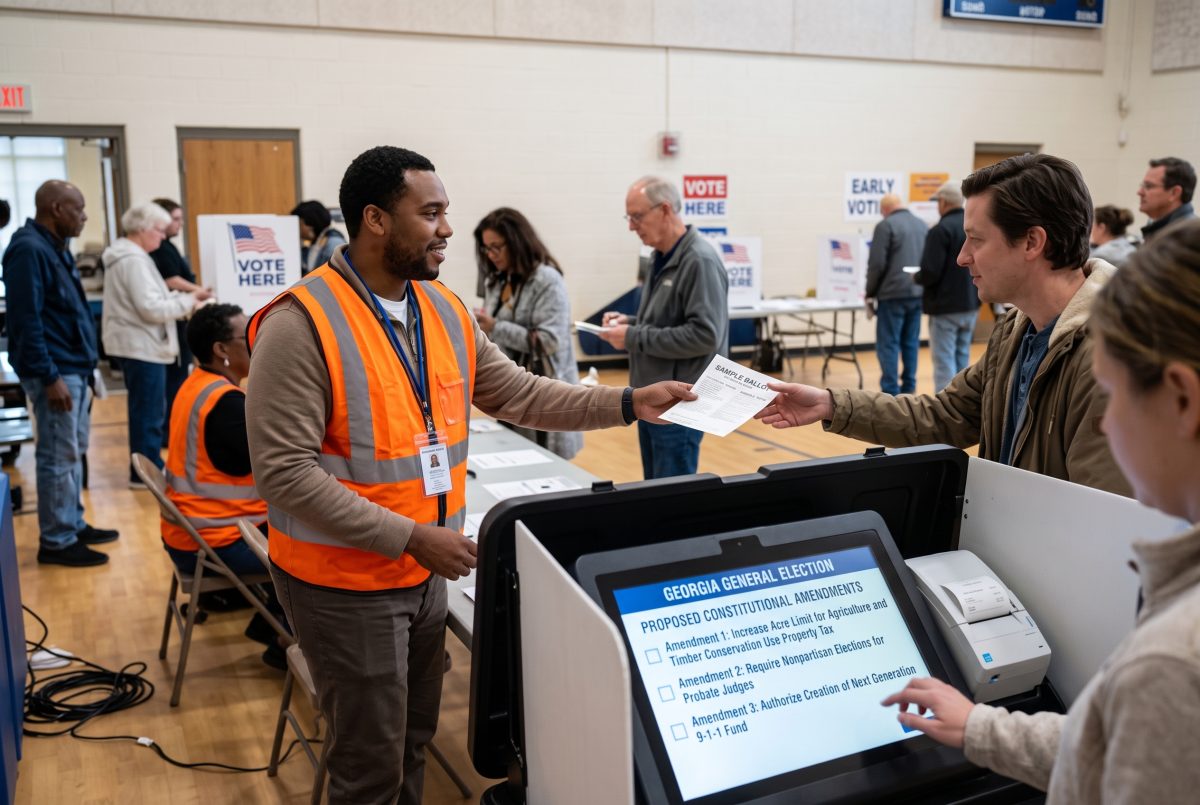
Early voting starts Tuesday, and every Georgia ballot ends with three proposed changes to the state constitution: a bigger property tax break for large farms and timberland, nonpartisan elections for probate judges, and a dedicated fund for upgraded 911 systems.
You may already know what they do. (If not, read our explainer: Georgia's 3 Constitutional Amendments on the Nov. 3 Ballot, Explained in Plain English.) Here are the next three questions voters ask: Which ones are likely to pass? Who's against them? And what happens if they fail?
No one has published a poll on the amendments, so no one knows for sure how they'll do. But the public record offers strong clues: how lawmakers voted, who is for and against each one, and how Georgians have voted on similar questions before.
Columbus Times does not endorse ballot measures. This is an analysis of the public record, not a prediction or a recommendation.
The big picture: Georgia voters usually say yes
An amendment needs a two-thirds vote in both the Georgia House and Senate just to reach the ballot. That high bar means most arrive with broad support, and voters usually approve them.
- From 1985 to 2024, 139 statewide measures went before Georgia voters. 112 passed and 27 failed, according to Ballotpedia. That's about 4 out of 5.
- Every statewide measure passed in 2018, 2020, 2022 and 2024. The last one to fail was in 2016, when voters rejected a plan to let the state take over "chronically failing" public schools.
- But some pass by a hair. In 2024, an amendment creating a statewide Georgia Tax Court passed with just 52% of the vote. When voters don't know much about a question, the margin can get thin.
Amendment 3: Money for upgraded 911 systems
What it does: Lets the legislature create a Georgia Next Generation 9-1-1 Fund and dedicate money to it. The money could be used only to expand, maintain and run the state's 911 systems, including the move to a digital system that can handle texts, photos and video and better pinpoint callers on cellphones.
Will it pass? It has the clearest path of the three.
- Unanimous final votes: 162-0 in the House and 49-0 in the Senate.
- Support from both parties: House Speaker Jon Burns (R), Senate Minority Leader Harold Jones (D) and Columbus state Rep. Carolyn Hugley (D), along with the Georgia Emergency Communications Authority and the Georgia Municipal Association.
- Recent fund amendments have passed easily. Since 1990, Georgians have voted on nine amendments that create a dedicated fund. Seven passed. The three most recent passed with 83% (Outdoor Stewardship, 2018), 83% (Safe Harbor for exploited children, 2016) and 70% (brain and spinal injuries, 2014). The two that failed were in the 1990s.
- "We hear many stories: They call 911, a person may not answer," Jones said. "This is what we're hoping to actually change."
Who's against it? No one, as far as the public record shows. Ballotpedia has found no campaign, committee or arguments against Amendment 3.
What happens if it fails? Georgia's 911 upgrade doesn't stop. A 2025 law, passed unanimously, already requires the state to move to a Next Generation 911 system. But there would be no protected fund. Lawmakers would have to find money for 911 in the regular state budget each year, where it would compete with everything else, and the money wouldn't be locked in for 911 only.
Amendment 1: A bigger tax break for large farms and timberland
What it does: Doubles the maximum acreage one owner can enroll in Georgia's "conservation use" property tax program, from 2,000 to 4,000 acres. Enrolled land is taxed at 40% of its value as farm or timber land. In exchange, owners must keep it in farming, timber or conservation for 10 years.
Will it pass? It looks likely.
- Nearly unanimous votes: 168-5 in the House and 50-1 in the Senate.
- Georgia voters have been saying yes to tax breaks. In 2024, a homestead property tax break passed with 63%, and a measure raising the personal property tax exemption passed with 64%.
- Supporters' argument is simple. "Agriculture has changed. Our family farms are getting much larger today," said state Sen. Sam Watson (R). Supporters include several Republican state senators and the national group Americans for Tax Reform.
Who's against it? No organized opposition has surfaced. Ballotpedia has found no campaign or arguments against it. The question voters may ask on their own: who benefits? The tax break mainly helps owners of large tracts, and most Georgians live in cities and suburbs. Because more land would be taxed at the lower rate, it could also reduce the property tax collected on that land, which helps pay for local governments and schools.
What happens if it fails? Nothing changes. The limit stays at 2,000 acres per owner, and the conservation-use program keeps working as it does today. Land already enrolled keeps its tax break.
Amendment 2: Nonpartisan elections for probate judges
What it does: Requires all probate judges to run without a party label. Probate judges handle wills, estates, guardianships and marriage licenses, and they are the last judges in Georgia who still run as Democrats or Republicans.
Will it pass? It has the most high-profile support, but it's the one to watch.
- The longest list of named supporters, including Georgia Supreme Court Chief Justice Nels Peterson, U.S. Rep. Buddy Carter (R), state Sen. Brian Strickland (R), and many mayors, among them Columbus Mayor B.H. "Skip" Henderson III. Former Govs. Nathan Deal (R) and Roy Barnes (D) back it too.
- A simple pitch. Probate courts handle "wills, estates, guardianships, marriage licenses, mental health commitments, and other deeply sensitive issues," supporters wrote in an open letter to voters. "These responsibilities are not inherently political."
- The final Senate vote was 46-0.
Who's against it? It's the only one of the three with named opposition:
- State Rep. Charlice Byrd (R) argues voters deserve to know where judges stand. "I believe that we need to know as individuals where you stand on issues," she said.
- Americans for Tax Reform, the national conservative group, opposes it. (The same group supports Amendment 1.)
- It also had the bumpiest road through the legislature: it passed the House 147-20, with "no" votes from both parties, and it fell short of the needed two-thirds on its first Senate vote before passing later.
Some voters simply like party labels as a shortcut in races where they don't know the candidates. Taking the label away can feel like losing information.
What happens if it fails? Probate judges keep running as Democrats or Republicans in each county. It would also undo a related change: a 2025 law that makes magistrate judges run without party labels is written to take effect only if Amendment 2 passes. If Amendment 2 fails, that law is repealed, and magistrate elections stay as they are now.
The bottom line
| Final legislative votes | Who's against it | If it fails | |
|---|---|---|---|
| Amendment 3 (911 fund) | House 162-0, Senate 49-0 | No one found | 911 upgrade continues, but no protected fund |
| Amendment 1 (farmland tax break) | House 168-5, Senate 50-1 | No organized opposition | Limit stays at 2,000 acres |
| Amendment 2 (probate judges) | House 147-20, Senate 46-0 | Rep. Charlice Byrd (R); Americans for Tax Reform | Probate judges stay partisan; magistrate change is repealed |
Amendment 3 has the clearest path. Amendment 1 looks likely, given near-unanimous votes and Georgia's recent record on tax breaks. Amendment 2 has the most high-profile support, but it's the only one with a "no" side, which makes it the one to watch on election night.
Still, history says all three start with the odds in their favor. The final say is yours.
How to vote
- Early voting: Tuesday, Oct. 13, through Friday, Oct. 30. In Columbus, the City Services Center (3111 Citizens Way), Shirley Winston Recreation Center (5025 Steam Mill Road) and the Elizabeth Bradley Turner Center at Columbus State University (4225 University Ave.) are open the whole period.
- Election Day: Tuesday, Nov. 3, 7 a.m. to 7 p.m.
- See your ballot: mvp.sos.ga.gov
- You don't have to vote on every question. Skipping an amendment doesn't cancel the rest of your ballot.
Read more: Georgia's 3 Constitutional Amendments on the Nov. 3 Ballot, Explained in Plain English; Early Voting in Columbus Starts Oct. 13; Voting in Georgia: 12 Questions Answered in Plain English.
Columbus Times does not endorse candidates or ballot measures.
News organizations may republish this story with credit. See our guidelines.
Know someone who'd want to read this? Email it to a friend.
Own a Columbus business? Reach 40,000+ monthly readers. Ads from $125/month. See ad optionsPlan your weekend with Columbus Times
Get This Weekend in Columbus every Thursday: the best local events, free things to do and family fun, plus each evening's local news. Free, and you can unsubscribe anytime.
More stories
 Politics 550,000 Georgians Dropped Marketplace Coverage This Year: Doctors, Ossoff and Collins Split Over Who's to Blame
 Politics Which of Georgia's 3 Amendments Is Most Likely to Pass? What the Votes, Supporters and History Say
 Politics Georgia Governor's Race: Bottoms vs. Jackson on Taxes, Schools, Health Care and Jobs, in Their Own Words
 Politics Your Georgia Power Bill Is on the Ballot: The Public Service Commission Races, Explained in Plain English