Your Georgia Power Bill Is on the Ballot: The Public Service Commission Races, Explained in Plain English

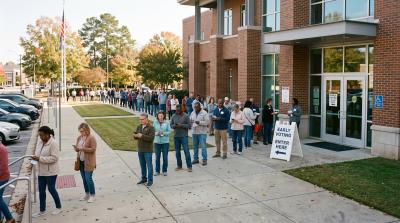
Illustration: AI-generated
Near the bottom of your Nov. 3 ballot, below the races for governor and U.S. Senate, are two contests most Georgians have never thought much about. They may affect your wallet more directly than almost anything else you vote on.
They're the races for the Georgia Public Service Commission, the five-member board that decides how much Georgia Power can charge you for electricity.
This year, control of the commission is up for grabs. Here's what the PSC does, why these races matter, and who's running, in plain English.
What the Public Service Commission does
The PSC regulates privately owned utilities in Georgia. The biggest one by far is Georgia Power, the only investor-owned electric company in the state.
When Georgia Power wants to raise rates, build a new power plant or pass along costs like fuel and storm repairs, the PSC has to approve it. The commission also regulates some natural gas and telephone companies.
Does this affect my bill? If your electricity comes from Georgia Power, yes. If it comes from an electric membership corporation (EMC) or a city-owned utility, the PSC doesn't set your electric rates. Those are set by the EMC's or city's own board. Check the name at the top of your power bill.
Why it matters now
Bills have gone up. Since late 2022, the PSC approved six rate increases that raised the average Georgia Power residential bill by about $43 a month, or about $516 a year.
Rates are frozen, but not completely. In July 2025, the commission approved a freeze on Georgia Power's base rates through 2028. But the freeze doesn't cover everything. Costs such as fuel and repairs from Hurricane Helene, the most damaging storm in Georgia Power's history, can still be passed on to customers separately.
Data centers are driving huge growth. In December 2025, the commission approved Georgia Power's plan to build nearly 10,000 megawatts of new power generation, about $16 billion worth. About 80% is expected to serve data centers, the giant computer facilities that power artificial intelligence and the internet. The agreement says serving data centers shouldn't raise rates for current customers, and Georgia Power agreed to cover the costs through 2031 if data center demand doesn't show up as expected. Whether those protections are strong enough is the central debate in this election.
The next big decisions are coming. PSC members serve six-year terms. The people elected this fall will help decide what happens when the rate freeze ends after 2028.
The balance of power
Republicans held every PSC seat for years. That changed in November 2025, when Democrats Alicia Johnson and Peter Hubbard each won about 61% of the vote in special elections. They were the first Democrats elected to a statewide state office in Georgia since 2006.
The commission now has a 3-2 Republican majority. Two seats are on the ballot this year:
- If Democrats win both, they take control of the commission.
- If Republicans win either one, they keep the majority.
Who's running
Every Georgia voter votes in both races, no matter where you live. The candidates must live in the district they represent, but the elections are statewide.
District 3
Peter Hubbard (Democrat, incumbent)
Hubbard won this seat in 2025 by defeating Fitz Johnson. Before joining the commission, he developed solar and other renewable energy projects. He says he's running for "lower power bills, reliable clean energy," and has argued Georgia is "oversubscribed on fossil fuels." He has criticized a recent data center power contract as lacking "sufficient financial guardrails," according to the Columbus Ledger-Enquirer.
Fitz Johnson (Republican)
Johnson is a former PSC commissioner who was appointed by Gov. Brian Kemp and served until losing to Hubbard in 2025. He's a 21-year Army veteran and businessman. He points to the commission's vote to freeze base rates for three years and its safeguards requiring large power users such as data centers to cover the costs of serving them.
District 5
This seat is open because Republican Commissioner Tricia Pridemore is running for Congress instead of re-election.
Shelia Edwards (Democrat)
Edwards is a community advocate who says affordability is her top priority. On data centers, she says "they must pay the full cost of the infrastructure needed to serve them - not shift those costs onto residential customers."
Josh Tolbert (Republican)
Tolbert is an engineer who has worked in the energy industry. He says data centers should "pay more for their costs" and that commission decisions should be based on "engineering, economics, evidence."
Thomas Blooming (Libertarian) is also on the District 5 ballot.
The bottom line
| What a win would mean | |
|---|---|
| Democrats win both seats | Democrats take control of the PSC, 3-2. |
| Republicans win at least one seat | Republicans keep the majority. |
Both parties' candidates say data centers should pay their own way. Where they differ is how much they trust the current safeguards, how quickly Georgia should add natural gas versus solar and other clean energy, and how hard to push back on Georgia Power.
How to vote
- Early voting in Columbus: Tuesday, Oct. 13, through Friday, Oct. 30, 7 a.m. to 7 p.m. (See our full guide: Early Voting in Columbus Starts Oct. 13: Every Site, the Hours, and What's on Your Ballot.)
- Election Day: Tuesday, Nov. 3, 7 a.m. to 7 p.m.
- See your sample ballot: mvp.sos.ga.gov

News organizations may republish this story with credit. See our guidelines.
Know someone who'd want to read this? Email it to a friend.
Own a Columbus business? 60,000+ page views a month. Ads from $125/month. See ad options Follow Columbus Times on FacebookLocal news, events and people, in your feed every day.Most read this week
- Georgia Spent $165.7 Million on Medicaid Work Requirement Program, but Only 18,527 Were Enrolled After 3 Years
- 8 Columbus Restaurants Got a C on Their Health Inspection in 2026, the Most of Any Year Since 2022. Here's Every One
- The Night Fight on the Chattahoochee: How Columbus Became the Site of What Many Call the Last Battle of the Civil War
- The 10 Best Mexican Restaurants in Columbus, Ga., Ranked by Diners
- Columbus' Top-Rated Barbecue: 12 BBQ Joints Ranked by Google Stars and Health Scores
More stories
 Politics How Columbus Has Voted: Muscogee County's Results in 19 Presidential Races Since 1952
 Politics Who's on Your Ballot? 5 Georgia House Districts and the Open Senate 15 Race in Columbus
 Politics 3,466 Columbus Voters Cast Ballots on Day One: Early Voting by the Numbers
 Politics Georgia Election Forecast 2026: Who Is Projected to Win Every Major Race?
Comments
Be respectful. No personal attacks, hate speech, spam or anyone's private information. Every comment is reviewed before it appears. Comment rules
No comments yet. Be the first to share your thoughts.