550,000 Georgians Dropped Marketplace Coverage This Year: Doctors, Ossoff and Collins Split Over Who's to Blame
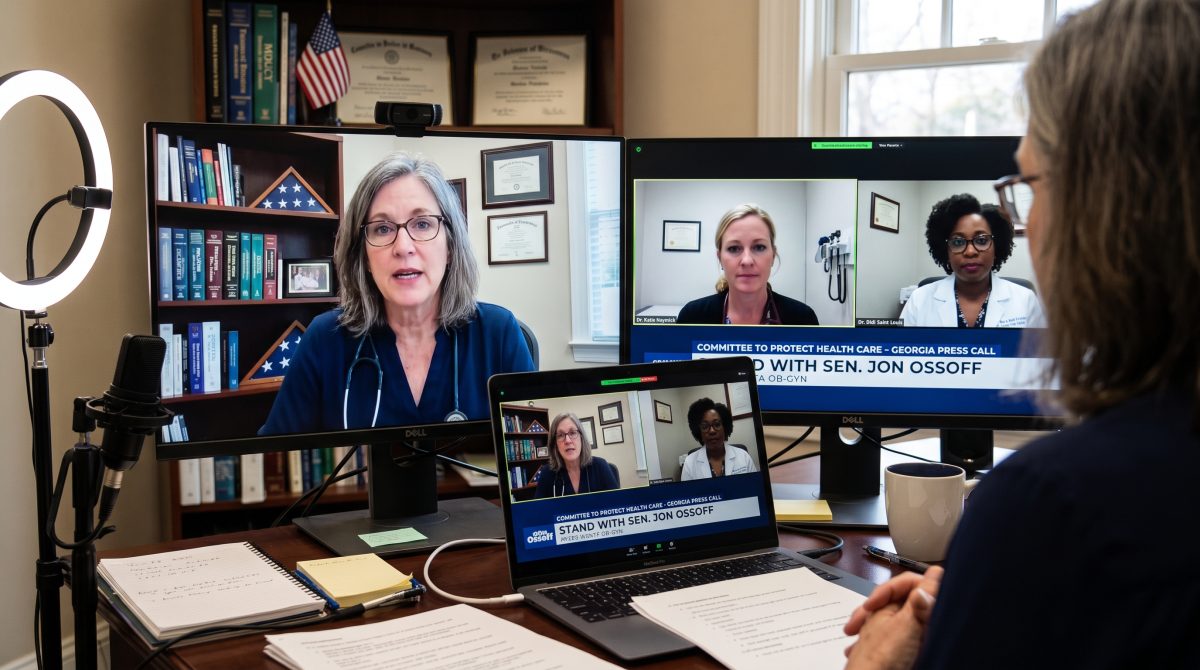
A group of Georgia doctors on Friday sided with Democratic U.S. Sen. Jon Ossoff on health care, a day after he and Republican challenger U.S. Rep. Mike Collins clashed over insurance costs, Medicaid and hospital closures in their first debate.
The doctors spoke on a virtual call organized by the Committee to Protect Health Care, a national advocacy group of physicians that works to "elect health care champions." The call came as more than half a million Georgians have dropped their marketplace health coverage since enhanced federal tax credits expired at the end of 2025.
Ossoff and Collins are on every Columbus ballot for the Nov. 3 election. Early voting starts Tuesday, Oct. 13.
What the doctors said
Three physicians spoke on the call, and all three backed Ossoff.
"In last night's Senate debate, we saw very different approaches on this topic from Senator Jon Ossoff and Representative Mike Collins," said Dr. Mimi Zieman, an OB-GYN in Atlanta. "As a physician, I want a senator who understands that health care isn't a luxury. It's the foundation that allows people to work, raise their families and live healthy lives."
Dr. Katie Naymick, a family doctor in Calhoun, said she has seen the effects of the expired tax credits at a free clinic where she volunteers.
"Since these tax credits have expired as of December 31, we saw premiums double. We saw deductibles — even if they could afford the premiums — the deductibles were outrageous," Naymick said. "Since January we've had triple the amount of patients try to come into this clinic. But we don't have enough doctors and mid-level providers to volunteer to service this."
Dr. Didi Saint Louis, an OB-GYN in Roswell, raised an issue she said didn't come up in the debate: reproductive health care. She pointed to the closing of the labor and delivery unit at St. Mary's Sacred Heart Hospital in Lavonia, in Collins' congressional district.
"We want a senator who trusts doctors, who trusts that women know how to take care of themselves and will make the best decisions for themselves and their families," Saint Louis said.
What the candidates said in the debate
The one-hour debate on Thursday, Oct. 8, was hosted by Atlanta News First and aired statewide on Gray Media stations. Health care was one of its sharpest fights.
Ossoff blamed Republicans for letting the enhanced Affordable Care Act tax credits expire and for Medicaid cuts in last year's Republican budget law, which Collins voted for. He called for expanding Medicaid in Georgia.
"The Congressional Budget Office warned us that if they pass this bill, health insurance premiums would skyrocket, that if they pass this bill, rural hospitals would have to close down services," Ossoff said, according to The Center Square. "He still refuses tonight to explain why he voted to double your health insurance premiums."
Collins defended his vote for the law, which Republicans call the "One Big Beautiful Bill," pointing to its $50 billion rural hospital fund. He blamed the Affordable Care Act itself for rising costs.
"The Affordable Care Act is what has caused your insurance to go sky high. Our premiums have gone through the roof and your coverage has gone through the floor," Collins said, according to CBS Atlanta.
Collins said he would push for more transparency in insurance and drug prices, and praised TrumpRx, the federal prescription drug pricing site. "The only people that get subsidized are our insurance companies and they make more money off of you and me while our insurance coverage goes down," he said.
Checking the claims
"Over half a million Georgians" without the coverage they had: this matches state data. Georgia's marketplace enrollment fell 37%, from about 1.5 million people in January 2025 to about 950,000 as of April 17, 2026, according to data obtained by The Current GA and the Georgia Recorder. That's roughly 550,000 fewer people. The data counts people who dropped or lost marketplace plans. It doesn't show how many found other coverage, such as a job-based plan.
"Premiums double": that's true for some people, but not on average. Nationally, what enrollees actually pay each month after tax credits rose an average of 58%, from $113 to $178, according to KFF, a nonpartisan health policy research group. The increase was much bigger for some, especially middle-income people who lost their subsidy entirely. KFF found the average deductible climbed to a record $3,786.
The Lavonia hospital: St. Mary's Sacred Heart closed its labor and delivery unit in October 2025. The hospital cited federal Medicaid cuts as one reason, along with physician recruitment challenges and changing demographics, factors that predated the law.
The $50 billion fund: the Republican law includes a $50 billion fund for rural health care. Supporters say it helps rural hospitals. Critics, including Ossoff, say it's far smaller than the law's Medicaid cuts.
What it means in Columbus
Even before the tax credits expired, health coverage was a bigger problem here than in most of the country:
- 10.7% of Columbus residents had no health insurance in 2024, according to the Census Bureau. Nationally it was 8.2%, and in Georgia it was 12.0%.
- Among working-age adults, ages 19 to 64, 16.9% of Columbus residents were uninsured, compared with 11.3% nationally.
Those numbers are from before this year's coverage losses, so the share may be higher now.
Georgia is one of a handful of states that hasn't fully expanded Medicaid to cover low-income adults, an issue both campaigns have argued about. Ossoff supports expansion. Collins has not called for it.
About the group
The Committee to Protect Health Care describes itself as a national group of doctors and health professionals working to build "a pro-patient health care majority in Congress and in states." It is a 501(c)(4) organization, a type of nonprofit allowed to do political advocacy. Its website says it works to "elect health care champions" and "hold anti-health care politicians accountable," and it supports expanding health care and abortion access. On this call, it featured doctors supporting Ossoff.
What's next
- Tuesday, Oct. 13: Ossoff and Collins meet again in the Atlanta Press Club's Loudermilk-Young Debate Series.
- Tuesday, Oct. 13: early voting begins in Columbus and across Georgia.
- Tuesday, Nov. 3: Election Day.
See every race on your ballot: Your Nov. 3 Ballot in Muscogee County: Every Race on It, in Plain English
News organizations may republish this story with credit. See our guidelines.
Know someone who'd want to read this? Email it to a friend.
Own a Columbus business? Reach 40,000+ monthly readers. Ads from $125/month. See ad optionsPlan your weekend with Columbus Times
Get This Weekend in Columbus every Thursday: the best local events, free things to do and family fun, plus each evening's local news. Free, and you can unsubscribe anytime.
More stories
 Politics Your Nov. 3 Ballot in Muscogee County: Every Race on It, in Plain English
 Politics Which of Georgia's 3 Amendments Is Most Likely to Pass? What the Votes, Supporters and History Say
 Politics Voting in Georgia: 12 Questions Answered in Plain English
 Politics Georgia Governor's Race: Bottoms vs. Jackson on Taxes, Schools, Health Care and Jobs, in Their Own Words