Columbus’s Oldest Businesses Still Open: 10 That Have Lasted 75+ Years
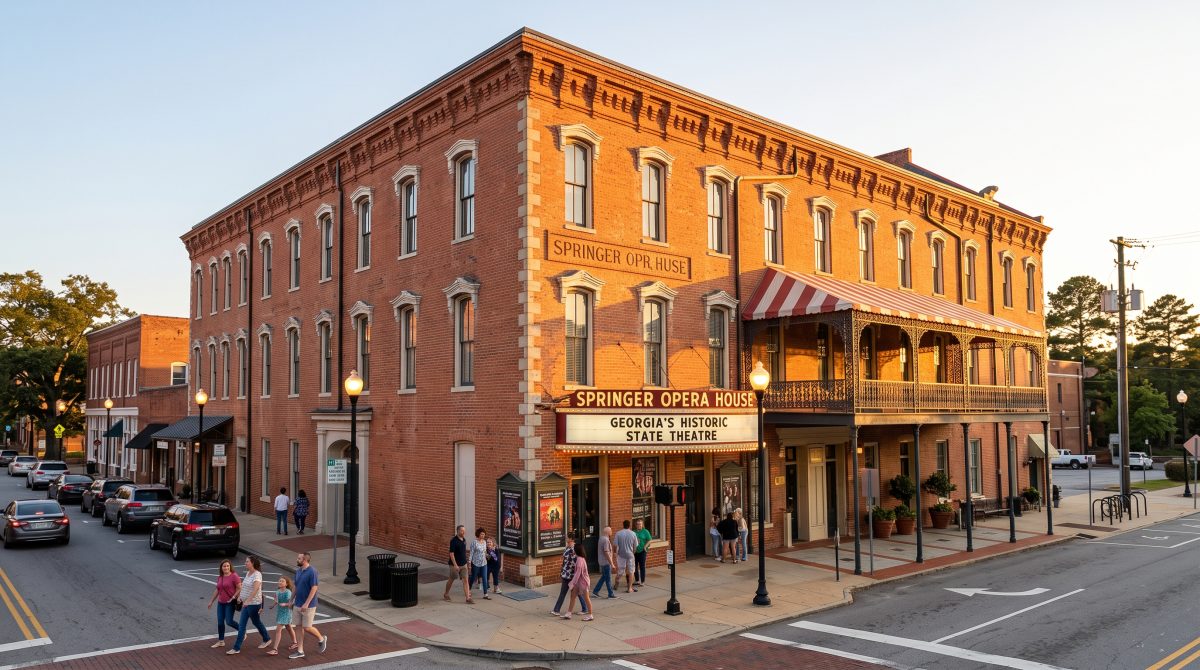
The historic Springer Opera House in downtown Columbus, Georgia, opened in 1871 and stands as one of the city's oldest surviving cultural institutions.
Some Columbus businesses have been around longer than the automobiles, shopping centers and neighborhoods that now surround them. A handful date back to the 1800s, when cotton mills powered the local economy and the Chattahoochee River carried goods between communities. Others survived the Great Depression, two world wars, economic downturns and decades of changing consumer habits.
While hundreds of businesses have opened and closed across Columbus over the generations, these 10 have histories stretching back at least 75 years. Some remain family-owned, while others have survived mergers, ownership changes or major transformations. Together, their histories tell the story of how Columbus grew from a riverfront trading town into a regional center for banking, manufacturing, commerce and culture.
This list includes businesses, commercial institutions and their surviving successors with documented Columbus roots before 1951. It is not a definitive ranking of every surviving business, and several entries have changed ownership, names or operating models over time.
1. Columbus Ledger-Enquirer — 1828 (198 Years)
One of Columbus’s oldest surviving commercial institutions is its longtime newspaper, the Columbus Ledger-Enquirer. Its history began in 1828 with the founding of the Columbus Enquirer, the same year Columbus was established. The Columbus Ledger followed in 1886, and the two newspapers eventually became a single publication in 1988.
Over nearly two centuries, the newspaper has documented wars, elections, industrial expansion, economic downturns and major changes throughout the Chattahoochee Valley. Its ownership changed again in July 2026, when the Georgia Trust for Local News purchased the Ledger-Enquirer from McClatchy. The newspaper continues operating, although the modern publication is the product of mergers and transformations rather than an unchanged business established in 1828.
2. Willcox-Lumpkin Co. — 1848 (178 Years)
Insurance agency Willcox-Lumpkin traces its history to 1848, making it one of Columbus’s oldest documented commercial enterprises. Historical city directories identify the business as an insurance agency that protected homes, businesses and property long before automobiles became common. The company remained associated with generations of the Willcox and Lumpkin families.
Its history is supported by advertisements appearing in Columbus directories more than a century ago. Georgia Secretary of State records currently list Willcox-Lumpkin Co. as active and in compliance, with its corporate registration dating to December 1923. That distinction matters because the business’s claimed operating history is considerably older than its present corporate registration.
3. Springer Opera House — 1871 (155 Years)
The Springer Opera House opened in 1871 and became one of the city’s most important entertainment destinations. Built by businessman Francis Joseph Springer, the theater attracted nationally recognized performers and helped establish Columbus as a cultural center. Its ornate Victorian architecture remains one of downtown’s most recognizable landmarks.
The Springer nearly disappeared during the 1960s after declining attendance and years of deterioration. Preservationists rescued the building, and theatrical performances returned in 1965. Although it has not operated continuously in the same form, the Springer remains an active performing arts institution and an example of how historic properties can find new economic life.
4. Schomburg’s Jewelers — 1872 (154 Years)
Few Columbus retailers can claim a family history as long as Schomburg’s Jewelers. Carl Frederick Schomburg established the jewelry business in 1872 after working as a clockmaker, and the company gradually expanded into watches, jewelry and other luxury goods. Five generations of the family have been associated with the business.
Today, Schomburg’s operates on Rollins Way and identifies itself as Georgia’s oldest fifth-generation jeweler. Its longevity reflects a business model built around specialized craftsmanship, customer relationships and family continuity. While many traditional jewelry stores have disappeared or become part of national chains, Schomburg’s has maintained a recognizable local identity.
5. Goldens’ Foundry & Machine Co. — 1882 (144 Years)
Two brothers, Theodore and J. Poitevent Golden, established Goldens’ Foundry & Machine Co. in 1882. The company began as a small foundry and machine shop during an era when Columbus was expanding rapidly as a manufacturing center. Its products helped supply the machinery and industrial equipment needed by businesses throughout the region.
More than 140 years later, the business remains associated with descendants of its founders. Goldens’ continues manufacturing industrial castings while also developing consumer products through its Goldens’ Cast Iron brand. Its survival is especially significant because many of the textile mills and industrial operations that helped create its original market have long since closed.
6. W.C. Bradley Co. — 1885 (141 Years)
The W.C. Bradley Co. traces its origins to 1885, when William Clark Bradley entered the cotton business in Columbus. Over time, his growing enterprise expanded into groceries, fertilizer, transportation, manufacturing and financial services. The company eventually became one of the most influential business organizations in the Chattahoochee Valley.
Its business interests helped shape the development of modern Columbus, including the city’s banking and manufacturing sectors. The company also became closely associated with Char-Broil, the nationally recognized outdoor cooking brand. Today, W.C. Bradley Co. maintains its corporate headquarters near the Chattahoochee River, continuing a business legacy that began when cotton dominated the regional economy.
7. Synovus Banking Legacy — 1888 (138 Years)
The banking institution that became Synovus began in 1888 with the establishment of two Columbus banks. According to company history, the idea developed partly from the need to provide textile workers with a safe place to keep their earnings. Those early banking operations eventually evolved into Columbus Bank and Trust and later Synovus Financial Corporation.
A major change occurred in January 2026 when Synovus merged with Pinnacle Financial Partners, ending its existence as an independent corporation. The combined organization continues serving Columbus customers under the Synovus name during the transition to Pinnacle branding, which is scheduled for 2027. Pinnacle also announced plans in June to expand its downtown Columbus workspace, reinforcing the city’s continued importance to the banking operation.
8. Dinglewood Pharmacy — 1918 (108 Years)
Dinglewood Pharmacy opened on November 13, 1918, and became one of Columbus’s most recognizable neighborhood businesses. While generations of customers have visited for prescriptions and pharmacy services, the business is equally famous for its traditional lunch counter. Its signature scrambled dog has become closely associated with Columbus food culture.
The pharmacy celebrated its centennial in 2018, an achievement relatively few independent neighborhood businesses reach. Its ability to combine traditional pharmacy services with a popular local dining experience has helped preserve its reputation across generations. Dinglewood remains an especially visible example of a business whose appeal extends well beyond the original service it was established to provide.
9. Striffler-Hamby Mortuary — 1923 (103 Years)
Striffler-Hamby Mortuary traces its business history to 1923, when David Abraham Striffler opened his own funeral establishment in downtown Columbus. Striffler had entered the local funeral industry in 1908 before eventually establishing an independent operation. In 1930, he moved the business into a building constructed specifically for funeral services.
The mortuary became an established name as generations of Columbus families turned to it for funeral arrangements. Today, the business operates as part of the Dignity Memorial network, showing how a longstanding local institution can continue under different corporate ownership. Its history also offers a look at how funeral services evolved from small undertaking establishments into modern funeral homes.
10. WRCG Radio, Originally WRBL — 1928 (98 Years)
Columbus entered the broadcasting era on May 10, 1928, when WRBL began transmitting radio programs to local listeners. The station was established through the efforts of early radio pioneer Bill Lewis and became the city’s first radio broadcasting operation. Its original programming helped bring news, entertainment and live events into Columbus homes.
The station eventually changed ownership, frequencies and call letters, becoming WRCG in 1977. Historical research by Columbus State University and Historic Columbus confirms the connection between the original WRBL radio operation and its later identity. Today, WRCG represents a surviving broadcasting legacy that predates television’s arrival in Columbus by approximately 25 years.
What These Businesses Reveal About Columbus
The survival of these institutions reflects the major industries that shaped Columbus over nearly two centuries. Banking, manufacturing, retail, insurance, entertainment and communications all played important roles in the city’s economic development. Several businesses adapted to changing markets, while others survived by maintaining relationships with generations of local customers.
Their histories also demonstrate that longevity does not necessarily mean remaining unchanged. Some businesses were acquired by larger corporations, others moved into new industries, and several preserved their names despite major changes in ownership. For Columbus residents, these institutions provide a tangible connection to the city’s past while continuing to influence its economic and cultural identity.
Source: Historic Columbus Foundation; Columbus State University Archives and Special Collections; Georgia Historical Society; New Georgia Encyclopedia;

News organizations may republish this story with credit. See our guidelines.
Know someone who'd want to read this? Email it to a friend.
Own a Columbus business? 60,000+ page views a month. Ads from $125/month. See ad optionsPlan your weekend with Columbus Times
Get This Weekend in Columbus every Thursday: the best local events, free things to do and family fun, plus each evening's local news. Free, and you can unsubscribe anytime.
Most read this week
- Georgia's 3 Amendments: Which Will Pass, Who's Against Them, and What Happens If They Fail
- Georgia's 3 Constitutional Amendments on the Nov. 3 Ballot, Explained in Plain English
- Early Voting in Columbus Starts Oct. 13: Every Site, the Hours, and What's on Your Ballot
- USDA Awards $3.3 Billion Loan for Georgia Power Plant to Meet Rising Electricity Demand
- Georgia Election Forecast 2026: Who Is Projected to Win Every Major Race?
More stories
 Community What's Open and Closed in Columbus on Columbus Day, Monday, Oct. 12
 Community Fort Benning Graduation in Columbus: Your Family's Guide to the Ceremony, the Gate, Hotels and Food
 Community Georgia Extends Gas Tax Suspension Through November 5: How Much Could Drivers Save?
 Community Is Columbus Safer Than It Was 5 Years Ago? What the Numbers Show
Comments
Be respectful. No personal attacks, hate speech, spam or anyone's private information. Every comment is reviewed before it appears. Comment rules
No comments yet. Be the first to share your thoughts.