Fort Benning Fires 4 Kinds of Shotgun Shells at 3D-Printed Drones Diving From 100 Feet as the Army Looks for a Close-In Drone Defense
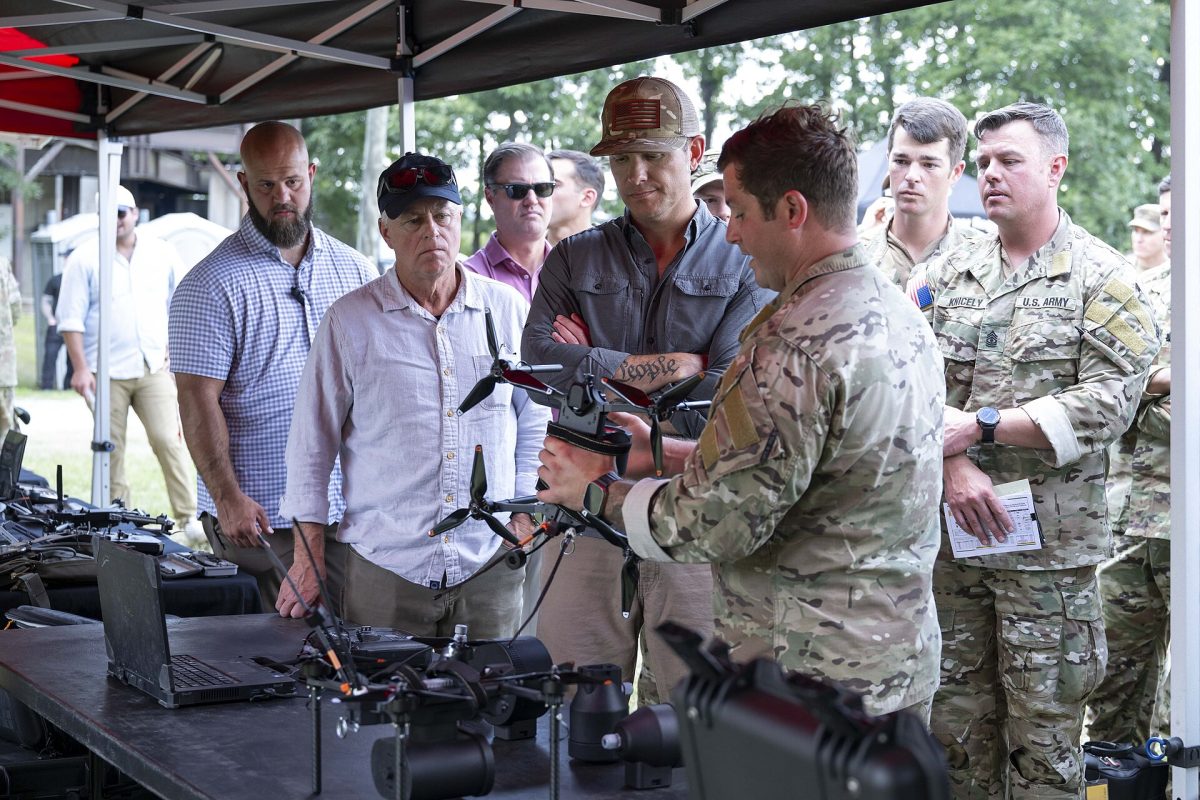
A soldier shows a small drone to visitors during a small unmanned aircraft system demonstration at Fort Benning on Sept. 4, 2025. Photo: U.S. Secretary of Defense / Wikimedia Commons (Public domain)
COLUMBUS, Ga. - Soldiers at Fort Benning spent part of this fall shooting at drones on purpose, and the latest test put the shotgun back into the Army's search for a close-in defense. The Maneuver Battle Lab fired 4 kinds of 12-gauge shotshells at small, 3D-printed target drones on Bryant Range on Sept. 21 and 22, according to an Army article published Nov. 20. The Army has not said which round did best, and the lab plans to hand its findings to Army decision-makers before the end of 2026.
What Fort Benning tested
The shooters were marksmanship instructors from the Rifle Squad Master Trainer Course with Charlie Company, 1st Battalion, 29th Infantry Regiment, the Army said. They fired one government-issued 12-gauge target round, the kind traditionally used for skeet and trap shooting, along with three commercial rounds that the article did not name. According to the Army, the shells differed in recoil, pellet spread and shot material, all of which change how hard and how densely the pellets strike at a distance.
Operators flew the target drones from beyond the shooters' line of sight in three kinds of runs, the Army said. Drones crossed left to right about 25 meters in front of the firing line, flew straight in at low altitude and dove at the shooters from 100 feet. Analysts recorded how long each hit took, how many rounds were fired and how far away each successful hit happened.
"On today's modern battlefield, the biggest threat is drones, and we need a way to defeat them," Master Sgt. Jonathan Gallogly, the lab's noncommissioned officer in charge, said in the Army article. Gallogly said the team had been planning the event for about a year. Brian Dutton, a contract project officer at the lab, described it as a Soldier Enhancement Program effort in which the team nominates commercial off-the-shelf products, evaluates them and decides whether they work as they are or need more engineering.
One of several drone tests on post this year
The shotgun shoot was the second half of a pair. On Aug. 18 and 19, soldiers used M4 carbines to compare an experimental 5.56mm drone round with the Army's standard M855A1 ammunition, which served as the baseline, according to the Nov. 20 article. Taken together, the two events asked whether the weapons an infantry squad already carries can bring down small drones if they are loaded with different ammunition.
Fort Benning has also been testing drones as tools, not only as targets. From July 27 to Aug. 7, the Maneuver Battle Lab ran a two-week assessment of two commercial tethered drones at McKenna Field Landing Site, timing how fast they climbed and retracted and whether they could follow an Infantry Squad Vehicle, the Army reported Sept. 2. Because power and data run through the tether, the drones can stay aloft indefinitely, and the lab said its report would help leaders decide whether the Army should buy the technology.
Drones were also a theme at Fort Benning's Maneuver Warfighter Conference in September. Col. Richard R. Bell, commander of the 3rd Brigade Combat Team, 101st Airborne Division, told the conference his unit "used drones to create space for companies, platoons, and squads" during an April training rotation, according to the Army's Sept. 18 summary. The Army said the event in Marshall Auditorium drew senior leaders and subject-matter experts from across the globe.
Why shotguns and rifle rounds
The search for a cheap, short-range answer reaches well beyond Georgia. Soldiers from the XVIII Airborne Corps trained in April with a 5.56mm round that breaks into pieces in flight, made by a company called Drone Round, at Oak Grove Training Center in North Carolina, Task & Purpose reported April 14. Army photo captions from that training called the round "the last line of defense in a layered protection system," and at least one small quadcopter was destroyed, the outlet reported.
The Marine Corps is moving to buy the same family of ammunition. The War Zone reported June 4 that Marine Corps Systems Command posted a notice of intent to buy Drone Round's "L Variant" 5.56mm cartridge for M4 and M27 rifles through a sole-source contract, with an award projected for December 2026. The L Variant splits into five pieces and is effective to roughly 100 meters, according to the manufacturer as cited by The War Zone, well short of the M4's usual effective range of about 500 meters.
That trade-off sits at the center of what Fort Benning is measuring. Spreading shot or splitting a bullet raises the odds of hitting a small, fast target up close, but it gives up distance, which is why the lab recorded hit distance along with time and rounds fired. Dutton put the urgency plainly in the Army article: "Drone warfare is not an emerging threat: it's here."
What it means for Columbus
Being the place where the Army tries out these ideas also matters to the local economy. Choose Columbus, the area's economic development group, pitched Fort Benning to defense companies on Nov. 16, noting that the post hosts the Armor and Infantry schools and the 75th Ranger Regiment, and that about 2,000 soldiers leave it for civilian life each year, with more than 700 staying in the Columbus area. The group listed Columbus State University, Columbus Technical College and Auburn University as training partners for employers that hire those veterans.
What to watch
The Maneuver Battle Lab will compile the shotgun data and send its findings to the Maneuver Future Capability Directorate's Lethality Team and the Product Manager for Small Caliber Ammunition before the end of 2026, the Army said. That report will help Army leaders decide whether to pursue commercial products or government-standard solutions for frontline squads. Dutton said future work may look at the whole squad, including how it is equipped and trained to defeat small drones, rather than ammunition alone.
Source: U.S. Army (Nov. 20, Sept. 18, Sept. 2, 2026); Choose Columbus (Nov. 16, 2026); Task & Purpose (Apr. 14, 2026); The War Zone (June 4, 2026)

News organizations may republish this story with credit. See our guidelines.
Know someone who'd want to read this? Email it to a friend.
Plan your weekend with Columbus Times
Get This Weekend in Columbus every Thursday: the best local events, free things to do and family fun, plus each evening's local news. Free, and you can unsubscribe anytime.
By signing up you agree to get the Columbus Times email newsletter. Unsubscribe anytime with one click.




Comments
Be respectful. No personal attacks, hate speech, spam or anyone's private information. Every comment is reviewed before it appears. Comment rules
No comments yet. Be the first to share your thoughts.