Columbus's Linwood Cemetery at 198: The 1828 Burial Ground and Its Estimated 14,000-18,000 Graves
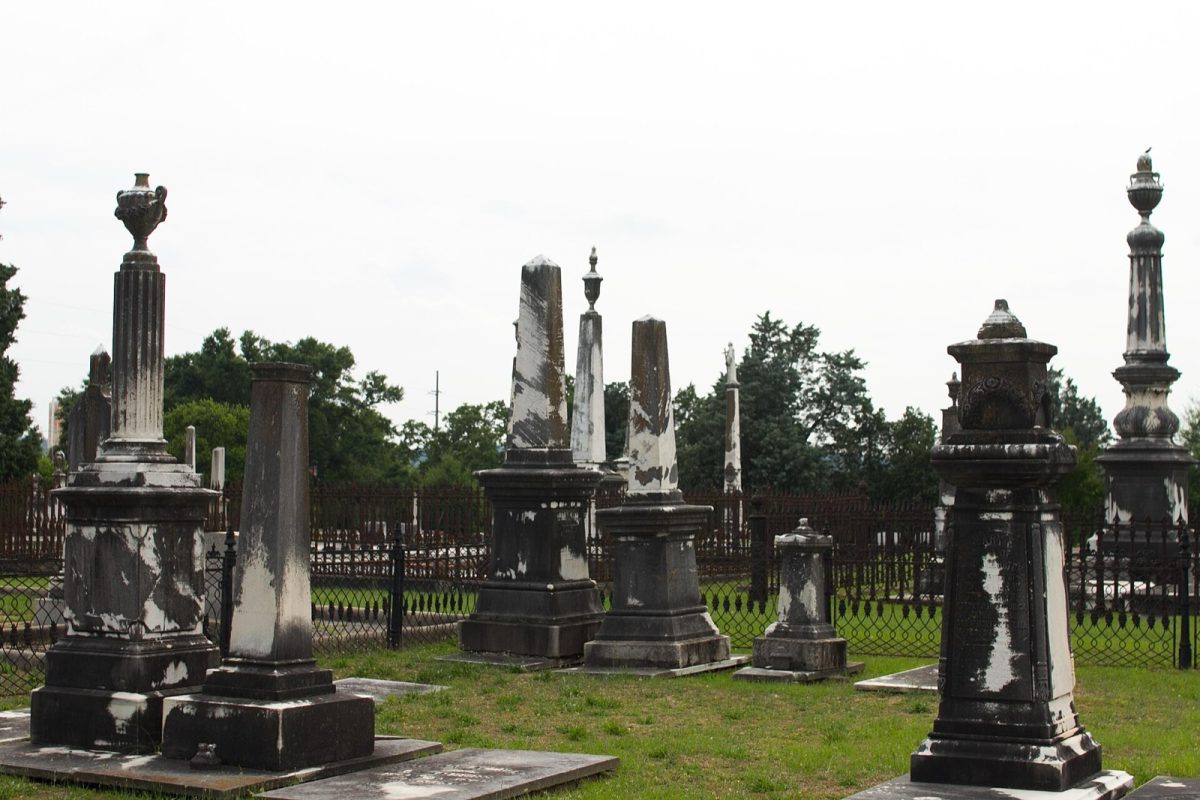
Tall marble monuments and obelisks stand in family plots at Linwood Cemetery, also known as Old City Cemetery, in Columbus. Photo: Cynthia Jennings / Wikimedia Commons (CC BY-SA 3.0)
COLUMBUS, Ga. - Linwood Cemetery has stood in Columbus for 198 years, dating to 1828, and contains an estimated 14,000 to 18,000 gravesites. The 28.7-acre burial ground at 721 Linwood Boulevard is Columbus's oldest public cemetery, according to a 1978 National Register survey. Its history reaches from the original survey of Columbus through the Civil War, the growth of local industry and nearly two centuries of public remembrance.
Also called Old City Cemetery, Linwood received its present name in 1894 and joined the National Register of Historic Places in 1980. The cemetery contains elaborate stone monuments, family burial plots and graves of people who helped shape Columbus and the nation. Today, the City of Columbus owns the property, while the nonprofit Historic Linwood Foundation helps preserve its monuments and share its history.
1828: A Cemetery Older Than Columbus City Government
Linwood appeared in surveyor Edward Lloyd Thomas's original plan for Columbus in 1828. His son Truman Thomas, who was assisting with the survey, became ill and died on March 26, 1828. Thomas buried his son in the area set aside for the town cemetery, although the location of Truman's grave is not known, and Edward Lloyd Thomas himself is not buried at Linwood.
The Historic Linwood Foundation describes the cemetery as the oldest institution of Columbus city government. According to the foundation, the burial ground began functioning four months before the city was created. That timeline places Linwood's origins at the beginning of Columbus's recorded municipal history.
The cemetery's history may extend even further into the past. A 1978 historical survey reported that historian William Clyde Woodall knew of marked graves older than Truman Thomas's burial. Woodall thought some older graves might be those of "early traders, river people, and Indians," so the burial ground may be older than the city.
1840-1854: Four Irish Stone Carvers Arrive
Linwood's monuments provide a record of the stone-carving trade in 19th-century Columbus. According to the Historic Linwood Foundation, 133 monuments are signed by artists or attributed to four Irish immigrant carvers who settled in Columbus in the 1800s. The 1978 survey lists sculpture and art among the cemetery's areas of significance.
Patrick Adams appears in records beginning in 1840, while John Madden arrived in Columbus in 1844. Thomas Kenny followed in 1852, and Henry McCauley arrived in 1854. At least 79 monuments bear McCauley's signature, making him particularly well represented among the identified carvers.
The cemetery contains simple carved headstones alongside Victorian Gothic and Egyptian Revival monuments. Brick walls, granite boundaries, cast iron and wrought iron rails distinguish individual family plots. Cedar and oak trees stand throughout the grounds, where a main east-west corridor connects perpendicular lanes leading to burial areas.
1861-1865: Civil War Soldiers Buried in Columbus
More than 200 Confederate soldiers who died in or near Columbus during the Civil War are buried at Linwood. The soldiers came from every Confederate state, according to the 1978 survey. Two burial sections in the southeast and southwest corners contain soldiers who died in Columbus hospitals during the war.
Among the cemetery's notable military burials is Confederate Brig. Gen. Paul Jones Semmes, who previously served as president of the Coweta Falls textile mill. Semmes was mortally wounded at Gettysburg in 1863 and died in Martinsburg. He was then buried at Linwood, according to the foundation and his Wikipedia biography.
Confederate Gen. Henry L. Benning, who lived from 1814 to 1875, is another prominent burial. Benning, for whom Fort Benning was originally named, died in Columbus and was buried in Linwood. He shares the Jones-Benning family lot with his father-in-law, Seaborn Jones, an early Columbus lawyer, U.S. representative and builder of the St. Elmo mansion.
Senators, Writers, Industry Leaders and a Famous Formula
Linwood also contains the graves of prominent political figures, including U.S. Sen. Walter T. Colquitt, who died in 1855, and former Georgia Gov. James Johnson, who died in 1891. Other congressional burials include James Abercrombie, Absalom Harris Chappell, Thomas Flournoy Foster, Hines Holt and Thomas M. Nelson. The Chappell family lot includes A.H. Chappell, who served in Congress during the 1840s, and L.H. Chappell, a six-term Columbus mayor.
Physician and poet Francis Orray Ticknor, known for the Civil War poem "Little Giffen," died on Dec. 18, 1874, and was buried in Old City Cemetery. Noble Leslie DeVotie, founder of Sigma Alpha Epsilon, is also buried at Linwood following his death in 1861. Ticknor's burial is noted by both the foundation and his Wikipedia biography.
Dr. John S. Pemberton (1831-1888), creator of the Coca-Cola formula, is also buried at Linwood. W.C. Bradley, who in 1919 co-purchased The Coca-Cola Company and was board chairman for more than 20 years, is among the foundation's notable residents. So are William H. Young, who started the Eagle and Phenix Mills; Francis Joseph Springer, the grocer who built the Springer Opera House; and Tom Huston, the creative force behind Tom's Peanuts.
1894: The Old City Cemetery Becomes Linwood
For its first 66 years, the burial ground was known as the Old City Cemetery. The city council officially named it Linwood in November 1894. The new name came from a nearby suburb and, before that, a novel.
The name likely originated with "Ernest Linwood," an 1856 novel by Caroline Lee Hentz, who lived briefly in Columbus. According to the Historic Linwood Foundation, a nearby suburb adopted the name Linwood from the novel, and the cemetery subsequently took the same name. Hentz herself is not buried at Linwood.
1980: National Recognition After 152 Years
The National Register of Historic Places listed Linwood Cemetery on Sept. 29, 1980, under reference number 80001188. The designation came 152 years after the cemetery's establishment and formed part of the Columbus multiple resource area. A 1978 historical survey identified sculpture, art and local history among the property's areas of significance.
That survey measured the property at approximately 28.66 acres, while National Register information and Wikipedia describe it as 28.7 acres. Using the rounded figure, the cemetery covers approximately 1.25 million square feet. Burial records can be searched through the Columbus Consolidated Government cemetery records database and the Dolores Autry Linwood Cemetery Collection at the Columbus State University Archives.
2005: Lummus Chapel Finds a Home at Linwood
The cemetery's preservation work expanded with the relocation and restoration of Lummus Chapel, a building more than 100 years old. Discussions about the project began at Dinglewood Pharmacy, and Ed Lummus led the effort. The restored chapel was donated to the Historic Linwood Foundation in 2005.
The chapel now provides a setting for the foundation's annual Linwood Ramble and private events. The 2026 Ramble, titled "Secretive Symbols in Plain Sight," took place Thursday, Oct. 15. The foundation has held the chapel since that 2005 donation.
Today: Visiting Linwood and Finding Its History
Linwood Cemetery is open daily from 7 a.m. to 7 p.m., and it is free to visit. The cemetery sits less than a mile from Uptown Columbus and the RiverWalk. Visitors can park on the paved roads inside the grounds. The foundation office, located just inside the main gate, operates Monday through Thursday from 10 a.m. to 2 p.m.
The Historic Linwood Foundation offers general history, Civil War and industrial tours by request, with donations accepted. The nonprofit also sells burial plots, maintains grave markers, organizes events and raises preservation funds, while the city maintains the landscaping. Visitors can contact the foundation at 706-321-8285 or [email protected], or reach the city's Cemetery Division at 706-225-4579.
Other notable residents include H. Augusta Howard, founder of Georgia's Woman Suffrage Association, whose gravestone bears the word "Martyr," and Johnnie Pearl Patrick Johnson, the first woman to serve on the school board. The cemetery also contains the graves of the Rev. Thomas Goulding, described in the 1978 survey as Georgia's first native-born Presbyterian minister, and Ulysses Lewis, described in the same survey as Columbus's first mayor. As Columbus approaches its 2028 bicentennial, Linwood remains a public record of the people and institutions that shaped the city's first 198 years.
## How we did this Columbus Times compiled this history from the Historic Linwood Foundation's website at linwoodcemetery.org, the National Register of Historic Places documentation available through the National Park Service and Wikipedia's Old City Cemetery (Columbus, Georgia) article and individual biographical entries. Sources were reviewed Oct. 28, 2026, including the cemetery's 1978 historical survey, which documents its origins, monuments, boundaries and significance. The age calculations use 1828 as the cemetery's founding year, while the burial count of 14,000 to 18,000 remains an estimate rather than a verified count of individual graves.
Source: National Park Service NRHP survey (1978), Historic Linwood Foundation, Wikipedia

News organizations may republish this story with credit. See our guidelines.
Know someone who'd want to read this? Email it to a friend.
Own a Columbus business? 60,000+ page views a month. Ads from $125/month. See ad options Follow Columbus Times on FacebookLocal news, events and people, in your feed every day.Most read this week
- Georgia Spent $165.7 Million on Medicaid Work Requirement Program, but Only 18,527 Were Enrolled After 3 Years
- 8 Columbus Restaurants Got a C on Their Health Inspection in 2026, the Most of Any Year Since 2022. Here's Every One
- Columbus' Top-Rated Barbecue: 12 BBQ Joints Ranked by Google Stars and Health Scores
- 12 Famous People From Columbus, Ga.: A Hall of Fame Slugger, a Grammy-Winning Bluesman and America's First Black Military Pilot
- 12 Columbus Seafood and Fish Restaurants Ranked by Google Stars, With Latest Health Scores
More stories
 Local Fort Benning Surveys a Site for 3 Nuclear Microreactors to Back Up Power on Post
 Local How to Reserve a Park Pavilion in Columbus: 4 Pavilions From $50 and the 3-Week Rule
 Local The Battle of Columbus: The April 16, 1865, Night Fight a Week After Lee Surrendered
 Local How to Get a Passport in Columbus: 7 Steps, 2 Places to Apply and $165 for an Adult's First Book
Comments
Be respectful. No personal attacks, hate speech, spam or anyone's private information. Every comment is reviewed before it appears. Comment rules
No comments yet. Be the first to share your thoughts.