Fort Benning Surveys a Site for 3 Nuclear Microreactors to Back Up Power on Post
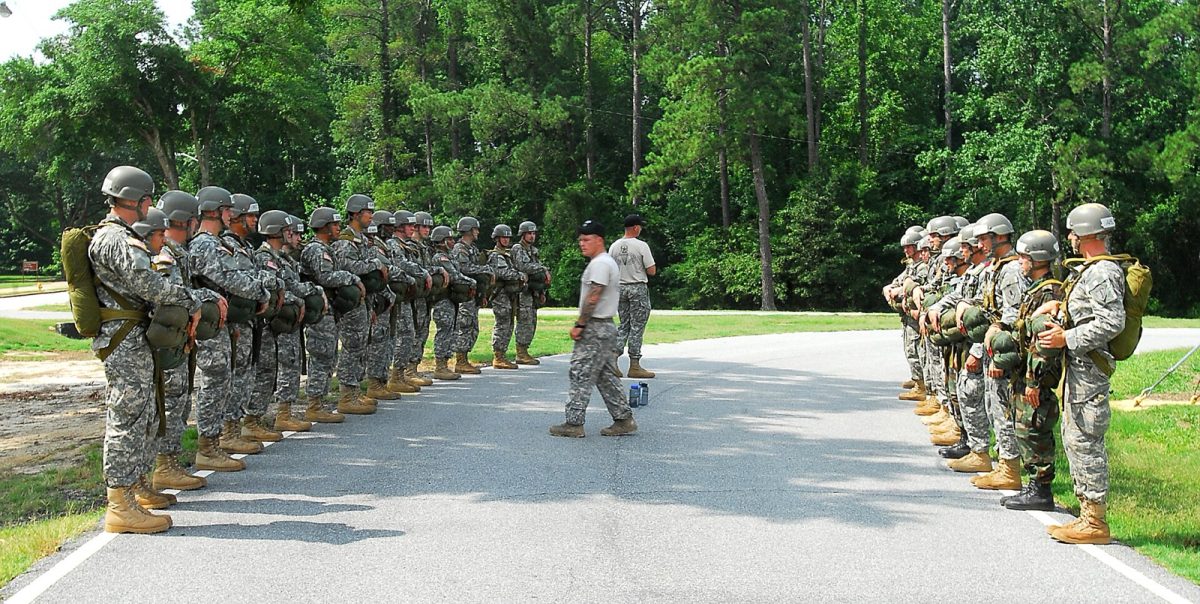
Instructors prepare soldiers for parachute training at Fort Benning in 2009 (file photo). Photo: Kristin Molinaro / Wikimedia Commons (public domain)
COLUMBUS, Ga. - Fort Benning is preparing to receive three nuclear microreactors designed to keep selected mission-critical facilities operating during commercial power outages. Army officials and representatives of Radiant Industries Inc. visited the installation Oct. 16 to assess a potential location for the reactors and review how they would connect to the post's existing power grid. The Army has identified a preferred site, but final approval depends on environmental and cultural resource surveys.
The project is part of the Army's Janus Program, an effort to strengthen energy resilience at military installations through nuclear microreactor technology. Radiant will provide, install, operate and maintain the systems planned for Fort Benning, according to an Oct. 19 Army news release. The Army has not disclosed the proposed location, identified which buildings would receive reactor power or specified the electricity output planned for the installation.
What Happened at Fort Benning on Oct. 16
Leaders and planners from the Maneuver Center of Excellence and Fort Benning met Oct. 16 with representatives from the Office of the Assistant Secretary of the Army for Installations, Energy and Environment, Radiant Industries and installation energy stakeholders. The Army described the gathering as the initial Janus Program site visit. Participants began with a briefing on Fort Benning's mission, vision and current energy posture before discussing the program's goals and the Army's broader microreactor initiative.
Radiant representatives led technical workshops on integrating the company's Kaleidos microreactors with Fort Benning's existing power grid. Participants reviewed administrative, regulatory and security requirements that would affect the project. They also discussed environmental compliance under the National Environmental Policy Act and considerations involving cultural resources on the installation.
Several Fort Benning offices participated in planning for the proposed systems, including the Directorate of Public Works, Directorate of Plans, Training, Mobilization and Security, Provost Marshal's Office and Installation Safety. Their discussions covered emergency response integration, physical security planning and safety protocols. Local utility providers, the installation's commercial power company and scientific and technical defense consultants also contributed to infrastructure mapping and potential site selection.
Locke described the visit as the start of in-person work with the project's long-term partners. "This kickoff meeting brings together all the partners responsible for delivering micro-nuclear power to Fort Benning. It's our first opportunity to collaborate face-to-face with our long-term partners," said Dr. Ed Locke, master planner for the Directorate of Public Works and the installation's Janus Project lead.
The visit ended with a physical assessment of one potential location for the reactors. The Army identified that location as its preferred option but said cultural resource and environmental surveys must be completed before final approval. The Army's announcement did not reveal where the site is located.
What the Army's Janus Program Is Designed to Do
The Janus Program focuses on providing independent power for military installations and mission-critical infrastructure when commercial electricity becomes unavailable. Fort Benning is a designated host installation under the program, with three next-generation microreactors scheduled for the post. The planned systems would support selected facilities rather than replace the entire installation's commercial power supply, according to the Army's description of their purpose.
Maj. Gen. Colin P. Tuley, commanding general of the Maneuver Center of Excellence and Fort Benning, emphasized the importance of keeping the installation's operational infrastructure running during power disruptions. He specifically cited Lawson Army Airfield and mission command centers as examples of critical infrastructure. His remarks did not establish that either would receive power from the proposed reactors.
"To project power globally, we must ensure our critical infrastructure - especially Lawson Army Airfield and our mission command centers - remains fully operational under any circumstances. Uninterrupted, resilient energy is the lifeblood of our flight line and deployment operations," Tuley said. His comments tie the project to the airfield and to the post's deployment mission.
Tuley also connected the October visit to the installation's preparation for the proposed technology. "This initial site visit is about setting the conditions to successfully receive and integrate this advanced power technology, protecting our operations from commercial grid vulnerabilities," he said. The Army describes energy resilience as a central purpose of the program, particularly for facilities that support military missions.
In an Aug. 26 Radiant news release, Dr. Jeff Waksman, Principal Deputy Assistant Secretary of the Army for Installations, Energy and Environment, described the program's transition toward deployable equipment. "The Janus Program is about transitioning from designs and experiments to reliable commercial hardware which secures our energy independence," Waksman said. His statement appeared in the company's announcement of its Army agreement.
What Radiant Says About the Kaleidos Microreactor
Radiant describes Kaleidos as a transportable nuclear microreactor that can move by land, sea or air and operate directly at customer locations. The company rates each reactor at 1 megawatt and says that amount of power could supply 1,000 homes for five years. Those figures come from Radiant's product descriptions, not from Fort Benning's site assessment.
Based on Radiant's stated rating, three 1-megawatt reactors would provide a combined nominal output of 3 megawatts. That is a calculation using the company's specifications, not an Army-confirmed generating capacity for Fort Benning. The Army's October announcement did not state how much electricity the installation's three planned systems would deliver.
Radiant says each Kaleidos reactor can operate for up to five years before refueling and is engineered for a 20-year operating life. According to the company, the unit arrives sealed and fueled, requires no cooling water and undergoes fueling and refueling at Radiant facilities. Radiant also says its customers would not need to store spent nuclear fuel at their sites.
The company says it is testing Kaleidos at Idaho National Laboratory's DOME facility and developing a 300,000-square-foot R-50 campus in Oak Ridge, Tennessee. In August, Radiant announced a binding agreement with the Army, working with the Defense Innovation Unit, worth up to $750 million to develop and deploy 15 Kaleidos reactors through Janus. Radiant described the agreement as the largest award within the program.
"Through Janus, Radiant will deploy 15 reactors by 2030," said Mike Starrett, Radiant's chief commercial officer, in the company's August announcement. Fort Benning's three planned reactors represent 20% of the 15 units covered by that agreement, based on the Army's installation announcement and Radiant's contract figures. That percentage describes the number of units, not Fort Benning's share of the contract's dollar value.
What Comes Next: Surveys and Site Approval
Before Fort Benning can finalize its preferred reactor location, planners must complete the required environmental and cultural resource surveys. The Army said those results will determine whether the preferred site receives final approval. Its October announcement did not identify an alternative location or provide a specific date for the approval decision.
"Today's collaborative site survey marks a significant step forward for the Janus Program. Our immediate priority is completing the required environmental and cultural resource surveys to secure final site approval. Every milestone brings us closer to strengthening Fort Benning's energy resilience and ensuring our ability to project power without fail," Locke said.
Radiant has expressed confidence about its partnership with Fort Benning and the path toward initial operations. Retired Rear Adm. Mark B. Sucato, U.S. Navy, Radiant's director of national security business development, described the company as working toward the Department of War's first operational nuclear microreactor. That characterization is Radiant's claim rather than a confirmed milestone announced by the Army.
The Army says its broader goal is to have the first microreactors operational by 2028. That target applies to the Army's overall initiative and should not be interpreted as a confirmed startup date for the three Fort Benning reactors. Radiant separately says it intends to deploy all 15 reactors covered by its Janus agreement by 2030.
What We Don't Know Yet
The Army has not publicly identified which Fort Benning buildings will receive electricity from the microreactors or how much power the installation will obtain from them. Although Tuley referenced Lawson Army Airfield and mission command centers while discussing critical infrastructure, the Army did not designate those facilities as reactor customers. The specific connections between the proposed systems and the post's electrical infrastructure remain undisclosed.
The precise location of the preferred reactor site also remains undisclosed pending the required reviews. Radiant has clarified that an image showing Fort Benning jump towers and buildings is a conceptual rendering, not a representation of the planned reactor location. The company says those landmarks are illustrative and that the actual location remains to be determined.
The announcements also leave open when Fort Benning's three reactors would be installed, begin operating or achieve initial operational capability. The Army's 2028 goal and Radiant's 2030 deployment target describe broader program objectives rather than a confirmed installation schedule. For now, Fort Benning's project remains in the site-assessment and approval stage.
## How we did this Columbus Times reviewed the Fort Benning Public Affairs Office's Oct. 19, 2026, Army news release describing the Oct. 16 Janus Program site visit, along with information published by Radiant Industries on its Kaleidos microreactor and its Aug. 26, 2026, Janus agreement announcement. The sources were reviewed Oct. 27, 2026, and technical specifications, contract figures and company projections are attributed to Radiant rather than presented as independent Army findings. Calculations involving the three planned Fort Benning reactors use the Army's unit count and Radiant's published figures, while details not disclosed in the announcements are identified as unknown.
Source: Fort Benning Public Affairs (army.mil, Oct. 19, 2026); Radiant Industries (radiantnuclear.com)

News organizations may republish this story with credit. See our guidelines.
Know someone who'd want to read this? Email it to a friend.
Own a Columbus business? 60,000+ page views a month. Ads from $125/month. See ad options Follow Columbus Times on FacebookLocal news, events and people, in your feed every day.Most read this week
- Georgia Spent $165.7 Million on Medicaid Work Requirement Program, but Only 18,527 Were Enrolled After 3 Years
- 8 Columbus Restaurants Got a C on Their Health Inspection in 2026, the Most of Any Year Since 2022. Here's Every One
- Columbus' Top-Rated Barbecue: 12 BBQ Joints Ranked by Google Stars and Health Scores
- 12 Famous People From Columbus, Ga.: A Hall of Fame Slugger, a Grammy-Winning Bluesman and America's First Black Military Pilot
- 12 Columbus Seafood and Fish Restaurants Ranked by Google Stars, With Latest Health Scores
More stories
 Local Columbus Iron Works: How an 1853 Foundry Made Confederate Guns, Survived 2 Fires and Became a Trade Center
 Local Where Columbus' Tap Water Comes From: 10 Questions About Lake Oliver, 2 Treatment Plants and a $200 Million PFAS Plan
 Local How to Get Public Records in Columbus: 6 Steps, the 3-Business-Day Rule and Where to Send Requests
 Local Fort Benning's 250-Foot Jump Towers: How World's Fair Parachute Towers Trained America's First Paratroopers
Comments
Be respectful. No personal attacks, hate speech, spam or anyone's private information. Every comment is reviewed before it appears. Comment rules
No comments yet. Be the first to share your thoughts.