Know Your Numbers: The 4 Health Checks Columbus Adults Shouldn't Skip, and Where to Get Them Free or Low-Cost
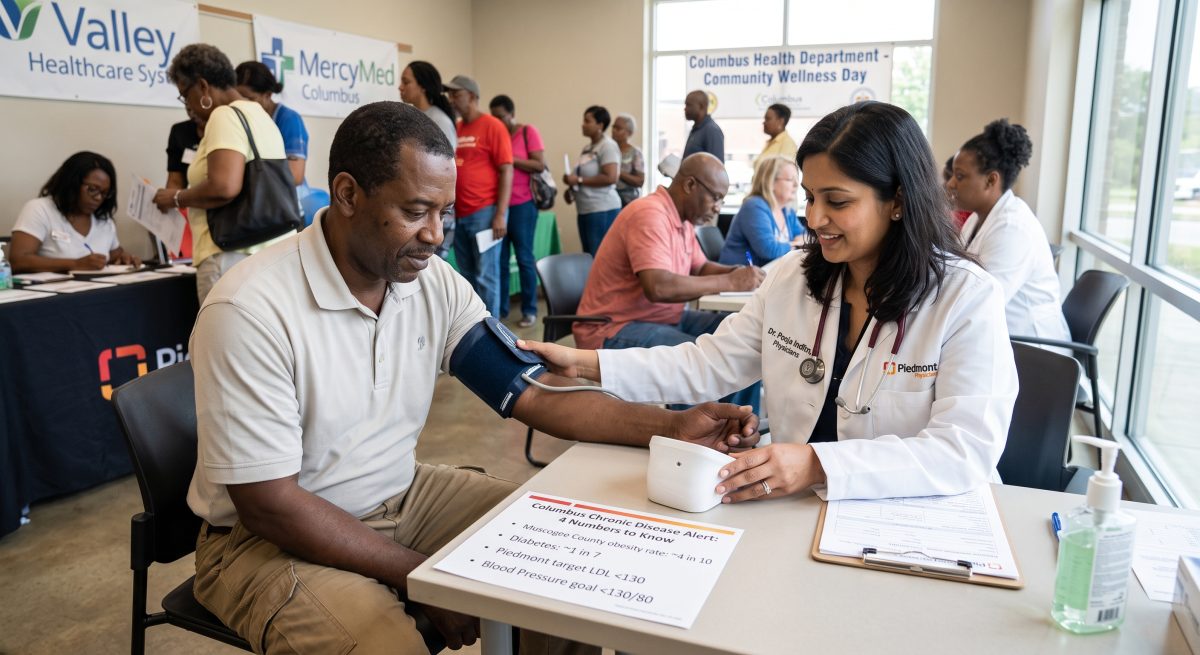
Illustration: AI-generated
Columbus adults face higher-than-average rates of some of the most serious chronic diseases, and many people who have them don't know it yet.
In Muscogee County, about 4 in 10 adults have obesity and roughly 1 in 7 has diabetes. Both rates are higher than the Georgia and national averages, according to U.S. News & World Report's Healthiest Communities data. High blood pressure, high cholesterol, diabetes and heart disease often develop with no symptoms at all, so the only way to know is to get checked.
That's why local doctors are urging residents not to let busy fall schedules push their checkups aside.
"It is one of the simplest ways to take control of your health," said Dr. Pooja Indir of Piedmont Physicians at Warm Springs Road. "When you understand where you stand, you and your healthcare provider can work together to reduce your risk for serious health problems down the road."
The 4 numbers to know
1. Blood pressure
Blood pressure is a key sign of heart health and stroke risk. Piedmont advises keeping it below 140/90.
The American Heart Association's 2025 guidelines go further. They consider a reading of 130/80 or higher to be high blood pressure, recommend a goal below 130/80 for most adults, and consider under 120/80 normal. Ask your doctor which target is right for you.
2. Cholesterol
Cholesterol levels help measure your risk of heart disease. Piedmont recommends keeping LDL, or "bad," cholesterol below 130. Your total and HDL ("good") cholesterol matter too.
3. Blood sugar (glucose and A1C)
These tests detect and track diabetes. For people managing diabetes, the CDC's target is a blood sugar of 80 to 130 mg/dL before meals and below 180 mg/dL two hours after eating. An A1C test shows your average blood sugar over about three months.
4. Body mass index (BMI) and weight
BMI and weight changes can signal risk for several chronic conditions. The CDC considers a BMI of 18.5 to 24.9 healthy, 25 to 29.9 overweight and 30 or higher obese. You can calculate yours with the National Institutes of Health's online BMI calculator.
Targets can vary based on your health history, so a primary care provider can help set goals that are right for you.
Small changes that make a big difference
Dr. Indir recommends these heart-healthy habits:
- Don't smoke or use tobacco products.
- Eat well: lean proteins, plenty of fruits and vegetables, and healthy fats.
- Move more: aim for 150 minutes of moderate activity a week. That's a 30-minute walk five days a week, and the RiverWalk is a great place to start.
- Manage stress.
- Sleep seven to nine hours a night.
Where to get checked in Columbus
If you have insurance: start with your primary care provider. Piedmont Physicians at Warm Springs Road has internal medicine and family medicine practices at 2737 Warm Springs Road (internal medicine 706-653-2255; family medicine 706-571-1136), open weekdays 8 a.m.-5 p.m. You can also find a Piedmont provider at piedmont.org.
If you're uninsured or underinsured, these options charge based on what you can afford:
- Valley Healthcare System, 1600 Fort Benning Road, 706-322-9599. This community health center offers primary care on a sliding fee scale based on household size and income, and accepts Medicare, Medicaid and private insurance.
- MercyMed of Columbus, a faith-based nonprofit serving uninsured and underinsured families since 2012. Care is on a sliding fee scale, and it's free for people experiencing homelessness. Main clinic: 3702 2nd Ave. Also at The Banks at Mill Village, 110 21st St., Suite 3101, 706-507-9209.
- Columbus Health Department, 5601 Veterans Parkway (lower level), 833-337-1749. It offers clinical and preventive services; call to ask about health screenings.
Quick tip: many local pharmacies have free blood pressure machines. A reading there won't replace a checkup, but it's an easy way to spot a number worth bringing to your doctor.

News organizations may republish this story with credit. See our guidelines.
Know someone who'd want to read this? Email it to a friend.
Own a Columbus business? 60,000+ page views a month. Ads from $125/month. See ad options Follow Columbus Times on FacebookLocal news, events and people, in your feed every day.Most read this week
- Georgia Spent $165.7 Million on Medicaid Work Requirement Program, but Only 18,527 Were Enrolled After 3 Years
- 8 Columbus Restaurants Got a C on Their Health Inspection in 2026, the Most of Any Year Since 2022. Here's Every One
- The Night Fight on the Chattahoochee: How Columbus Became the Site of What Many Call the Last Battle of the Civil War
- The 10 Best Mexican Restaurants in Columbus, Ga., Ranked by Diners
- Columbus' Top-Rated Barbecue: 12 BBQ Joints Ranked by Google Stars and Health Scores
More stories
 Health Why Adult Siblings Sometimes Become Enemies After Their Parents Die
 Health How to Deal With Toxic Family Members Without Losing Your Peace
 Health Georgia's $166 Million Medicaid Program Faces Questions as State Seeks More Federal Funding
 Health Georgia Reports 22 Measles Cases in 2026 After New Case in Macon County
Comments
Be respectful. No personal attacks, hate speech, spam or anyone's private information. Every comment is reviewed before it appears. Comment rules
No comments yet. Be the first to share your thoughts.