Moving to Fort Benning With School-Age Kids? 8 Transfer Rules, From 10 Days for Records to 30 Days for Shots and a Senior-Year Diploma
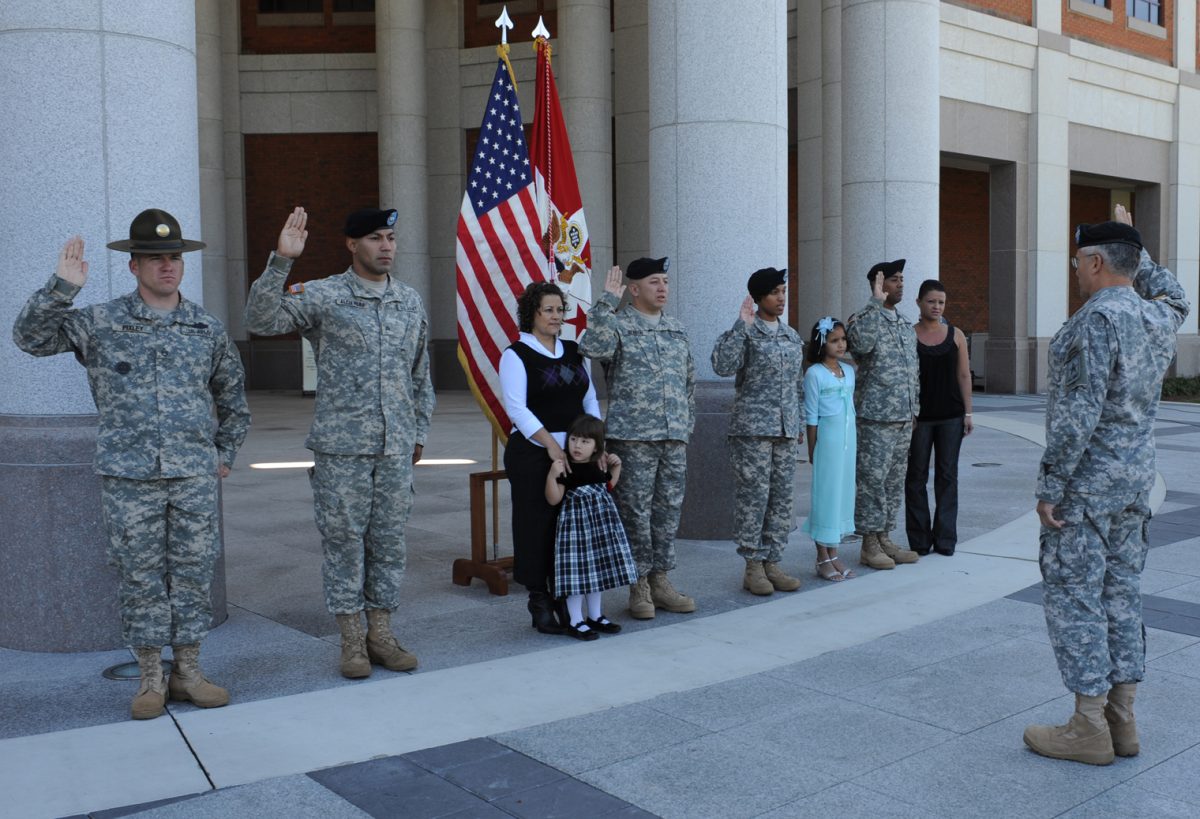
Then-Army Chief of Staff Gen. George W. Casey Jr. re-enlists soldiers, with their families, in front of the National Infantry Museum at Fort Benning in October 2009. Photo: Brandon McGahee / Wikimedia Commons (Public domain)
COLUMBUS, Ga. - Army families who arrive at Fort Benning in the middle of a school year face familiar problems, from missing records to a senior who suddenly lacks one required course. A law that both Georgia and Alabama have adopted is meant to solve most of those problems. It is called the Interstate Compact on Educational Opportunity for Military Children, and it applies in Muscogee County schools and across the river in Phenix City and Russell County.
Georgia's version is in the state code at O.C.G.A. 20-17-1 and 20-17-2, and Alabama's is in Chapter 44B of Title 16 of the Code of Alabama. The compact's stated purpose is to remove barriers to educational success imposed on children of military families "because of frequent moves and deployment of their parents." The rules below come from the Georgia text, which follows the compact's model language.
Who is covered
The compact applies to the children of active-duty members of the uniformed services, including National Guard and Reserve members on active-duty orders. It also covers children of members or veterans who are severely injured and medically discharged or retired, for one year after the discharge or retirement, and children of members who die on active duty, for one year after the death. It does not cover children of inactive Guard and Reserve members, of retirees and veterans outside those two exceptions, or of Defense Department civilians and contractors.
The uniformed services in the compact include the Army, Navy, Air Force, Marine Corps and Coast Guard, along with the commissioned corps of NOAA and the Public Health Service. The rules apply to public school districts, which the compact calls local education agencies. A child must be enrolled in kindergarten through 12th grade to be covered.
8 rules that matter most at enrollment and graduation
The compact has many provisions, but eight of them come up most often when a family arrives in the middle of a year. They cover records, shots, grade placement, activities, absences and graduation. The paragraphs after the list explain each rule.
- Hand-carried, unofficial records are enough to enroll and place a student.
- The old school must send official records within 10 days.
- Students get 30 days from enrollment to get required immunizations.
- Kindergarten and first grade continue regardless of the new state's age cutoff.
- Course and program placement from the old school is honored at first.
- Extracurricular application deadlines bend for new arrivals.
- Extra excused absences are allowed around a parent's deployment.
- Graduation rules flex for students who transfer late in high school.
Records come first. If official records cannot be released to parents for a move, the old school must give the parent a complete set of unofficial records, and the new school must enroll and place the student based on them while it waits. At enrollment the new school requests the official record, and the sending school must furnish it within 10 days or within a time set by the compact's Interstate Commission.
Shots and grade level come next. Students get 30 days from the date of enrollment to obtain any immunization the new state requires, and for a series of shots, the initial vaccinations must be obtained within 30 days. A student may continue in the grade he or she was enrolled in at the old school, including kindergarten, regardless of age. A student who completed the prerequisite grade is eligible for the next grade in the new state, also regardless of age.
The new school must initially honor placement in courses such as honors, International Baccalaureate, Advanced Placement and career pathways, and in programs such as gifted and English as a second language. Students with disabilities must initially receive comparable services based on their current Individualized Education Program, and the new school may still run its own evaluations later. Schools must also help transitioning military children join extracurricular activities regardless of application deadlines, as long as they are otherwise qualified.
Deployments get their own rule. A student whose parent has been called to duty for, is on leave from or immediately returned from deployment to a combat zone or combat support posting may receive additional excused absences, at the superintendent's discretion. The compact defines the deployment period as one month before the service member leaves home station through six months after returning.
Graduation is the last hurdle. Districts must waive specific graduation courses when similar work was completed elsewhere, or give a reasonable justification for denying the waiver, and states must accept the old state's exit or end-of-course exams or other tests in lieu of their own. If a student who transfers at the beginning of or during senior year still cannot graduate from the new district, the two districts must ensure the student receives a diploma from the old district, provided he or she meets its requirements.
Two more protections for families split by orders
The compact also deals with guardianship. A special power of attorney covering the guardianship of a military child is enough for enrollment and anything else that needs a parent's consent. A district may not charge local tuition to a military child placed with a noncustodial parent or another guardian who lives in a different district, and that child may keep attending the school he or she attended while living with the custodial parent.
Where to get help locally
Each side of the river has a contact for military families. The Muscogee County School District lists Dr. Michael Forte, its senior director of student services, as its military family liaison at 706-748-3217. The district also runs Army Youth Program in Your Neighborhood after-school sites, which the Army helps fund for Army-connected youth, at Columbus, Hardaway, Northside, Shaw and Spencer high schools, with Robin Savell as administrator at 706-748-2258.
Fort Benning itself has a school liaison officer who works with public and private schools in the area. Phenix City Schools lists Jasponica Florence in the garrison's Child and Youth Services Division, Building 104, 6880 Marchant Ave., at 706-545-2034. According to the district, school liaison officers help families with transitions, explain local school policies and graduation requirements, and help with the High School Senior Stabilization program, which can delay a parent's change of duty station so a student can finish senior year.
For disputes, the Military Interstate Children's Compact Commission lists each state's commissioner at mic3.net. The commission's office can also be reached at 859-244-8000 or [email protected]. The commission's website also links to an "Ask for Help" flowchart for parents and a tool for finding a school liaison.
Source: O.C.G.A. 20-17-2 via MIC3; Code of Alabama 16-44B-1; Muscogee County School District; Phenix City Schools (Nov. 2026)

News organizations may republish this story with credit. See our guidelines.
Know someone who'd want to read this? Email it to a friend.
Plan your weekend with Columbus Times
Get This Weekend in Columbus every Thursday: the best local events, free things to do and family fun, plus each evening's local news. Free, and you can unsubscribe anytime.
By signing up you agree to get the Columbus Times email newsletter. Unsubscribe anytime with one click.
Most read this week
More stories
 Education Lee County Schools Picks Its Own Operations Chief
 Education Columbus State Names Archives for Historian Kenneth H. Thomas Jr. Ahead of 2028…
 Education Callaway Middle Principal Named a Georgia Distinguished Principal
 Education Columbus State Sent More Than 100 Students Into Dimon Magnet Academy
Comments
Be respectful. No personal attacks, hate speech, spam or anyone's private information. Every comment is reviewed before it appears. Comment rules
No comments yet. Be the first to share your thoughts.