Columbus General Fund Revenue Up 9.49% to $20.9 Million in the First Quarter: $8.9 Million From Sales Tax, 77% of Budget Unspent
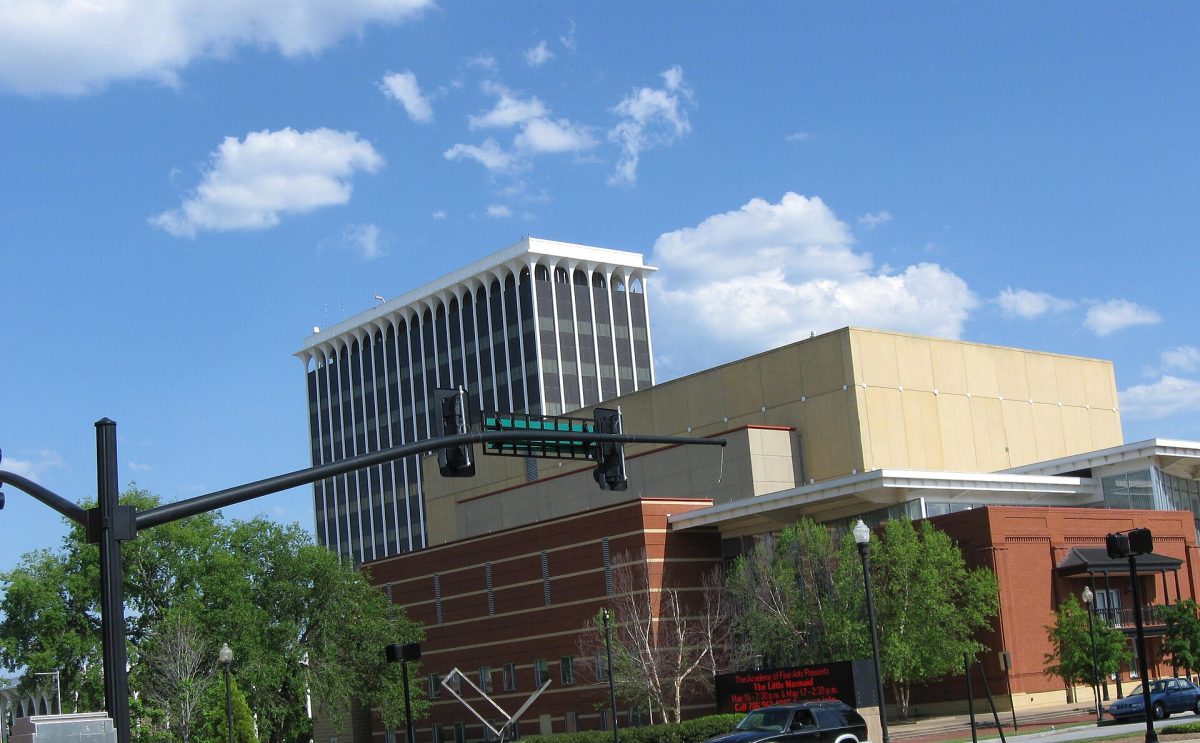
The Columbus Consolidated Government Center in downtown Columbus, where the city's finance and tax offices are based. Photo: Drew Zimmerman / Wikimedia Commons (CC BY-SA 3.0)
COLUMBUS, Ga. - Columbus' general fund took in $20,921,396, or about $20.9 million, in the first three months of the 2027 fiscal year, 9.49% more than the $19,108,467 collected over the same stretch a year earlier, according to an unaudited monthly financial snapshot the city's Finance Department prepared for Columbus Council. The report, covering July through September 2026, was attached to the council's Nov. 10 agenda for a finance update by Finance Director Angelica Alexander. It is the first look at how the Consolidated Government's revenue and spending are tracking against the budget that took effect July 1.
Spending ran well ahead of collections in the quarter, which is normal for a government whose biggest revenue source arrives in December. General fund expenditures through September were $50,706,182, up 3.60% from $48,945,646 a year earlier, the snapshot shows. That left the city having spent about 23% of its $222,251,139 general fund expenditure budget, with 77% still unspent against an internal target of at least 75% remaining at the end of the first quarter.
Where the money came from
Sales tax was the biggest single source of general fund cash in the quarter. The Local Option Sales Tax brought in $8,881,654, roughly $8.9 million, or 17.68% of the $50,225,000 budgeted for the full year, and accounted for 42% of everything the general fund collected, according to the report. The snapshot does not explain the timing of sales tax distributions, and it does not say whether the first-quarter figure reflects a full three months of collections.
Property taxes, the largest line in the budget at $59,318,888, had produced only $2,192,488, or 3.70% of the year's total, by Sept. 30. Columbus property tax bills for 2026 are due in a single payment on Dec. 1, according to the summary of the council's July 14 meeting, so most of that money will not show up in the city's books until the second quarter. Franchise fees, budgeted at $22,295,000, showed no collections at all through September.
Several smaller revenue lines were running ahead of a straight 25% quarterly pace. Fines and forfeitures stood at $1,308,615, or 24.25% of a $5,396,000 budget, and culture and recreation charges reached $392,830, or 29.43% of a $1,334,900 budget. The occupational tax, which businesses pay on their gross receipts, had generated $1,332,557, or 6.50% of the $20,500,000 budgeted, while a catch-all category of other general fund revenues brought in $6,813,254, or 12.07% of $56,430,434. All told, the general fund had collected 9.71% of its $215,500,222 revenue budget.
Where the money went
Public safety dominates the spending side, as it does every year. The Fire Department had spent $7,974,702 of its $38,835,723 budget, leaving 79% unspent, while the Sheriff's Office had used $8,901,253 of $35,321,731, leaving exactly 75%, and the Police Department had spent $6,656,256 of $30,617,312, leaving 78%. Muscogee County Prison had drawn $2,255,344 of its $11,525,258 budget, with 80% remaining.
A handful of departments were below the 75% target, which usually reflects bills that come due early in the year rather than overspending. Information Technology had already spent $4,876,134 of $11,716,357, leaving just 58%, the lowest share of any department in the report. Employee Benefits was at 61% remaining and Human Resources at 69%. The snapshot does not say why, though software licenses and insurance premiums are often paid in a lump sum at the start of a fiscal year.
| Department | FY2027 budget | Spent through Sept. 30 | Share unspent |
|---|---|---|---|
| Fire | $38,835,723 | $7,974,702 | 79% |
| Sheriff | $35,321,731 | $8,901,253 | 75% |
| Police | $30,617,312 | $6,656,256 | 78% |
| Parks and Recreation | $16,924,289 | $3,706,410 | 78% |
| Muscogee County Prison | $11,525,258 | $2,255,344 | 80% |
| Information Technology | $11,716,357 | $4,876,134 | 58% |
| Facilities Maintenance | $8,533,282 | $1,714,366 | 80% |
| Public Works | $7,293,601 | $1,828,317 | 75% |
| Elections | $1,545,116 | $196,387 | 87% |
The department figures above come from the same September 2026 snapshot, which the city labels unaudited. The Elections office had spent only $196,387 of its $1,545,116 budget, leaving 87%, but that figure predates the Nov. 3 general election and the costs that come with it. Parks and Recreation had spent $3,706,410 of $16,924,289, leaving 78%. The Public Defender's office had the most room of any department at 93% remaining, having spent $203,036 of $2,765,724.
Beyond the general fund
The snapshot also tracks the city's other operating funds, and several of them moved in different directions than the general fund. The Other Local Option Sales Tax fund took in $9,006,037, essentially flat at 0.33% below last year's $9,035,549, while its spending dropped 20.06% to $7,187,272 from $8,990,438. The Integrated Waste fund, which handles garbage service, saw revenue rise 6.99% to $3,290,303 and spending climb 24.56% to $4,624,411.
One line is entirely new this year. A School Zone Safety Initiative fund, which did not exist in the September 2025 report, recorded $213,716 in revenue and $363,937 in spending in its first quarter, according to the snapshot. The report does not describe the fund or say what the money was spent on.
Revenue fell at several of the city's entertainment and recreation operations. The Civic Center and Sports Authority fund collected $535,203, down 16.42% from $640,371, while its spending fell 45.87% to $1,042,707 from $1,926,168. Bull Creek Golf Course revenue slipped 6.06% to $678,960, Oxbow Creek Golf Course revenue dropped 22.57% to $163,815, and the Trade Center fund was down 3.32% at $822,115. The Paving fund showed negative revenue of $6,679 against $153,178 a year earlier, and the Stormwater fund rose 16.02% to $141,886.
What comes next
The snapshot is a routine report, and the council does not vote on it. Columbus runs its fiscal year from July 1 to June 30, so the September numbers represent the first quarter, and the December report will show whether property tax collections arrive as budgeted after the Dec. 1 deadline. The council's next regular meeting is scheduled for Tuesday, Nov. 17, at 9 a.m. at the C.E. "Red" McDaniel City Services Center, 3111 Citizens Way, according to the city's meeting portal.
Source: Columbus Consolidated Government Monthly Financial Snapshot, FY2027 September 2026, in the Columbus Council Nov. 10, 2026 agenda packet; Columbus Council Nov. 10, 2026 agenda; Columbus Council July 14, 2026 meeting summary; columbus-ga.municodemeetings.com meeting portal (Nov. 10, 2026)

News organizations may republish this story with credit. See our guidelines.
Know someone who'd want to read this? Email it to a friend.
Plan your weekend with Columbus Times
Get This Weekend in Columbus every Thursday: the best local events, free things to do and family fun, plus each evening's local news. Free, and you can unsubscribe anytime.
By signing up you agree to get the Columbus Times email newsletter. Unsubscribe anytime with one click.


Comments
Be respectful. No personal attacks, hate speech, spam or anyone's private information. Every comment is reviewed before it appears. Comment rules
No comments yet. Be the first to share your thoughts.