How the Chattahoochee Powered Columbus: A 1899 Dam, a Rope Drive Used Until 1954 and Today's Georgia Power Hydro Chain
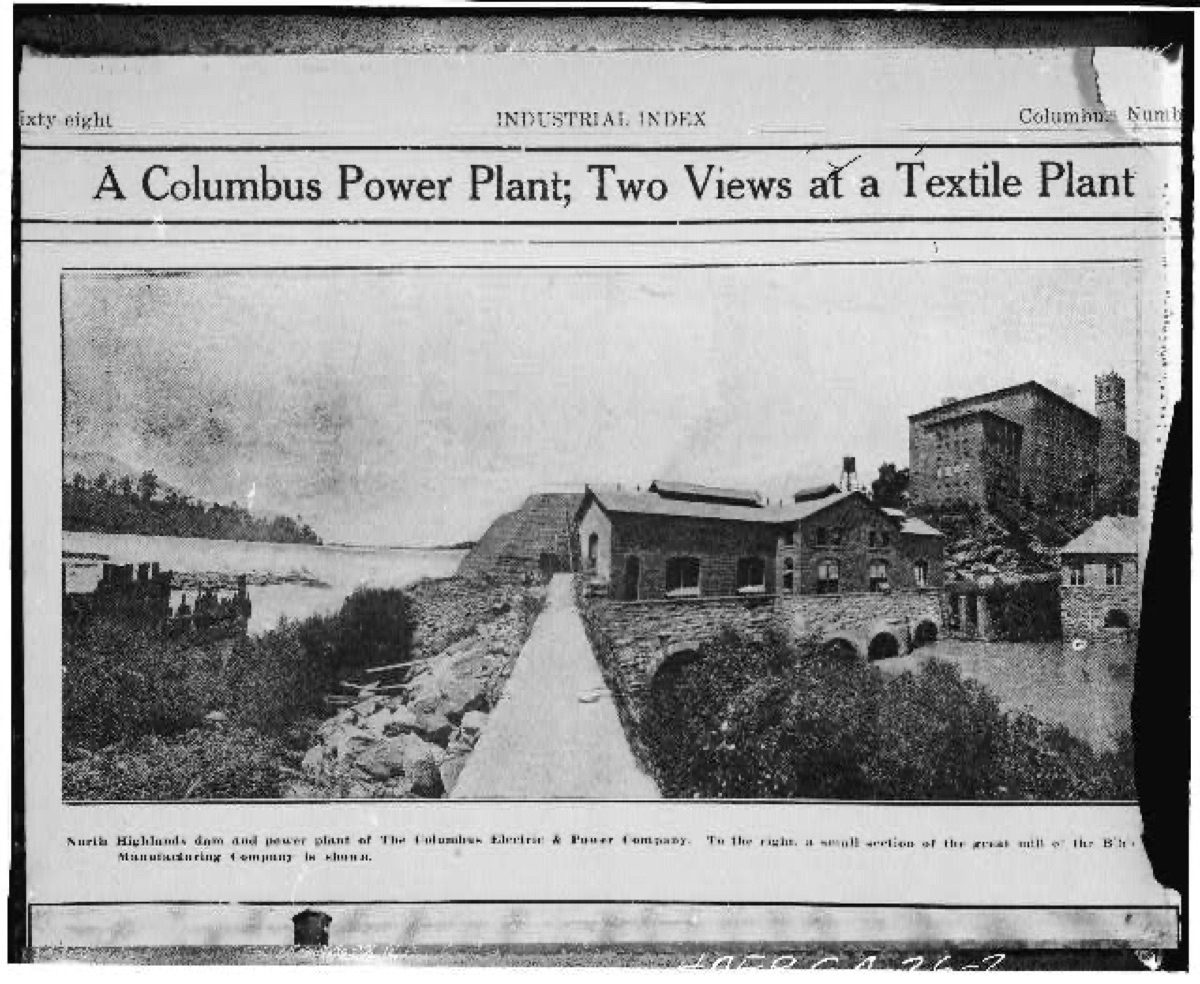
A historic clipping showing the North Highlands dam and power plant of the Columbus Electric & Power Company. Photo: U.S. Government (Industrial Index clipping) / Wikimedia Commons (public domain)
COLUMBUS, Ga. - For most of its history, the Chattahoochee River was Columbus' engine. The fall line between Columbus and Franklin has about 20 miles of waterfalls, which citizens used to power the first large-scale hydroelectric dams in the South, built between 1899 and 1924 at North Highlands, Goat Rock and Bartletts Ferry, according to the New Georgia Encyclopedia. By 1861, Columbus was known as "the Lowell of the South," the same source says, because the river drove its textile mills.
Some of those dams are gone, and some now make electricity for Georgia Power customers. Two were breached to create the whitewater course that draws rafters through downtown today. Here is a timeline with the dates the sources agree on, and the places where they do not.
A timeline of the dams
| Dam | Year | What it did |
|---|---|---|
| City Mills | Wooden dam 1828; rebuilt 1907 | Powered the City Mills grist mill; breached March 12, 2013 |
| Eagle & Phenix | 1882 | Powered the Eagle and Phenix textile mill; breached March 2012 |
| North Highlands | 1899 | Powered the Bibb City mill and supplied general power |
| Goat Rock | 1912 (per one source) | Part of the hydro chain north of Columbus |
| Bartletts Ferry | 1924-25 | Built by Columbus Electric and Power Company; forms Lake Harding |
| Oliver | 1959 | Georgia Power's last hydro dam built near Columbus |
The mill dams in town
The Eagle & Phenix Dam, a stone dam just south of the 13th Street Bridge, was built in 1882 to supply water power to the Eagle and Phenix textile mill, according to Wikipedia. It created a 45-acre reservoir that reached about 1 mile upstream. The City of Columbus breached it in March 2012 to restore natural flow, and the city now owns the site.
City Mills Dam was built in 1907 to power the City Mills grist mill, and a wooden dam dating to 1828 stood there earlier, according to Wikipedia. The city breached it on March 12, 2013, to create an urban whitewater area. Between them, the two breaches opened the river that rafting companies now use.
North Highlands: the Bibb City connection
North Highlands Dam was built in 1899 to power the former Bibb City mill and is described as one of the first large dams in the South, according to Wikipedia. A flood in 1901 nearly destroyed it, and it was rebuilt and reconfigured two years later. After the rebuild, two powerhouses operated: one generated 5,000 kilowatts for general use, and the other sent power to the Bibb City mill by rope drive, which was maintained until 1954.
In 1963, the old powerhouses were replaced by a four-unit generator house with a capacity of 29,600 kilowatts. Columbus Electric and Power Company owned the dam until Georgia Power bought that utility in 1930. Georgia Power owns it today, and the dam is fully automated and controlled remotely from Bartletts Ferry, according to the same entry.
Numbers from the river
The dam impounds Bibb Pond, which has 131 acres of surface water and 3 miles of shoreline. The crest elevation is 269 feet above mean sea level. The drainage area is 4,670 square miles, according to the entry.
Discharge records from 1929 to 1960 show how much the river can vary. The average was 6,286 cubic feet per second, and the highest recorded was 198,000 cfs on March 16, 1929. The minimum recorded was 294 cfs, on Oct. 23 and Nov. 14, 1931, according to the page.
Bartletts Ferry and Oliver
Bartletts Ferry Dam was built in 1924-25 by Columbus Electric and Power Company, and Georgia Power took it over in 1930, according to willylogan.com. It forms Lake Harding. The New Georgia Encyclopedia says Georgia Power built Oliver Dam near Columbus in 1959.
Georgia Power's Chattahoochee Hydro Group has six generating stations along a 29-mile stretch of the river, and together they produce 316 megawatts, according to the company's 2016 fact sheet. That figure may have changed since 2016, so check Georgia Power for current numbers. Goat Rock was built in 1912, according to one source, but sources differ on some early dates.
Where the river stands now
Beyond the Columbus stretch, the federal dams on the river include Walter F. George and Jim Woodruff, part of the Apalachicola-Chattahoochee-Flint Project that Congress authorized in 1953. That project's four dams were completed by 1963, according to the New Georgia Encyclopedia. A West Point dam was authorized in 1962 after a 1961 flood and completed in 1975.
See it for yourself
The 2012 and 2013 breaches mean visitors can now see the old dam sites from the RiverWalk and the whitewater course. The Georgia Power dams are active utility facilities, so access to them is limited and people should obey posted signs. Lake Harding and Lake Oliver, the reservoirs behind two of the dams, are open for boating and fishing under their own rules.
Source: Wikipedia North Highlands Dam, Eagle & Phenix Dam and City Mills Dam entries; New Georgia Encyclopedia (Chattahoochee River)
News organizations may republish this story with credit. See our guidelines.
Know someone who'd want to read this? Email it to a friend.
Plan your weekend with Columbus Times
Get This Weekend in Columbus every Thursday: the best local events, free things to do and family fun, plus each evening's local news. Free, and you can unsubscribe anytime.
By signing up you agree to get the Columbus Times email newsletter. Unsubscribe anytime with one click.
Comments
Be respectful. No personal attacks, hate speech, spam or anyone's private information. Every comment is reviewed before it appears. Comment rules
No comments yet. Be the first to share your thoughts.