Columbus and Phenix City Are Joined by 5 Road and Foot Crossings: From an 1832 Horace King Covered Bridge to the 2000 Thirteenth Street Span
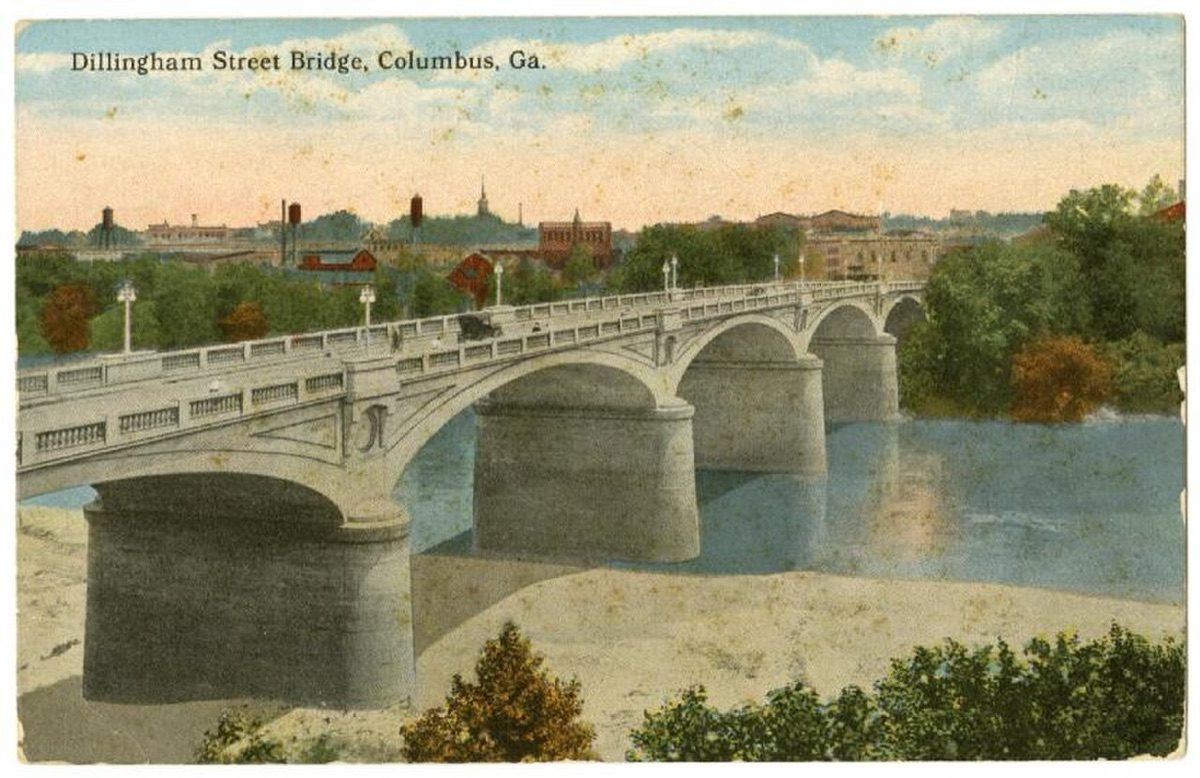
A vintage postcard showing the Dillingham Street Bridge over the Chattahoochee River in Columbus, Georgia. Photo: Chattahoochee Valley Regional Library System (postcard) / Wikimedia Commons (Public domain)
COLUMBUS, Ga. - People cross the Chattahoochee River every day between Columbus, Georgia, and Phenix City, Alabama, and the connection has a history that stretches back to 1832. According to the Encyclopedia of Alabama, builders John Godwin and Horace King began the first covered bridge between the two banks that year, linking Columbus with the town of Girard, now part of Phenix City. Today the crossings include four bridges that carry cars or foot traffic through downtown, a fifth road bridge farther north, two rail bridges and a zipline, and each has its own story.
This guide walks through the crossings in order from south to north, using dates and details from the Encyclopedia of Alabama, Historic Columbus and the list of Chattahoochee River crossings on Wikipedia. Where the sources disagree, the differences are noted. Readers can use the table as a quick reference.
The crossings at a glance
| Crossing | What it carries | River mile | Date or detail |
|---|---|---|---|
| General James Edward Oglethorpe Memorial Bridge | U.S. 280 (Fourth Street) | 155.4 | Opened 1963, per the Encyclopedia of Alabama |
| M&G District Rail Bridge | Norfolk Southern Railway | 156.0 | Rail |
| Dillingham Street Bridge | Dillingham Street | 156.1 | Opened 1912, per Historic Columbus |
| Thirteenth Street Bridge | Thirteenth Street | 156.7 | Opened 2000, per the Encyclopedia of Alabama |
| Frank K. Martin Pedestrian Bridge | Fourteenth Street | 156.8 | Concrete arches from the early 1920s |
| Central of Georgia Railway Bridge | Norfolk Southern Railway | 157.2 | Rail |
| U.S. 80 Bridge | J. R. Allen Parkway | Not listed | Farther north |
The river miles come from Wikipedia's list of Chattahoochee crossings, which does not give construction years. Dates in the table therefore come from the other sources. The Encyclopedia of Alabama counts five bridges linking the two cities, listing Dillingham Street (1912), 14th Street (1921), Oglethorpe (1963), 13th Street (2000) and the North Bypass.
The Dillingham Street Bridge: first concrete span
Historic Columbus says the wooden bridge at Dillingham Street was replaced by a concrete structure. Benjamin Hurt Hardaway was the only bidder in 1910 on what Historic Columbus describes as the first concrete bridge across the Chattahoochee, and it opened to traffic in 1912. Hardaway was born in 1866 in Bullock County, Alabama, and incorporated the Hardaway Contracting Company in 1911.
Wikipedia places the bridge at river mile 156.1, on Dillingham Street in downtown Columbus. The Encyclopedia of Alabama says the earlier covered bridge at this location was started in 1832 by Godwin and King and was damaged by floods and by fire during the Civil War. King rebuilt or repaired it several times, according to the encyclopedia.
The 14th Street Bridge: built for mill workers
The first bridge at 14th Street was a covered bridge built in 1856 by Godwin and King, funded by factory owners to carry workers from their Alabama homes to the mills, according to Historic Columbus. King built a similar replacement after the Civil War. In 1901 the city built a new structure with five 140-foot pin-connected trusses on four concrete piers, designed to carry trolley cars to Phenix City.
In 1922, Historic Columbus says, a concrete structure was poured under the steel trusses with minimal disruption to traffic, with four new piers added to the four existing ones and filled spandrel arches formed. The architects were Garret & Stack of Atlanta, and the builder was Hardaway Construction Company of Columbus. The Encyclopedia of Alabama gives the date for the 14th Street bridge as 1921, so the exact year of the concrete bridge varies by source. Today the bridge is the Frank K. Martin Pedestrian Bridge, a foot crossing on the Chattahoochee RiverWalk.
Oglethorpe and Thirteenth Street: the newer spans
The General James Edward Oglethorpe Memorial Bridge carries U.S. 280 on Fourth Street and opened in 1963, according to the Encyclopedia of Alabama. Wikipedia places it at river mile 155.4, the southernmost of the downtown crossings. The Thirteenth Street Bridge opened in 2000, according to the same encyclopedia, and sits at river mile 156.7, near the site of the former Eagle and Phenix Dam.
Those two spans are the newest of the four downtown crossings. The U.S. 80 bridge, listed as J. R. Allen Parkway, lies farther north near Lake Oliver, and neither source reviewed gave a construction date for it. Sources reviewed also did not report traffic counts for any of the bridges, so figures on daily crossings are not included here.
Horace King, the builder behind the early bridges
Historic Columbus describes King as the most respected bridge builder in west Georgia, Alabama and northeast Mississippi from the 1830s to the 1880s, known for town lattice truss bridges. He was born enslaved in South Carolina and moved with his enslaver, John Godwin, to Girard, Alabama, where Godwin held the contract for the first public bridge between Alabama and Georgia. Godwin freed him in 1846.
King served twice in the Alabama House of Representatives during Reconstruction, moved to LaGrange in 1872 and died there on May 28, 1885, according to Historic Columbus. His children continued the work through the King Brothers Bridge Company. He designed the 1837 covered bridge at Eufaula, Alabama, which survived many floods before being swept away.
How to see them
The Chattahoochee RiverWalk runs along the Georgia bank and gives views of several crossings, including the pedestrian bridge at 14th Street. The Eagle and Phenix Mills stand near the river downtown. The Blue Heron Zipline crosses the river at about mile 156.3, between the Dillingham and 13th Street bridges, according to Wikipedia's list.
Dates and construction details for these structures vary between sources, and the Encyclopedia of Alabama, Historic Columbus and Wikipedia do not always agree. Treat any single year as the best available figure rather than the last word. Readers who want historic photographs can search the Columbus State University Archives.
Source: Encyclopedia of Alabama; Historic Columbus; Wikipedia list of Chattahoochee River crossings
News organizations may republish this story with credit. See our guidelines.
Know someone who'd want to read this? Email it to a friend.
Plan your weekend with Columbus Times
Get This Weekend in Columbus every Thursday: the best local events, free things to do and family fun, plus each evening's local news. Free, and you can unsubscribe anytime.
By signing up you agree to get the Columbus Times email newsletter. Unsubscribe anytime with one click.
Comments
Be respectful. No personal attacks, hate speech, spam or anyone's private information. Every comment is reviewed before it appears. Comment rules
No comments yet. Be the first to share your thoughts.