NOAA Expects Very Strong El Nino This Winter: What the Outlook Says for the Southeast and Two November Update Dates
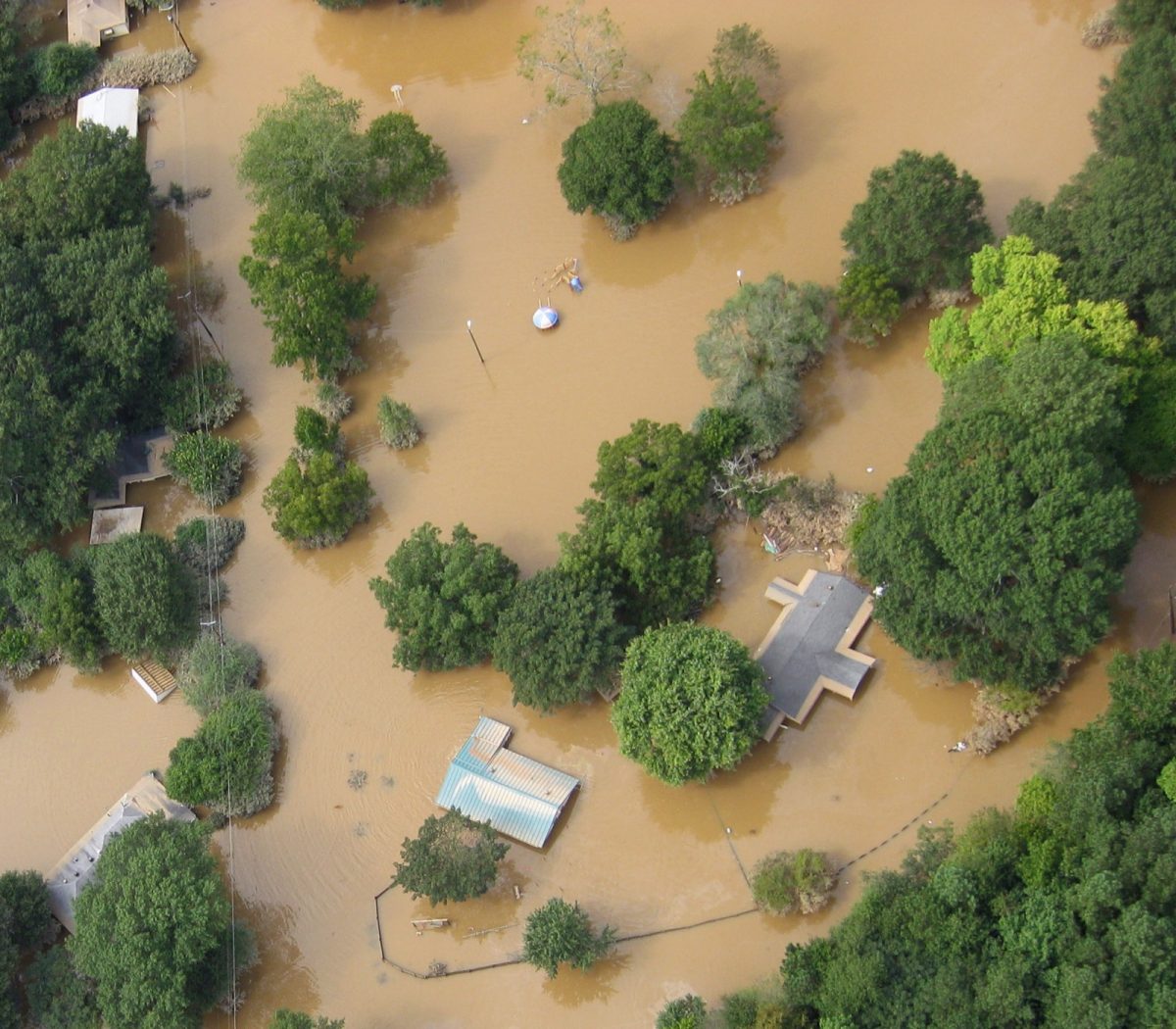
NOAA expects a strong El Nino this winter, with wetter conditions favored across the Southeast. Two major outlook updates arrive Nov. 12 and 19. Shown: aerial view of homes and yards surrounded by brown floodwater in Central Georgia (file photo from a past flood, not this winter). Photo: Bruce Kinney / Wikimedia Commons (Public domain)
COLUMBUS, Ga. - A very strong El Nino is expected to influence weather across the United States this winter, with wetter-than-average conditions favored across the Southeast, according to the National Oceanic and Atmospheric Administration. NOAA's 2026-2027 U.S. Winter Outlook, released Oct. 15, covers December 2026 through February 2027 and identifies El Nino as a major factor in the seasonal forecast. Two additional federal weather updates are scheduled for Nov. 12 and Nov. 19, providing new information about the developing climate pattern and the outlook for the months ahead.
The forecast indicates that wetter-than-average conditions are most likely across the southern United States and along the East Coast, according to NOAA. Near-normal temperatures are favored in parts of the Southeast, including Florida, while warmer-than-average conditions are favored across much of the eastern United States. The outlook describes broad regional patterns rather than specific predictions for Columbus or Muscogee County.
NOAA's Winter Outlook Covers December Through February
NOAA released its national winter outlook Oct. 15 under the title "El Nino looms large over U.S. Winter Outlook." The forecast covers the three-month period from December 2026 through February 2027. It addresses expected temperature patterns, precipitation trends and drought conditions across different regions of the country.
According to NOAA, wetter-than-average conditions are most likely across the southern tier of the United States, extending from the Southwest to the Southeast. The agency also favors above-average precipitation along the East Coast. These regional projections describe seasonal precipitation tendencies rather than specific rainfall amounts or individual storms.
NOAA's temperature outlook identifies near-normal temperatures as the most likely outcome in parts of the Southeast, including Florida. At the same time, warmer-than-average temperatures are favored across much of the East, the Midwest and the Mississippi Valley. NOAA also favors warmer-than-average temperatures in the Pacific Northwest, northern California and Alaska.
NOAA's forecast can favor wetter conditions in a region without assigning that region the same temperature category. The agency's October release provides these broad geographic patterns without specifying winter rainfall totals or temperature probabilities for Columbus. Readers who want local detail should treat the outlook as a regional guide rather than a Columbus forecast.
A Very Strong El Nino Is Expected to Influence Weather Patterns
Ken Graham, director of NOAA's National Weather Service, said a very strong El Nino is likely to affect the position of the jet stream across the continental United States. The anticipated change involves a shift toward the south and east, according to Graham. NOAA identified that expected shift as part of its explanation of the coming winter's weather patterns. "A very strong El Nino will likely bring a southward and eastward shift to the jet stream for the contiguous U.S.," Graham said in NOAA's Oct. 15 announcement.
The Climate Prediction Center's separate Oct. 8 discussion also described the strengthening El Nino. According to the center, an El Nino Advisory was in effect, and the climate pattern was continuing to intensify. The center projected a greater than 83% chance of strong-to-very strong El Nino conditions continuing through the January-March 2027 period.
The center reported a Nino-3.4 index reading of +2.1 degrees Celsius in its October discussion. That measurement appeared alongside the agency's assessment that El Nino was continuing to strengthen. The discussion also included probabilities for an event potentially reaching historic strength during several overlapping three-month periods.
Climate Prediction Center Gives Historic El Nino High Probabilities
NOAA's Climate Prediction Center assigned substantial probabilities to an El Nino event meeting its historic-strength threshold. The center defined that threshold as a three-month Relative Oceanic Nino Index, or RONI, of +2.5 degrees Celsius or higher. According to its Oct. 8 discussion, such a reading would be stronger than any El Nino event since 1950.
The center's probabilities varied depending on which three-month period was examined. The highest published probability among the three periods listed was 83% for October through December. The other periods carried lower, but still substantial, probabilities.
| Three-month period | Chance of historic-strength El Nino |
|---|---|
| September-November 2026 | 54% |
| October-December 2026 | 83% |
| November 2026-January 2027 | 70% |
Source: NOAA Climate Prediction Center, Oct. 8, 2026.
Those figures describe the likelihood of El Nino reaching the center's defined historic-strength threshold. They do not represent probabilities of particular weather outcomes in Georgia or any other individual state. The Climate Prediction Center specifically cautioned that weather impacts consistent with El Nino become more likely during an event of this magnitude but are not guaranteed.
An unusually strong El Nino does not, by itself, establish how much precipitation any individual community will receive. The federal outlook provides regional expectations without assigning Columbus a specific seasonal rainfall total. The center's caution that impacts are not guaranteed applies to every region, including Georgia.
Wetter Conditions Favored Across the Southeast
The precipitation outlook identifies the Southeast as part of a broader southern region where above-average precipitation is most likely. According to NOAA, the favored wetter pattern stretches from the Southwest across the southern tier and extends along the East Coast. The outlook does not provide a specific precipitation amount for Columbus.
NOAA also expects drought conditions to improve or end in several regions by the end of January. Those areas include the Southwest, Southern Great Plains, Southeast and parts of the East Coast. The forecast describes a regional expectation and does not identify the current drought classification of Muscogee County.
Graham warned that heavy precipitation can create dangers when it falls on dry ground. In NOAA's announcement, he said, "too much precipitation on dry soil can fuel destructive flash floods and mudslides." That statement is a general caution about dry soil and heavy rain, not a forecast for Columbus.
The expected improvement in drought conditions and the possibility of flooding are separate aspects of the outlook. NOAA anticipates drought relief in several regions while also identifying potential hazards associated with excessive precipitation. Neither assessment establishes that Columbus will experience flooding or a particular amount of winter rainfall.
What NOAA Says About Temperature and Snow
NOAA's temperature outlook favors near-normal conditions in parts of the Southeast, including Florida. Warmer-than-average conditions are favored across much of the East and several other regions. The agency does not assign a Columbus-specific temperature forecast in the information provided with the October outlook.
The winter outlook also should not be interpreted as a forecast of seasonal snowfall totals. Fox 5 Atlanta, reporting on NOAA's outlook, noted that the federal forecast does not provide seasonal snow totals. NOAA's Oct. 15 release likewise does not project snowfall amounts.
The absence of seasonal snowfall totals means the outlook cannot be used to determine how much snow a particular city will receive. It also does not establish whether Columbus will experience an ice storm or other specific winter weather event. NOAA's published outlook addresses broader seasonal conditions rather than predicting individual winter storms.
NOAA Introduces Additional Forecast and Warning Information
Alongside the seasonal forecast, NOAA announced that its Probabilistic Precipitation Portal is operational. The agency included the portal in its Oct. 15 winter outlook announcement. The release also identified changes to wording that may appear in certain winter weather warnings during the coming season.
According to NOAA, selected Blizzard Warnings and Ice Storm Warnings will use the designation "Particularly Dangerous Situation." The agency described this wording as part of its winter warning information. The announcement did not identify a specific warning for Columbus or predict that one would be issued locally.
Graham also urged communities and individuals to prepare for the upcoming winter. "Now is the time for communities and individuals to plan ahead for the upcoming winter," he said in NOAA's announcement. The advice is general and applies to communities across the country.
Next El Nino Update Scheduled for November 12
The Climate Prediction Center's next El Nino-Southern Oscillation discussion is scheduled for Thursday, Nov. 12, 2026. That update follows the center's Oct. 8 advisory, which identified strengthening El Nino conditions and provided the probabilities for a strong-to-very strong event. It is the next scheduled opportunity for the center to update its assessment of the developing climate pattern.
The Oct. 8 discussion placed the probability of strong-to-very strong El Nino conditions through January-March 2027 above 83%. It also listed the three probabilities for an event meeting the historic-strength threshold. Those figures remain the published estimates from that discussion until they are superseded by a subsequent update.
NOAA's Climate Prediction Center publishes its El Nino discussions at https://www.cpc.ncep.noaa.gov/products/analysis_monitoring/enso_advisory/ensodisc.shtml. The page is the official source identified for the Oct. 8 discussion and the scheduled Nov. 12 update. The November discussion will follow the center's October assessment of a strengthening event.
November 19 Brings NOAA's Next Three-Month Outlook
NOAA has scheduled its next three-month outlook update for Thursday, Nov. 19, 2026. The date appears in the agency's Oct. 15 winter outlook announcement. That update follows the Nov. 12 El Nino discussion by one week.
The two dates involve related but distinct federal climate products. The Nov. 12 discussion concerns the status and expected development of El Nino, while the Nov. 19 release is NOAA's scheduled three-month outlook update. Together, they provide the next scheduled federal updates following the October forecasts.
NOAA's official winter outlook is available at https://www.noaa.gov/news-release/el-nino-looms-large-over-us-winter-outlook. Local forecasts and weather alerts are available through the National Weather Service at weather.gov, including its Peachtree City forecast office. The October seasonal outlook does not provide Columbus-specific precipitation totals, snowfall amounts or winter storm predictions.
Source: National Oceanic and Atmospheric Administration (NOAA), NOAA Climate Prediction Center

News organizations may republish this story with credit. See our guidelines.
Know someone who'd want to read this? Email it to a friend.
Own a Columbus business? 20,000+ page views in 30 days. Ads from $125/month. See ad options Follow Columbus Times on FacebookLocal news, events and people, in your feed every day.Most read this week
- Georgia's 3 Amendments: Which Will Pass, Who's Against Them, and What Happens If They Fail
- Georgia's 3 Constitutional Amendments on the Nov. 3 Ballot, Explained in Plain English
- Columbus Early Voting Ends Friday: 32,307 Muscogee Ballots Cast, 6% Ahead of 2022 Pace
- Georgia Election Forecast 2026: Who Is Projected to Win Every Major Race?
- Early Voting in Columbus Starts Oct. 13: Every Site, the Hours, and What's on Your Ballot
More stories
 Military Fort Benning Ceremony Calendar: 12 Graduations, 20 Turning Green Events and 2 Turning Blue Ceremonies Through Dec. 17
 Education Columbus Technical College Graduates Record 1,543 Students, Reports 94.6% Job Placement and Five Years of Growth
 Politics What Polls and Forecasters Say About Georgia's Nov. 3 Races and 3 Amendments
 Community Columbus Native Writes the Tom's Foods Story: Author Haisten Willis Speaks and Signs Books at Columbus Public Library Nov. 19
Comments
Be respectful. No personal attacks, hate speech, spam or anyone's private information. Every comment is reviewed before it appears. Comment rules
No comments yet. Be the first to share your thoughts.