Columbus Airport's 6 Biggest Milestones: From Early Airmail Service to a $24 Million Runway Rebuild
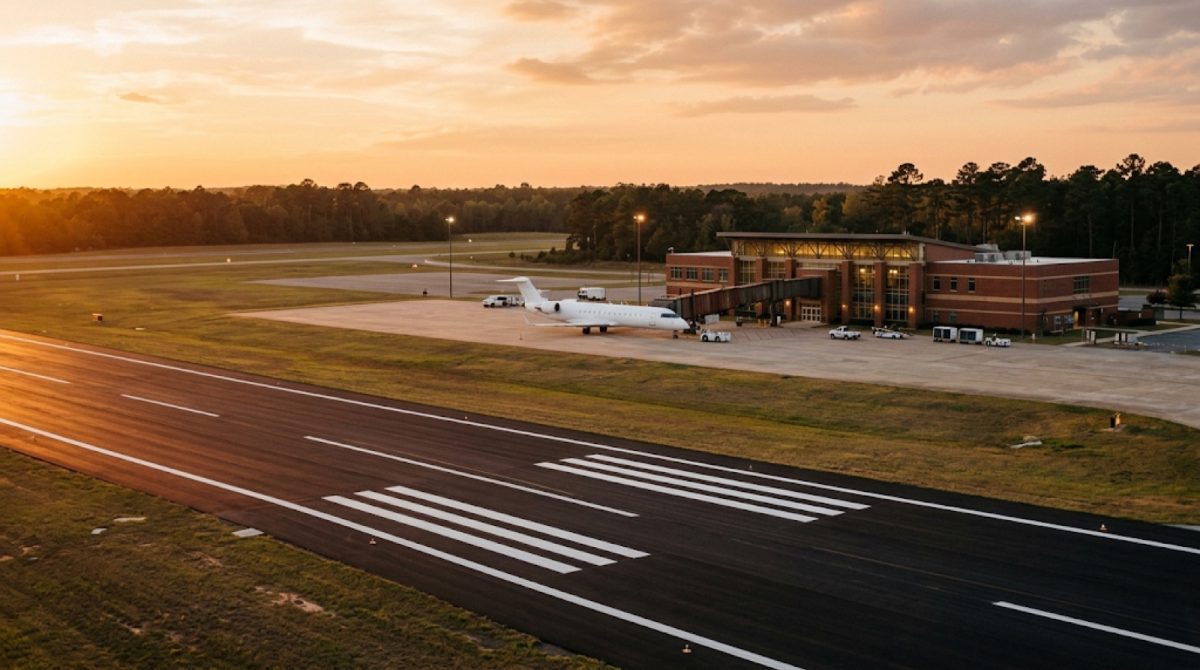
Columbus Airport traces its history to the 1940s and rebuilt its main runway in 2025. Illustration: AI-generated
Columbus Airport has evolved from an early airmail facility serving the Chattahoochee Valley into a 680-acre regional airport with two runways, a modern passenger terminal and more than $40 million in major terminal and runway projects announced or completed since 2020. Six milestones explain how the airport developed, from the introduction of commercial jet service in 1968 to the reconstruction of its primary runway in 2025.
The airport, identified by the three-letter code CSG, serves Columbus, Phenix City, Fort Benning and neighboring communities in Georgia and Alabama. Its story includes changes in airline service, airport governance, passenger facilities and the infrastructure needed to keep commercial and private aircraft operating.
Today, the airport is owned and operated by the Columbus Airport Commission. Its official records describe an institution that has repeatedly adjusted to changing aviation demands while maintaining its role as the Chattahoochee Valley's hometown airport.
Here are six documented milestones, counted down chronologically from the airport's earliest history to its latest major reconstruction.
The 6 milestones at a glance
| No. | Year | Milestone |
|---|---|---|
| 6 | 1940s | Early airport service and airmail origins |
| 5 | 1968 | Airport Commission established; Delta introduces jet service |
| 4 | 1969 | Eastern begins service; land acquired at Britt David Road |
| 3 | 1991 | Modern two-story passenger terminal completed |
| 2 | 2020-2022 | Major terminal renovation and statewide recognition |
| 1 | 2025 | Primary commercial runway reconstructed |
The milestones are ordered by time, not by financial value or importance. Each represents a documented change in how Columbus Airport was governed, operated, used or maintained.
No. 6: The 1940s — Columbus Airport begins with airmail service
The airport's earliest purpose was different from what most travelers associate with flying today. According to the Columbus Airport Commission's historical account, the facility originally developed to provide airmail service to the Columbus area.
Mail transportation was one of the airport's earliest documented functions, establishing an aviation connection for a city that would later support scheduled passenger flights and general aviation. The airport's history page also says the facility was among the relatively few airports established without a hearing before the federal aviation authority.
The earliest location was not the passenger terminal used today. In a 2019 anniversary announcement, the Airport Commission described the original facility as a small, one-room terminal off Victory Drive in south Columbus.
There is an important discrepancy in the airport's own historical records concerning its starting year. The airport director's current welcome message says Columbus Airport has served the region since 1941, while the Commission's 2019 anniversary announcement celebrated 75 years of service dating to Aug. 1, 1944.
The available official pages do not explain whether those dates refer to different stages of airport development, such as the start of operations and the beginning of another form of air service. For that reason, the exact opening date should not be treated as settled by those records alone.
What is clear is that the airport's roots extend into the 1940s and that its early operation was closely associated with airmail. From that starting point, it developed into a much larger operation with commercial flights, private aircraft, maintenance facilities and dedicated airport administration.
The difference between the original one-room terminal and the present facility illustrates the physical growth documented by the Commission. The airport's current terminal complex alone covers approximately 66,000 square feet.
No. 5: 1968 — A new Airport Commission and Delta jet service
The year 1968 brought two major developments to Columbus aviation. The Columbus Airport Commission was created, and Delta Air Lines introduced jet air service to the city.
The Commission was established April 9, 1968, through an amendment to the Georgia Constitution. According to the airport's 2018 anniversary announcement, the organization was created to oversee airport operations and the development of its facilities.
The governing structure includes five members appointed by Columbus Council. This arrangement places the management of the airport under a dedicated public body rather than a private airline or independent commercial operator.
The same year, Delta began jet service at Columbus Airport, according to the Commission's official history. That milestone reflected a change in the type of commercial aviation available to passengers in the Chattahoochee Valley.
Jet service represented a significant technological and operational development compared with earlier generations of aircraft. It also meant that airport infrastructure and passenger facilities needed to remain compatible with the aircraft and airline requirements of the jet era.
The Commission's creation and the arrival of Delta jets were separate events, but their timing makes 1968 a particularly important year. Columbus had both a new organization responsible for airport development and a commercial airline operating jet aircraft.
Delta remains central to the airport's passenger service decades later. The airport's current airline information page identifies Delta as its commercial air carrier, giving the 1968 introduction of jet service a continuing connection to today's operations.
No. 4: 1969 — Eastern Airlines arrives and the airport secures land for expansion
Another airline milestone followed in 1969, when Eastern Airlines introduced service to Columbus. The airport's official history places Eastern's arrival one year after Delta began operating jets.
With the two airlines serving Columbus, the city's aviation connections were developing beyond the original airmail operation. The Commission's history does not provide a complete timetable of Eastern's flights, so the number of daily departures, routes and aircraft used that year cannot be confirmed from that account.
The same year also brought a change involving the airport's physical property. A later Airport Commission press release states that the airport acquired land at 3250 W. Britt David Road in August 1969.
That address remains the airport's official location today. The acquisition is a useful landmark in the institution's development because it connects the airport's earlier history to the site occupied by its modern terminal and other facilities.
The Commission's historical material also documents how modest some of its administrative facilities remained in the years following that acquisition. A 2023 announcement about longtime employee Marshall Upshaw says the airport's administrative offices were located inside a hangar when he began working there in August 1978.
Upshaw's career provides an unusually long perspective on the airport's development. According to the Commission, he started as a janitor on Aug. 21, 1978, later worked in maintenance and grounds operations, and witnessed the 1991 terminal dedication as well as the renovated terminal's 2021 opening.
The combination of Eastern's arrival and the land acquisition makes 1969 more than another date in an airline timetable. It was a year that linked expanding commercial service with the development of the property that would become the airport's modern home.
Today, the airport occupies approximately 680 acres, according to its official fact sheet. The current property supports commercial aviation, general aviation and the other operational facilities needed to maintain an active regional airport.
No. 3: 1991 — Columbus completes a modern two-story terminal
In 1991, Columbus Airport completed a modern two-story passenger terminal, replacing an earlier generation of airport facilities with a larger building designed for commercial operations. It was a substantial physical milestone in the airport's development.
The Commission's historical account identifies 1991 as the year the terminal was completed. Its later renovation announcements repeatedly refer to the building as the existing terminal, making clear that the modernization undertaken three decades later was not the construction of an entirely new terminal on a different site.
The 1991 project provided a foundation for the airport's future passenger operations. However, a building constructed to meet the expectations and technology of one decade does not necessarily remain efficient or convenient indefinitely.
By the late 2010s, the airport was examining the limitations of its existing terminal. Its fiscal 2017-18 annual report states that the Federal Aviation Administration had issued a grant in fiscal 2017 to assess the passenger terminal.
That report described the 1991 building as retaining many of its original systems and architectural elements. The Commission considered the facility outdated and expensive to operate, and it planned a project to modernize the building and make it more convenient for travelers.
The report also connected modernization with a goal of reducing operating costs. In other words, airport officials were considering more than the appearance of the terminal; they were evaluating whether its infrastructure could remain practical for future operations.
The 1991 construction also stands out because it established the building that continued to serve travelers for the next three decades. Airport records show that a major modernization did not begin until March 2020.
The current airport fact sheet lists a terminal complex measuring 66,000 square feet, with two terminal buildings and three gates. Although those figures describe the present complex rather than the original 1991 building alone, they provide a sense of the scale of passenger facilities now available at Columbus Airport.
No. 2: 2020-2022 — A $19.8 million terminal project changes the airport
One of Columbus Airport's most important recent construction projects began in March 2020, as the COVID-19 pandemic disrupted travel and business activity nationwide. Instead of abandoning its modernization plans, the airport proceeded with a substantial terminal renovation funded through federal, state and local sources.
The Airport Commission announced that the completed terminal improvements would be celebrated Oct. 21, 2021. Its news release dated Oct. 19, 2021, describes the project as the first major modernization of the existing terminal since the building's completion in 1991.
The Commission's release gives a total project funding figure of $19.8 million. The individual amounts identified in that announcement are shown below.
| Funding source | Amount announced |
|---|---|
| Federal Aviation Administration grant | $9.7 million |
| State of Georgia grant | $650,000 |
| U.S. Department of Transportation grant | $3.5 million |
| Columbus Airport Commission local share | $6 million |
| Total reported by the airport | $19.8 million |
Source: Columbus Airport Commission, Oct. 19, 2021. The listed amounts are rounded; their arithmetic sum is $19.85 million.
The project changed the terminal's appearance and infrastructure. The Commission's published project information and annual report describe renovations to building systems, passenger areas, electrical equipment, plumbing, heating and cooling systems, and lighting.
The airport's annual report states that the terminal renovation replaced internal electrical, plumbing and HVAC systems, while LED fixtures replaced existing lighting. It also describes improvements in passenger circulation, security processing and passenger amenities.
The redesigned terminal incorporated elements representing several communities served by the airport. According to the Commission, its interior design included blue representing the Chattahoochee River connecting Columbus and Phenix City, green representing the forests of Harris County, and sand tones representing Fort Benning.
Those features reflect the airport's regional mission. The airport is located in Columbus, but its passenger market and public identity extend across the Georgia-Alabama state line and into neighboring counties.
The new look also helped bring back a second airline. American Airlines returned to Columbus on Aug. 17, 2021, with daily nonstop flights to Charlotte and Dallas/Fort Worth, and a 2022 Commission release credited the renovation with helping recruit it. The airport's airline page today lists Delta as its commercial carrier.
The renovation also gained statewide recognition. Columbus Airport's official history reports that the Georgia Airports Association named the project its 2022 Commercial Service Airport Project of the Year.
There is one financial distinction worth understanding. Although the October 2021 completion announcement lists approximately $19.8 million in project funding, another Commission announcement later describes the terminal renovation as a $20.8 million project. The publicly available announcements do not reconcile the two totals, so the $19.8 million figure here refers specifically to the October 2021 funding announcement.
That distinction matters when reviewing large public infrastructure investments. Announced funding totals, construction budgets and final project costs are not always identical, and they should not be treated as interchangeable without supporting financial documentation.
For Columbus, the practical result was a substantially updated passenger terminal built around the existing 1991 structure. The investment addressed systems that had remained in service for decades and gave the airport a renovated facility for future commercial aviation.
No. 1: 2025 — Columbus rebuilds its primary commercial runway
The most recent milestone in this countdown is the reconstruction of Runway 6-24, the airport's primary commercial runway. Columbus Airport announced a major rebuilding project in 2025 after engineering investigations identified deterioration requiring more than ordinary pavement maintenance.
The airport's April 2025 announcement estimated the project at $22.2 million, funded through Federal Aviation Administration and Georgia Department of Transportation grants. By the August groundbreaking, the Commission's announcement and its runway project page put the estimate at $24 million. The project page also shows the bids that came in back in August 2024: six of them, one for asphalt and five for concrete, ranging from $22.23 million to $37.96 million. The work was a full rebuild, not a simple repaving.
According to the Airport Commission, a geotechnical assessment examined conditions beneath the runway through field reconnaissance, soil borings and sampling. The findings supported removing and replacing the existing asphalt and base materials.
The project also included improvements to drainage infrastructure. Those were important because the airport identified deteriorated storm drains and underlying drainage problems among the reasons for the reconstruction.
The Commission planned the job as a continuous 103-day closure. Construction began in August 2025, and the Commission announced that the runway reopened Friday, Nov. 28, 2025. A public ribbon-cutting ceremony was scheduled for Dec. 5, 2025.
The work had a direct impact on passenger service. During the planned reconstruction period, commercial flights were suspended because the runway used for commercial airline operations was unavailable.
Military and large general aviation operations were suspended too. The airport's secondary runway, Runway 13-31, stayed open except for a short stretch when contractors worked through the spot where the two runways cross.
The project represented an investment in infrastructure that passengers may rarely consider when booking a flight. Runway surfaces, supporting pavement layers and drainage systems are essential to maintaining reliable aircraft operations, regardless of the size of an airport's passenger terminal.
Officials describe Runway 6-24 as 6,997 feet long. The project was designed to address the condition of that pavement and provide a more durable operating surface for commercial, military and general aviation activity.
Together with the earlier terminal renovation, the runway project demonstrates the scale of the airport's latest modernization efforts. Add the Commission's $19.8 million terminal funding figure to the $24 million runway estimate and you get about $43.8 million ($19.8 million + $24 million). That is a total of announced figures, not an audited final cost for both projects.
What does Columbus Airport look like today?
The Columbus Airport Commission's published fact sheet provides a detailed picture of the facility following decades of development. It operates on approximately 680 acres, about six miles from downtown Columbus, with two runways and a passenger terminal complex containing three gates.
| Airport feature | Published information |
|---|---|
| Airport code | CSG |
| Location | 3250 W. Britt David Road |
| Distance from downtown | Approximately 6 miles |
| Airport property | 680 acres |
| Runways | 2 |
| Terminal complex | 66,000 square feet |
| Passenger gates | 3 |
| Public parking | More than 1,214 spaces |
| Commercial airline listed | Delta Air Lines |
Source: Columbus Airport Commission's official airport fact sheet and airline information page.
Commercial passenger flights are only part of the airport's activity. The Commission also operates Flightways Columbus, a fixed-base operator serving general aviation customers, and maintains facilities for aircraft other than scheduled passenger jets.
The airport's history shows how those responsibilities developed alongside commercial air service. Early airmail operations eventually gave way to jet service, expanded facilities and a dedicated commission responsible for the airport's operation and development.
For travelers, the airport's airline page asks passengers to arrive 2 hours before a scheduled departure. It also says Delta ticket counters close 45 minutes before departure, so arriving early matters even at a smaller airport.
The six milestones also help explain why Columbus Airport remains a regional institution rather than simply another commercial terminal. Its governing body, airport property, passenger infrastructure and runway system represent decades of public investment serving communities on both sides of the Chattahoochee River.
How we did this
Columbus Times reviewed the Columbus Airport Commission's official history, anniversary announcements, press releases, annual reports, passenger information and airport fact sheet.
The countdown follows six documented periods in chronological order. Project amounts are identified as published funding figures or estimates, and conflicting historical dates and construction totals have been distinguished rather than presented as settled facts.
Source: Columbus Airport Commission; Columbus Airport historical records, press releases and project reports
News organizations may republish this story with credit. See our guidelines.
Know someone who'd want to read this? Email it to a friend.
Own a Columbus business? 60,000+ page views a month. Ads from $125/month. See ad optionsPlan your weekend with Columbus Times
Get This Weekend in Columbus every Thursday: the best local events, free things to do and family fun, plus each evening's local news. Free, and you can unsubscribe anytime.
Most read this week
- 8 Columbus Restaurants Got a C on Their Health Inspection in 2026, the Most of Any Year Since 2022. Here's Every One
- Georgia's 3 Amendments: Which Will Pass, Who's Against Them, and What Happens If They Fail
- The Night Fight on the Chattahoochee: How Columbus Became the Site of What Many Call the Last Battle of the Civil War
- The 10 Best Mexican Restaurants in Columbus, Ga., Ranked by Diners
- Georgia's 3 Constitutional Amendments on the Nov. 3 Ballot, Explained in Plain English
More stories
 Local 35 Years of Columbus Weather Records Show When the First Freeze Usually Arrives
 Local Columbus vs. Augusta, Macon and Savannah: 15 Questions on Pay, Rent and Home Prices
 Local Columbus' 10 Biggest Chattahoochee River Floods Since 1841, Ranked by USGS Records
 Local The Night Fight on the Chattahoochee: How Columbus Became the Site of What Many Call the Last Battle of the Civil War
Comments
Be respectful. No personal attacks, hate speech, spam or anyone's private information. Every comment is reviewed before it appears. Comment rules
No comments yet. Be the first to share your thoughts.