3 Columbus Landmarks Tell 155 Years of History: The Springer, Liberty Theatre and a 390-Building Historic District
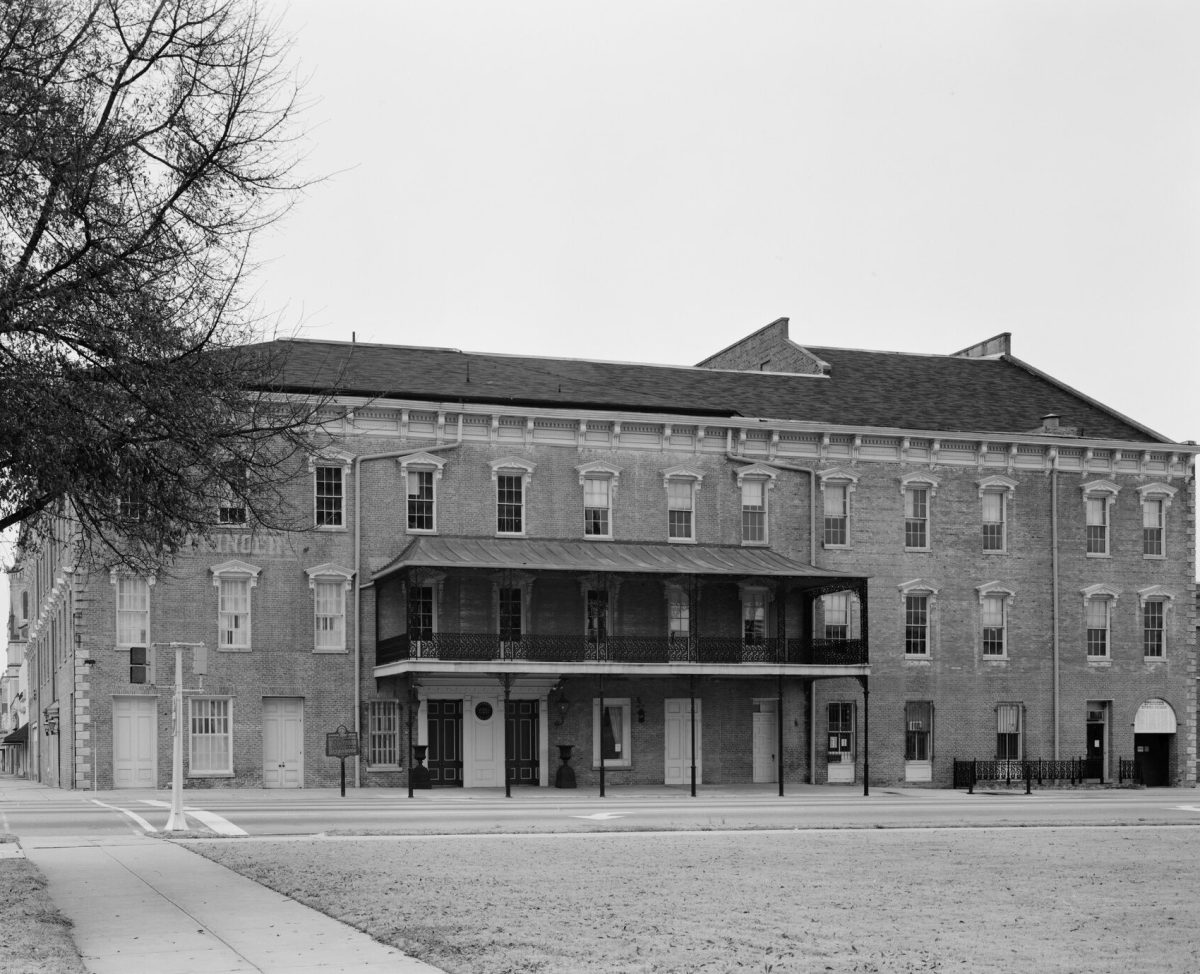
The Springer Opera House, opened in 1871, photographed for the Historic American Buildings Survey. Photo: Historic American Buildings Survey / Library of Congress (public domain)
Columbus, Georgia, has three historic places that tell very different stories about the city's development: the Springer Opera House, which opened in 1871; the Liberty Theatre, built for Black audiences in 1925; and the Columbus Historic District, whose preservation records document hundreds of buildings dating from the 19th and early 20th centuries. Together, they reveal how entertainment, segregation, architecture and preservation helped shape the city.
These are more than familiar buildings or destinations for photographs. Their historical records explain who could attend performances, how Columbus neighborhoods developed, and why some structures survived when others disappeared.
The documentation also contains details that are easy to overlook. The Springer nearly disappeared before preservation efforts revived it. The Liberty's own history is still being sorted out by researchers, while the Historic District became an early example of organized neighborhood preservation in Georgia.
Here is what National Register nominations, university archives and official venue histories reveal.
1. Springer Opera House: The theater built in 1871 that almost disappeared
The Springer Opera House opened in February 1871, only a few years after the Civil War. Its founder, Francis Joseph Springer, was an immigrant from Alsace who had established himself in Columbus as a businessman.
According to the theater's National Register nomination, architect Daniel Matthew Foley designed the building. The opera house sits inside a three-story red-brick building that the nomination says was formerly a Victorian hotel.
The building reflected the ambitions of a city rebuilding its commercial and cultural life. The theater's opening production was an amateur concert presented by members of Trinity Episcopal Church.
Today, the Springer remains one of Columbus's most recognizable cultural institutions. Its significance, however, extends beyond the productions presented on its stage.
What made the Springer different from other theaters?
The original Springer was part of an elaborate three-story red-brick building at First Avenue and 10th Street. Its National Register nomination describes a Victorian structure with ornamental metalwork, stone window sills, chandeliers and a richly decorated auditorium.
The building occupied a substantial downtown property, measuring approximately 145 by 150 feet. Its exterior included evenly spaced upper-story windows, pressed-metal decorative elements and a substantial cornice.
Inside, the theater combined architectural decoration with performance technology. The nomination describes an elaborate stage system, balcony seating, ornamental lighting and decorative borders around the stage opening.
One of its distinctive features was a wooden overhead stage grid used to raise and lower scenery. The nomination described this system as an unusual surviving example when the building was documented.
The original marble foyer floor was also identified as a surviving historic feature. Other decorative elements were restored or reproduced during preservation work.
These details are important because the Springer is not simply an old building still being used as a theater. Its architectural fabric provides evidence of how large performance venues were designed and equipped in the 19th century.
Which performers and public figures appeared at the Springer?
The National Register nomination includes a documented list of performers, entertainers and speakers associated with the Springer during its early history. It records appearances by figures who were prominent nationally as well as people connected to the Chattahoochee Valley.
Among those identified are Buffalo Bill in 1875, actor Edwin Booth in 1876, musician Blind Tom in 1879 and writer Oscar Wilde in 1881. The nomination also lists appearances by actress Lillie Langtry in 1888 and boxer John L. Sullivan in 1892.
The theater was not restricted to opera, despite its name. Its programming included theatrical productions, musical performances, lectures and other public entertainment.
The Georgia Historical Society's marker notes another appearance of historical interest: Franklin D. Roosevelt delivered a speech at the Springer in 1928.
Taken together, these records show how an entertainment venue in Columbus participated in a much larger national cultural network. Performers and public figures traveled to the city during an era when live appearances were a major form of public entertainment.
How did the Springer survive demolition?
The Springer's history was not an uninterrupted success story. The venue's official history describes the growing popularity of motion pictures and changing economic conditions as factors in its decline.
The Georgia Historical Society's marker says the Springer sons completed renovations in 1902. The building became a movie house in 1941, reflecting the nationwide shift from live performances toward filmed entertainment.
By 1959, the Springer had closed. Its future became uncertain, and preservation advocates eventually organized efforts to keep the property from being demolished.
In 1964, the Columbus Little Theater Opera House Trustees was formed to save the building. Restoration followed, and the theater reopened with a production of St. Elmo on Oct. 6, 1965.
The Springer was listed in the National Register of Historic Places in 1970. It subsequently continued operating as a performance venue rather than remaining only a preserved architectural exhibit.
More recently, the theater reports completing an $11.5 million capital campaign in 2013 that included the development of the adjacent McClure Theatre. The newer performance space expanded its ability to present programming while maintaining the original historic building.
The Springer's survival illustrates how preservation can retain both historic architecture and the original purpose of a building.
2. Liberty Theatre: The 1925 landmark built for Black audiences
The Liberty Theatre opened in Columbus in late April 1925, during the era of racial segregation. Its original purpose was significantly different from that of the Springer Opera House.
The theater was constructed by the Martin Theatre chain to serve Black audiences. Its National Register nomination describes it as one of the relatively few theaters in Georgia built specifically for African Americans during that period.
Roy E. Martin, a white businessman who operated a growing theater chain, owned the enterprise. The Liberty was built in a predominantly Black section of Columbus known as East Commons.
Its significance cannot be understood without the conditions that shaped its creation. Segregation limited access to entertainment venues, making the availability of a dedicated theater particularly important to the surrounding community.
The Liberty became a place for movies, live entertainment and cultural gatherings at a time when many other public spaces were segregated.
What did the original Liberty Theatre look like?
The Liberty is a brick building at 813 8th Ave. The city's theater website says it contained a full stage where local groups could perform plays, a balcony and a stage loft.
The building included a stage suitable for live performances as well as equipment for showing motion pictures. This arrangement allowed the same space to accommodate different kinds of entertainment.
The National Register nomination and the city's website both put the seating at about 600, while Columbus State University's more recent research says the theater seated a maximum of 540.
Those source differences make it inappropriate to describe the original seating capacity as one settled number.
In April 1928, Martin opened the Royal Theater in Columbus, which the Liberty nomination says seated 2,800 people.
The Liberty also underwent a major remodeling in 1955, when a tile, plastic and glass front facade was attached over the original, according to the nomination.
Those changes reflected the building's continued commercial use rather than a deliberate effort to preserve its original appearance.
What could audiences see at the Liberty?
The Liberty showed silent films and later talking pictures, according to its National Register nomination. Local musicians accompanied screenings during the silent-film era, and the venue also hosted live entertainment.
Columbus State University's historical research identifies Saturday matinees and "Midnight Rambles," after-hours screenings of so-called race films made for Black audiences.
The university's exhibit reports that balcony movie tickets once cost 5 cents, while orchestra seats cost 10 cents. It also documents a partnership with RC Cola that let patrons trade five RC bottle caps for a Saturday matinee ticket.
These details offer a different perspective on the theater's role. The Liberty was not only a venue for major performances but also an everyday entertainment destination for members of the surrounding community.
The Liberty therefore provides a record of both entertainment history and the unequal social conditions that shaped access to it.
Did Ma Rainey and other famous musicians perform at the Liberty?
This is one area where historical sources require careful interpretation.
The Liberty's National Register nomination, prepared in the 1980s, identifies Columbus native Gertrude "Ma" Rainey as an important performer associated with the theater. It also discusses other blues and jazz musicians connected to Columbus's Black entertainment scene.
However, Columbus State University's more recent Liberty Theatre research warns that surviving concert programs and advertisements are limited. The university says it has not found concrete documentary evidence confirming many famous performers traditionally associated with the theater, including Ma Rainey.
The university suggests the stories may trace to performances by those artists organized by the local Elks Lodge at an exhibit hall at the old Columbus Fairgrounds, not at the Liberty.
That means the historical association between the Liberty and celebrated Black musicians should not automatically be treated as proof of a particular concert.
The safest conclusion is that the Liberty played an important role in Columbus's Black entertainment culture, while specific claims about appearances by nationally known performers remain disputed or unverified.
How was the Liberty Theatre saved?
Columbus State University's historical timeline records that the Liberty closed in 1973.
The city-operated Liberty Theatre website gives 1974 as the closing year, reflecting another difference among historical accounts. The university's more detailed research uses 1973.
Preservation efforts eventually centered on the William H. Spencer Golden Owlettes, an organization established by Spencer High School alumni. The group worked to protect local Black history and became closely associated with the effort to preserve the Liberty.
The theater was added to the National Register of Historic Places in 1984. Its restoration became part of a larger effort to preserve an important piece of Columbus's cultural and community history.
The Liberty reopened in 1997, according to the city's official theater website and Columbus State University's historical account.
Unlike the Springer, the Liberty's significance is inseparable from the history of segregation and the efforts of Black Columbus residents to preserve a cultural landmark. Its survival makes that history accessible through a physical building rather than historical documents alone.
3. Columbus Historic District: The neighborhood preservation effort that began in 1969
The third landmark is not a single building. The Columbus Historic District encompasses a large collection of homes, streets, churches and other properties documenting the city's early residential development.
The district entered the National Register of Historic Places on July 30, 1969. According to a National Park Service amendment prepared in 1988, it was the first historic district in Georgia listed through the regular National Register nomination process.
That distinction requires explanation. Some other nationally recognized Georgia historic areas had entered the federal register automatically through earlier landmark or park designations.
Columbus's nomination followed the standard district-listing procedure, making it an important example of organized historic preservation in the state.
The Historic Columbus Foundation sponsored the original nomination. The federal documentation describes the organization as an early leader in Georgia's preservation movement.
How large is the Columbus Historic District?
The 1988 National Register amendment documented a district covering approximately 166 acres and 20 city blocks in southwestern Columbus.
Its survey identified 390 buildings, approximately 95% of which were residential. The same survey classified 88% of the buildings as contributing to the district's historic character.
| Measure | 1988 National Register documentation |
|---|---|
| Historic district area | 166 acres |
| Approximate city blocks | 20 |
| Buildings documented | 390 |
| Residential buildings | 95% |
| Buildings contributing to historic character | 88% |
These figures describe the district as documented in 1988, not a newly conducted inventory of buildings standing in 2026.
The district generally extends between Ninth and Fourth streets, with the Chattahoochee River to the west and Fourth Avenue to the east. Its street layout reflects the city's original planning pattern.
Broadway serves as a central feature, with its wide right-of-way, median, brick pavement, street trees and sidewalks.
The National Register documentation treats those streetscape features as important parts of the district's character. Historic preservation in this setting concerns more than individual houses.
What kinds of houses are preserved in the district?
The 1988 amendment identifies homes dating from the late 1820s through the mid-1930s. They range from modest cottages and shotgun houses to large residences on Broadway.
Architectural styles include Federal, Greek Revival, Gothic Revival, Italianate, Second Empire, Queen Anne, Colonial Revival and Craftsman. Many houses combine stylistic features rather than following a single architectural design.
The survey found that nearly half the houses displayed Victorian eclectic characteristics. Approximately another third were classified as Greek Revival or Italianate.
Larger and older houses were concentrated primarily toward the western portion of the district, especially along Broadway. Smaller and later homes appeared more frequently along Second and Third avenues.
The variety matters because it records changes in housing over time. The neighborhood was not built during one short construction period and was not designed exclusively for one type of residence.
Its historic character comes from the relationship between houses, streets, landscaping and other neighborhood buildings.
Why does the historic district include ordinary houses?
The National Register evaluates historic districts as collections of related properties. A building does not have to be a mansion or the former residence of a famous person to contribute to an important historic neighborhood.
The Columbus nomination identifies neighborhood stores, churches, a school and industrial buildings alongside residential properties. These structures help document how the community functioned.
One example is the former Seventh Street School at 633 Second Avenue, which the federal amendment identifies as a two-story brick school building constructed in 1902.
The documentation also describes the Columbus Iron Works complex along the riverfront. Its presence illustrates the relationship between industrial activity and the surrounding neighborhood.
Even the streets and landscaped spaces are part of the historical record. The district's granite curbs, brick paving, sidewalks, median and tree-lined avenues help preserve the physical arrangement of the city.
The result is a district that tells the story of daily life and neighborhood development, not simply the lives of prominent individuals.
Why were some historic houses moved into the district?
One surprising detail in the 1988 National Register survey is that some historic houses had been relocated. The survey identified 15 houses moved into or within the district during the preceding decades.
According to the amendment, these buildings were moved to protect them from demolition at their original locations. Preservation officials considered their age, style, materials and placement when evaluating whether they contributed to the district.
The relocated properties generally matched surrounding historic buildings in appearance and construction. Their new positions were intended to remain compatible with the neighborhood's character.
This shows that preservation sometimes involves difficult choices. Saving a historic building at another location may preserve significant architecture even when the original setting cannot be retained.
The National Register amendment treated these particular relocated houses as contributing properties, explaining the basis for that decision in its documentation.
What connects these three Columbus landmarks?
The Springer, Liberty Theatre and Columbus Historic District represent different forms of preservation.
The Springer demonstrates how a deteriorating performance building can return to its original cultural purpose. The Liberty preserves an important part of Black entertainment history shaped by segregation and community organization.
The Historic District represents a broader effort to protect the architecture and layout of an entire neighborhood.
Their histories also overlap through the work of local preservation advocates, including the Historic Columbus Foundation, which prepared the Springer's National Register nomination and sponsored the Historic District's.
Together, these places show that preserving history involves more than retaining attractive architecture. It also requires understanding how buildings were used, who had access to them, and why communities fought to keep them.
For Columbus residents, the buildings offer a direct connection to different chapters of local history. Their value lies not only in their age but in the stories that official records allow future generations to examine.
How we did this
Columbus Times reviewed the National Register nominations for the Springer Opera House and Liberty Theatre, along with the 1988 National Park Service amendment to the Columbus Historic District nomination. We also examined the Georgia Historical Society's Springer marker, official venue histories and Columbus State University Archives' Liberty Theatre research.
All figures describing the Historic District refer to the federal survey documented in 1988. Conflicting historical dates, seating figures and performer claims were identified rather than presented as settled facts.
Source: National Park Service; Georgia Historical Society; Columbus State University Archives; Springer Opera House
News organizations may republish this story with credit. See our guidelines.
Know someone who'd want to read this? Email it to a friend.
Own a Columbus business? 60,000+ page views a month. Ads from $125/month. See ad optionsPlan your weekend with Columbus Times
Get This Weekend in Columbus every Thursday: the best local events, free things to do and family fun, plus each evening's local news. Free, and you can unsubscribe anytime.
Most read this week
- Georgia's 3 Amendments: Which Will Pass, Who's Against Them, and What Happens If They Fail
- Georgia's 3 Constitutional Amendments on the Nov. 3 Ballot, Explained in Plain English
- Early Voting in Columbus Starts Oct. 13: Every Site, the Hours, and What's on Your Ballot
- Georgia Election Forecast 2026: Who Is Projected to Win Every Major Race?
- 8 Columbus Restaurants Got a C on Their Health Inspection in 2026, the Most of Any Year Since 2022. Here's Every One
More stories
 Local Columbus' 10 Biggest Chattahoochee River Floods Since 1841, Ranked by USGS Records
 Local The Night Fight on the Chattahoochee: How Columbus Became the Site of What Many Call the Last Battle of the Civil War
 Local Columbus Holds On to No. 2 in Georgia by Just 172 People, and Grows for the First Time Since 2020
 Local Columbus Museum Announces Two October Events: Free Fall Festival and Roaring Twenties Mystery Night
Comments
Be respectful. No personal attacks, hate speech, spam or anyone's private information. Every comment is reviewed before it appears. Comment rules
No comments yet. Be the first to share your thoughts.