Columbus Fall Yard Waste 2026: 10 Rules for Leaves, Branches, Tree Removal and Pickup Fees
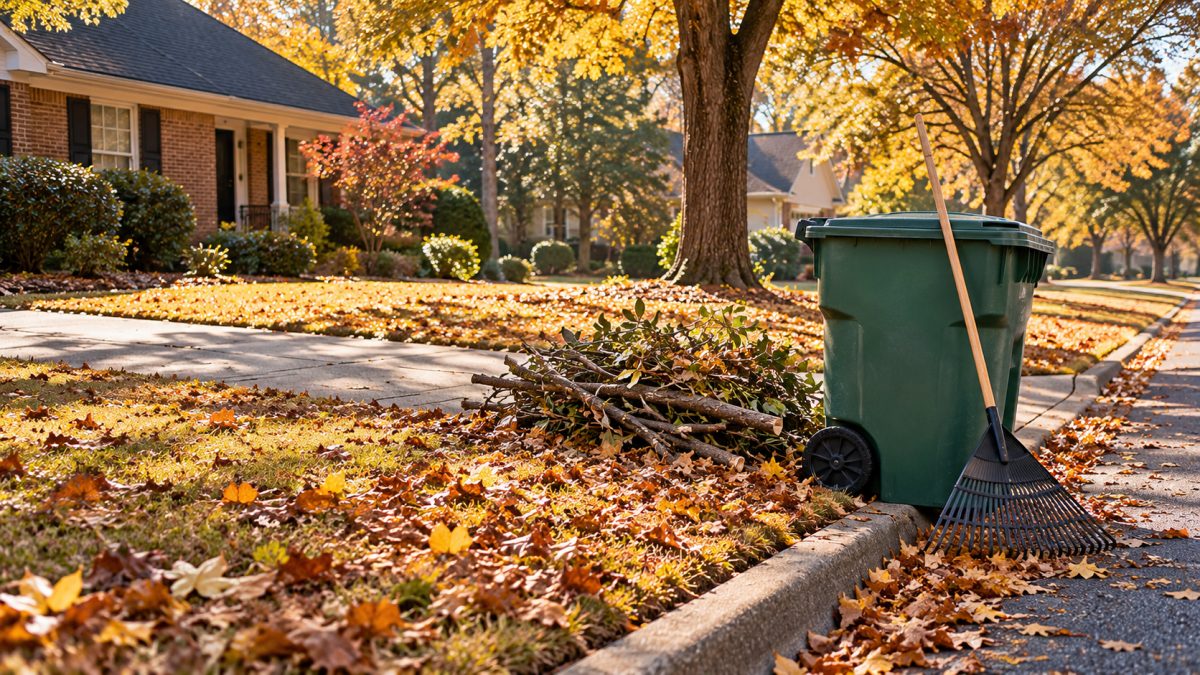
Leaves and grass go in the green cart; branches must be 4 feet or shorter and no more than 6 inches across. Illustration: AI-generated
Columbus, Georgia, residents can have fallen leaves, grass clippings, pine needles and other approved yard debris collected once a week through the city's yard waste service, but branches, large piles and entire trees follow different rules. As the late October and November cleanup season arrives, homeowners need to know the city's 4-foot branch-length limit, 6-inch diameter limit and special pickup fees before placing materials at the curb.
The Columbus Consolidated Government provides yard waste collection through its Public Works Department. Its current policy schedules household garbage, recycling, yard waste and bulk waste services on the same collection day, although the trucks and collection procedures are not necessarily the same.
Some yard debris belongs in a green rolling cart. Other materials require a special collection request, and waste produced by landscaping contractors must be removed by those businesses.
Here are 10 rules that can help homeowners avoid missed collections, unexpected charges and unnecessary trips to the landfill.
No. 10: Use the green cart for leaves, grass clippings and pine needles
The most basic rule is also one of the easiest to overlook. Columbus uses different colored carts for different types of household waste, and the green cart is specifically designated for yard debris.
According to the city's Integrated Waste Resources page, acceptable green-cart materials include fallen leaves, grass clippings, pine needles and similar yard waste. These materials are collected once per week as part of the city's regular residential service.
The green cart should not become an overflow container for household garbage. Columbus Public Works specifically states that ordinary household trash does not belong in it.
| Cart color | Designated purpose |
|---|---|
| Black | Household garbage |
| Brown | Additional household garbage |
| Blue | Recycling |
| Green | Yard waste |
The distinction matters when cleaning up a property because yard waste and household garbage are handled under separate collection rules. Putting ordinary trash in the green cart violates the city's published instructions.
Homeowners should keep the cart's contents limited to approved yard materials and avoid mixing them with plastic packaging, litter or other household debris.
No. 9: Your yard waste pickup is on your regular garbage day
Columbus changed its residential collection schedule effective Sept. 9, 2024. Under that policy, household garbage, recycling, yard waste and bulk waste service are assigned to the same collection day.
In other words, whatever day your black garbage cart is collected is also your day for recycling, yard waste and bulk waste.
That does not mean one truck collects every type of material. It means the various services are coordinated around the same day for the customer's address.
Residents can check their upcoming collection dates through the city's official Columbus GA Recycles mobile app. After entering an address, the app displays the scheduled dates for garbage, recycling, yard waste and bulk waste.
The city also cautions that normal pickup times can change as crews adjust their routes. Residents should not assume a truck will arrive at exactly the same hour each week.
For fall cleanup, the simplest approach is to check the assigned collection day and have the green cart ready before crews travel through the neighborhood.
No. 8: Keep leaves out of plastic bags
Columbus's current yard waste instructions require leaves and similar material to go into the green rolling cart without bags or household garbage. The city also prohibits mixed waste from being collected as ordinary yard debris.
That is particularly important during the fall, when homeowners may be tempted to fill plastic garbage bags with leaves. A bag may make yard work easier, but the city's published green-cart instructions do not authorize placing those bags inside the container.
The distinction also applies to other materials such as pine needles and grass clippings. They are accepted as yard debris, but that does not mean they can be mixed with household trash or plastic.
For a manageable amount of leaves, the recommended collection method under the current city instructions is straightforward: Put the loose material in the green cart. When the amount becomes too large for the container, follow the city's special bulk yard waste procedures instead.
Homeowners should not assume that an unrequested pile of filled bags will automatically be removed on collection day.
No. 7: Large leaf piles and bulk yard waste require a call to 311
The city's regular green-cart service is different from collection of large piles of yard debris. Columbus says bulk yard waste and large piles require residents to contact 311 and request a scheduled pickup.
That requirement comes from the city's September 2024 waste collection policy, which remains published on the Public Works website. It applies even though the different residential waste services share the same scheduled collection day.
A homeowner cleaning a large yard may therefore need to use two collection arrangements. Loose leaves that fit in the green cart can follow the regular service, while a large accumulation of yard debris should be reported for a bulk collection appointment.
The city also states that bulk waste crews cannot collect mixed piles. Combining yard trimmings with construction debris, household garbage or other unwanted materials can prevent collection.
Residents can contact Citizen Services by dialing 311 or 706-653-4000. When making the request, they should describe the type of debris and explain whether the material includes large branches or an entire cut-down tree.
That last distinction is especially important because a completely removed tree is handled under the city's separate fee-based policy.
No. 6: Branches must be no longer than 4 feet or wider than 6 inches
Columbus has specific dimensions for limbs placed out for ordinary city collection. Its official policy states that branches must be no longer than 4 feet and no more than 6 inches in diameter.
A limb that exceeds either limit is not eligible for collection under the published dimensions. Cutting a large branch into shorter sections does not solve the problem if the pieces are still too thick.
| Branch measurement | City maximum |
|---|---|
| Length | 4 feet |
| Diameter | 6 inches |
The city's Integrated Waste Resources page permits tree and shrub trimmings from pruning to be placed together at the curb. Its collection policy adds the size restrictions and the requirement to schedule pickup for bulk yard waste or large piles.
This means residents should distinguish routine trimming from a major tree removal project. A few appropriately sized branches from ordinary maintenance are not treated the same as a complete tree that has been cut down.
Before hiring a tree service or undertaking major pruning, homeowners should determine who will remove the resulting debris. The cost and collection responsibility can change considerably depending on who performs the work.
No. 5: Cutting down a whole tree can cost $50 plus $76.50 per ton
One of the most significant differences in the Columbus yard waste rules concerns entire trees removed from private property. The city does not include collection of cut-down trees in its normal solid waste service.
Instead, homeowners who want Columbus Public Works to remove a cut-down tree must request the Tree for Fee service. The city's current collection information lists a $50 collection charge per load plus a tipping fee of $76.50 per ton.
The policy also directs residents to request this service at 706-225-4661 and states that the charges are billed separately.
Here is what the published formula would produce for hypothetical loads:
| Tree debris weight | Collection charge | Disposal charge | Total |
|---|---|---|---|
| 0.5 ton | $50 | $38.25 | $88.25 |
| 1 ton | $50 | $76.50 | $126.50 |
| 2 tons | $50 | $153.00 | $203.00 |
The calculations assume one load for each example. Actual bills depend on the amount of material, the number of loads and any applicable adjustments.
For example, a one-ton load would cost $50 for collection plus $76.50 for disposal, producing a total of $126.50. A two-ton load would cost $50 plus twice the $76.50 disposal rate, or $203.
The city's policy says customers already receiving a reduced garbage collection fee qualify for a corresponding percentage reduction in this service's charges. Residents should confirm their eligibility and estimated costs when requesting collection.
The department asks customers to allow approximately one week from the request for Tree for Fee service. It also states that homeowners who decline city collection must remove their cut-down trees within 10 days of receiving notice.
No. 4: Your landscaping company must remove the waste it creates
Columbus makes an important distinction between yard work performed by residents and debris generated by commercial landscaping businesses. Its collection policy cites Columbus Code Section 13-167.2(8), requiring landscaping firms and certain other contractors to remove waste accumulated through their work.
The rule covers nurseries, landscape gardening firms, clearing and grading contractors, building contractors, and logging and pulpwood-related operations. It is not simply a preference about how branches should be stacked.
A homeowner who hires a landscaping company should make debris removal part of the service discussion before work begins. Otherwise, the customer may be left with a pile that does not qualify for collection in the same way as ordinary residential yard trimmings.
The distinction is especially relevant for tree cutting, major pruning and extensive property clearing. These projects can produce volumes or sizes of debris beyond the city's routine collection rules.
The city explicitly reminds customers to make sure their hired contractors remove waste in compliance with the ordinance. Residents should not assume that paying the regular household collection fee also covers cleanup from commercial landscaping operations.
No. 3: Pine Grove Landfill accepts yard debris, but there is a disposal charge
Homeowners who prefer to transport their own yard waste have an official disposal option at Pine Grove Municipal Landfill. The facility is located at 7900 Pine Grove Way, Columbus, GA 31907.
The city's published landfill information lists organic waste at $76.50 per ton. Accepted organic materials include limbs, stumps, trees, shrubs and land-clearing debris.
The landfill also operates equipment that grinds organic material as part of Columbus's recycling and compost program. However, the city prohibits green waste from being mixed with other waste in the same load.
Pine Grove accepts waste only from Muscogee County residents, who need a valid ID and a water bill. Contractors must show proof of where the job is being done, such as a work order or invoice.
The facility is open Monday through Friday from 8 a.m. to 5 p.m. It opens one Saturday a month on a published schedule, from 8 a.m. to noon.
The remaining scheduled Saturday openings in 2026 are:
| Date | Published hours |
|---|---|
| Nov. 7, 2026 | 8 a.m.–noon |
| Dec. 5, 2026 | 8 a.m.–noon |
The city requests that customers with normal loads arrive at least 30 minutes before closing. For large loads, it asks customers to arrive at least 90 minutes before the facility closes.
Residents should verify the schedule before making a trip, particularly when planning to transport heavy or bulky material.
No. 2: Burning leaves is generally prohibited in Columbus
Burning fallen leaves might seem like an alternative to hauling or collecting yard debris. However, Columbus has an ordinance that generally prohibits open burning of materials, including leaves, garbage, construction waste and other rubbish.
The Fire and EMS Department publishes Columbus Code Section 13-167.6 on its official website. The ordinance identifies exceptions for certain activities, including cooking, recreation, authorized fire-service training and qualifying construction or land-clearing operations using approved equipment.
Ordinary residential leaf disposal is not listed as a general exception. Homeowners should therefore not interpret the city's burning rules as permission to set fire to yard waste.
The fire department's guidance also explains that applicable burning activities must comply with Georgia Department of Natural Resources requirements. Its website directs readers to the Georgia Forestry Commission for burn permit and notification information.
The fact that a statewide permit or notification system exists does not automatically override the local restrictions. Residents should follow the stricter applicable requirements and use approved collection or disposal methods for routine leaves and branches.
For most Columbus homeowners, the city green cart or a properly scheduled bulk yard waste pickup is the more straightforward option.
No. 1: You may not need to collect every fallen leaf
The cheapest and simplest method of dealing with some fall leaves may be to reuse them on the property. University of Georgia Cooperative Extension recommends shredding leaves and using them as mulch in appropriate landscape beds.
UGA Extension explains that shredded leaves can help cover soil around trees, shrubs and other plants. It recommends a layer approximately 3 to 5 inches deep, depending on the application.
Shredding is important because large, whole leaves can blow out of planting beds. A lawn mower, bagging attachment or leaf shredder can reduce the material into smaller pieces that remain in place more easily.
The Extension guidance also describes using shredded leaves as a base underneath other landscaping materials such as pine straw or bark mulch. That approach can reduce the amount of additional mulch a property owner needs to purchase.
Leaves may also be added to compost systems rather than collected for disposal. Composting and mulching are separate from Columbus's curbside collection rules, but both offer homeowners a way to reduce the amount of material requiring pickup.
Residents do not have to retain all their leaves. The practical choice depends on the type of lawn, the amount of debris and whether there are suitable areas for reuse.
For homeowners with trees and garden beds, keeping some properly shredded leaves on the property can reduce the work of filling green carts or arranging bulk collection.
The Columbus fall yard waste checklist
The city's rules become easier to follow when the different categories are separated.
| Material or situation | What to do |
|---|---|
| Loose leaves and grass clippings | Use green cart |
| Pine needles | Use green cart |
| Small tree and shrub trimmings | Follow curbside yard waste rules and branch limits |
| Large yard waste pile | Call 311 for scheduled collection |
| Branch over 4 feet or 6 inches in diameter | Not eligible under normal limb dimensions |
| Entire tree cut down | Request Tree for Fee service |
| Landscaping contractor debris | Contractor must remove its waste |
| Yard waste mixed with household garbage | Separate materials |
| Self-hauled organic waste | Check Pine Grove Landfill fees and hours |
| Leaves suitable for landscaping | Consider shredding for mulch |
The first step is to determine whether the material is routine yard debris, bulk yard waste or a cut-down tree. That classification determines which collection rules apply and whether additional charges may be involved.
Homeowners should also remember that the collection day does not guarantee immediate service for an unrequested large pile. Scheduling is required for bulk debris, and city crews cannot collect mixed piles under the current rules.
For collection problems, use the city's 311 Citizen Services system. The official mobile app can help confirm an address's upcoming scheduled collection dates.
How much does Columbus residential collection cost?
Columbus Public Works lists its standard residential collection fee at $24 per month. It also lists an $18 monthly low-income rate.
Those are the city's published household collection charges. They should not be confused with the separate Tree for Fee service or landfill charges incurred when a resident transports material directly to a disposal facility.
The published difference between the standard and reduced monthly collection rates is $6. Over 12 months, the standard fee would total $288 and the reduced fee $216, using the monthly rates shown on the city's website.
A homeowner should not assume those amounts cover every possible type of debris removal. The city's policies establish separate procedures and charges for particular services.
The practical way to avoid an unexpected fee is to identify the material before arranging disposal and ask Public Works whether a special collection charge applies.
What residents should remember before November
Columbus's yard waste system offers regular collection for common debris, but homeowners need to distinguish ordinary leaves and trimmings from large piles, contractor-generated waste and entire trees. The green cart handles routine materials, while large bulk pickups require advance contact with the city.
Branch size and material separation also matter. A pile can be left behind if it includes oversized limbs, prohibited material or waste that should have been removed by a hired contractor.
For residents facing heavy fall cleanup, the best approach is to plan before placing debris at the curb. Check the collection schedule, separate the materials, request special pickup when necessary and consider reusing suitable leaves as mulch.
Those steps can help homeowners navigate the seasonal workload without confusing regular collection with the fee-based services described in the city's official policies.
How we did this
Columbus Times reviewed Columbus Public Works' current Integrated Waste collection policies, resource pages, landfill fees and operating schedules, together with Columbus Fire & EMS open-burning regulations. We also consulted the city's official collection app instructions and University of Georgia Cooperative Extension guidance on reusing leaves.
The prices in this article come from the city's published rates. The Tree for Fee calculations are hypothetical examples using the official per-load and per-ton charges, not actual customer bills. No collection volume, seasonal waste total or average homeowner expenditure has been estimated.
Source: Columbus Public Works; Columbus Fire & EMS; UGA Cooperative Extension

News organizations may republish this story with credit. See our guidelines.
Know someone who'd want to read this? Email it to a friend.
Own a Columbus business? 60,000+ page views a month. Ads from $125/month. See ad optionsPlan your weekend with Columbus Times
Get This Weekend in Columbus every Thursday: the best local events, free things to do and family fun, plus each evening's local news. Free, and you can unsubscribe anytime.
Most read this week
- Georgia's 3 Amendments: Which Will Pass, Who's Against Them, and What Happens If They Fail
- Georgia's 3 Constitutional Amendments on the Nov. 3 Ballot, Explained in Plain English
- Early Voting in Columbus Starts Oct. 13: Every Site, the Hours, and What's on Your Ballot
- Georgia Election Forecast 2026: Who Is Projected to Win Every Major Race?
- 8 Columbus Restaurants Got a C on Their Health Inspection in 2026, the Most of Any Year Since 2022. Here's Every One
More stories
 Community Georgia Trout Season Opens November 1 With Five Streams Stocked for Fishing
 Community Columbus’s Oldest Businesses Still Open: 10 That Have Lasted 75+ Years
 Community Columbus Approves $9.1 Million Pickleball Complex to Attract Tournaments and Visitors
 Community Emergency Responders Train in Columbus to Make Crash Scenes Safer and Reopen Roads Faster
Comments
Be respectful. No personal attacks, hate speech, spam or anyone's private information. Every comment is reviewed before it appears. Comment rules
No comments yet. Be the first to share your thoughts.