Columbus's Whitewater by the Numbers: 2.5 Miles, 45,000 Rafters a Year and 2 Dams That Came Down
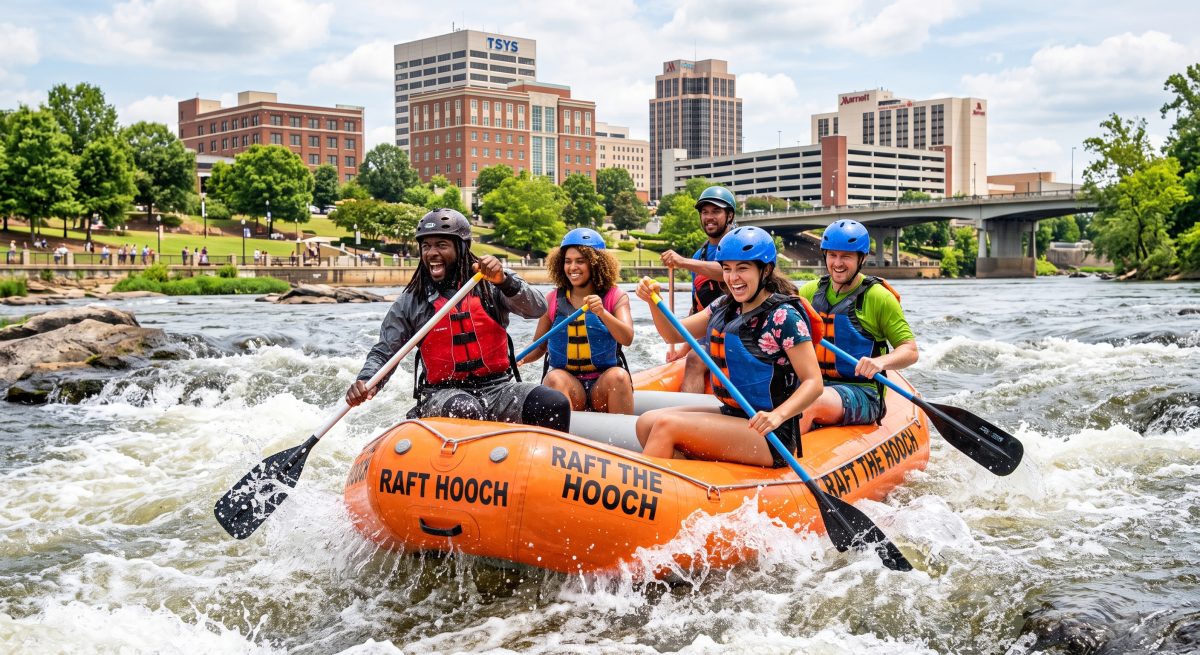
Columbus, Georgia, has turned a stretch of river once dominated by industrial dams into one of the region’s most recognizable outdoor attractions.
Today, the Chattahoochee River draws whitewater rafters, kayakers, outdoor enthusiasts and visitors looking for an experience that is difficult to find in the middle of a major American city. The course runs directly alongside Uptown Columbus, with the river forming the boundary between Georgia and Alabama.
The attraction is notable for its scale. Columbus is home to what Whitewater Express describes as the world’s longest urban whitewater rafting course, stretching approximately 2.5 miles through a series of rapids.
But the modern river experience required years of planning, millions of dollars in investment and the removal of two historic dams that had shaped the Chattahoochee for generations.
The project also helped change the way residents and visitors experience downtown Columbus, creating a new outdoor recreation destination while raising questions about river restoration, tourism and the long-term effects of removing the dams.
Here’s a closer look at the Chattahoochee whitewater course by the numbers.
The River: 2.5 Miles of Whitewater in the Heart of Columbus
2.5 miles: That’s the approximate length of the urban whitewater course running through the Chattahoochee River between Columbus and Phenix City, Alabama.
Rather than traveling to a remote mountain river, visitors can experience whitewater rafting within walking distance of restaurants, hotels, businesses and downtown attractions.
The course features a variety of rapids, allowing outfitters to offer trips for different experience levels. Water conditions and the configuration of the rapids help determine the experience on any given day.
Two dams: The City Mills and Eagle & Phenix dams were removed as part of the river restoration project that made the modern whitewater course possible.
For generations, the dams helped support industrial activity along the river. Their removal allowed water to flow through previously obstructed sections, opening the way for a new recreational use of the Chattahoochee.
1828: The year the City Mills dam was built. The structure stood approximately 5 to 8 feet high and powered a grist mill that continued operating until the 1980s.
1882: The year the Eagle & Phenix dam was built. At approximately 30 feet high, it was described in historical accounts as the largest masonry dam in the South at the time. It remained in operation until the 1990s.
The dams were part of a much larger industrial story. For generations, Columbus used the Chattahoochee’s waterpower to support mills and manufacturing, helping establish the city as an important industrial center in the Southeast.
Their removal therefore represented more than an engineering decision. It marked a change in how Columbus could use one of its most significant natural resources.
1972: The year the Columbus Industrial District, including the historic dams, was listed as a National Historic Landmark.
That designation underscores the historical significance of the industrial development along the river and the complicated balance between preserving the past and creating new uses for the waterfront.
What controls the rapids?
The whitewater course does not operate independently of the river’s water supply.
Approximately 2.5 miles upstream, the North Highlands dam regulates water releases that influence conditions along the rafting course.
Those releases affect the amount of water moving through the rapids and help determine when particular rafting experiences can operate.
The result is a recreation destination built around a working river system rather than a purpose-built attraction with artificial water circulation.
For visitors, that connection between water management and recreation is an important part of the experience.
The Build: About $25 Million and Years of Planning
Approximately $25 million: That’s the reported cost of the river restoration project. Published estimates have ranged from approximately $24.4 million to $26 million, depending on the source and accounting period.
The project required years of planning, fundraising, engineering and coordination among public and private stakeholders.
Approximately 15 years: That’s how long the concept had been in development before the dams were breached, according to Georgia Public Broadcasting’s retrospective coverage.
The extended timeline reflected the scale of the undertaking. Removing historic industrial structures and developing a usable whitewater course required more than simply clearing a channel.
The project had to account for river conditions, public access, recreation, infrastructure and the future use of the surrounding waterfront.
$5 million: That’s the amount the W.C. Bradley Co. contributed toward the project after purchasing the Eagle & Phenix dam in 2003, according to reporting by the Atlanta Journal-Constitution.
Uptown Columbus played a leading role in fundraising and advancing the broader vision for the riverfront.
The moment the project became real
March 11, 2013: Crews blasted the Eagle & Phenix dam, marking a major milestone in the transformation of the river.
The removal opened the way for the water to move through the restored section and helped make the new whitewater experience possible.
May 25, 2013: Whitewater Express conducted its first test trips on the course.
The timing was significant. After years of planning and construction, the Chattahoochee was becoming an attraction that visitors could experience directly rather than simply observe from the riverbank.
The technology behind the waves
60 feet wide: That’s the approximate width of the Waveshaper, a steel structure equipped with movable vanes that can alter the shape of the water.
The structure helps create different wave characteristics and allows operators to adjust the course for different types of paddling.
That adaptability is important because the same stretch of river serves visitors seeking a guided recreational trip and experienced paddlers looking for more demanding whitewater.
The engineering behind the course is one reason Columbus has been able to position itself as a destination for both casual outdoor recreation and competitive kayaking.
The Rafters: From 10,000 Expected Visitors to About 45,000 a Year
The whitewater course attracted attention quickly after opening.
Approximately 10,000: That’s how many rafters Columbus expected to attract during the course’s first year, according to the Ledger-Enquirer.
The early projections reflected the uncertainty surrounding a major recreation project in an urban setting. While Columbus had a long history as a river city, guided whitewater rafting on this scale was a new offering.
The initial interest exceeded those expectations.
More than 13,100: By July 2014, more than 13,100 people had already rafted the course during its second summer, according to contemporary news reports.
1,115: That’s how many rafters traveled down the river on a single Saturday in August 2015, the Ledger-Enquirer reported.
The figure illustrates how a concentrated period of strong demand can bring large numbers of visitors to the riverfront.
Approximately 45,000 a year: That’s the annual rafting figure cited in Georgia Public Broadcasting’s 2023 reporting on the course.
50,000: That was the number of rafters recorded in 2021, which GPB identified as the busiest year in the reporting it examined.
Those figures demonstrate the course’s ability to attract substantial recreational traffic. They also help explain why rafting became an important part of Columbus’s broader tourism identity.
The annual total can vary, however, and should not be confused with the number of unique tourists visiting Columbus. Some people may visit the city for other reasons, while others may participate in multiple activities during the same trip.
The Trips: Three Ways to Experience the Chattahoochee
Whitewater Express offers several rafting options designed for different levels of adventure.
The following prices and requirements reflect the information listed on the outfitter’s website as of October 10, 2026. Visitors should confirm current rates, age requirements and operating conditions before booking.
Experience Listed price per person Approximate duration Rapids General eligibility Classic $49.95 2 hours Up to Class III+ Ages 7 and older; minimum weight of 60 pounds Challenge $64.95 2.5 hours Up to Class V Ages 12 and older Carnage $79.95 2.5 hours Up to Class V, with favorite rapids repeated Ages 12 and older
The Classic trip is aimed at visitors looking for a guided introduction to whitewater rafting. The more challenging options offer a more intense experience for participants who meet the outfitter’s requirements.
Four to seven people: That’s the typical number of participants in a Classic raft, although some larger rafts can accommodate up to nine.
Every trip includes a guide, but visitors should be comfortable in and around water and follow the outfitter’s safety instructions.
Cut Bait and the course’s most demanding water
Class V: That’s the rating Whitewater Express assigns to Cut Bait, which it identifies as the biggest rapid on the course.
The outfitter describes the rapid as one of the largest on the East Coast.
Other named features include Ambush, Turner’s Tumbler, Pemberton Falls and the Waveshaper.
The names help distinguish the individual features of the course, but the difficulty of a particular rapid can depend on water conditions and the experience being offered.
For visitors, the attraction is the combination of challenging water and an unusual setting: the rapids run alongside an urban waterfront rather than through an isolated wilderness.
More than rafting
The riverfront experience extends beyond rafts and kayaks.
Approximately 1,200 feet: That’s the length of the Blue Heron dual zipline, which opened the year after the whitewater course.
The attraction crosses the river between Alabama and Georgia, giving visitors another way to experience the Chattahoochee.
Together, the rafting course and zipline offer different perspectives on the same river. One takes visitors through its rapids, while the other sends them above the water.
That combination also makes the riverfront appealing to groups whose members may not all want to participate in the same activity.
The Big Events: Columbus on the Competitive Kayaking Map
The course has hosted major whitewater competitions, helping introduce Columbus to athletes, spectators and paddling enthusiasts from outside the region.
Four notable events cited in reporting on the course include:
- 2017: U.S. National Championships.
- 2018: U.S. National Championships.
- 2022: World Cup competition.
- 2023: World Championship competition.
Georgia Public Broadcasting described the 2023 championship as comparable to the Olympics of kayaking.
Hosting major events can bring more than competitors to a city. Athletes may travel with coaches, family members and support staff, while spectators and other visitors may spend money on hotels, restaurants and local attractions.
The events also provide an opportunity to showcase the course’s engineering and the riverfront’s proximity to downtown amenities.
However, the economic effect of any individual competition depends on attendance, visitor spending and other factors. The number of events alone does not establish how much revenue they generated.
What It Meant for Columbus: Tourism and Uptown Investment
The whitewater course was developed as part of a broader effort to reconnect Columbus with its riverfront and strengthen the appeal of Uptown.
More than $230 million: That’s the reported amount of property investment in Uptown, including building renovations, highlighted in GPB’s 2023 retrospective.
New Uptown hotels began appearing in 2017, expanding accommodation options for visitors.
The investment figure provides a sense of the scale of development around the district, but it should not be interpreted as money generated by rafting alone. Multiple factors contribute to real estate investment, including business activity, public infrastructure, demand for housing and the overall attractiveness of a location.
The whitewater course is one element of a larger destination that includes restaurants, entertainment, historic buildings, public spaces and other attractions.
How much tourism contributes to Columbus
Tourism Economics, working with VisitColumbusGA, reported the following figures for fiscal year 2025:
3.1 million: The number of visitors to Columbus during the fiscal year.
$650.3 million: The amount those visitors spent in the city.
$1 billion: The reported total economic impact of tourism.
6,269: The number of jobs supported by visitor spending, according to the study.
These figures help illustrate the broader importance of tourism to the local economy.
Visitor spending can support restaurants, hotels, retailers, transportation providers, entertainment businesses and other employers. Some of that spending also circulates through the local economy as businesses purchase supplies, pay workers and contract with other companies.
The distinction between visitor spending and total economic impact matters. The two figures measure different things, and the total impact should not be added to visitor spending as though they were separate pools of money.
The study also does not isolate the economic contribution of the whitewater course from other tourism drivers, including Fort Benning graduations, sporting events, the National Infantry Museum and other attractions.
Consequently, the tourism figures describe the overall market in which the whitewater course operates, not the amount of economic activity that rafting alone produces.
Why the riverfront matters to local businesses
A visitor who comes to Columbus for rafting may also purchase a hotel room, eat at a local restaurant, visit another attraction or shop downtown.
That creates opportunities for businesses beyond the rafting outfitter itself.
The extent of those benefits depends on how long visitors stay, how much they spend and whether the attraction brings people to Columbus who otherwise would not have visited.
Those are important questions for future reporting because they help distinguish between an attraction that is popular on its own and one that generates measurable benefits across a wider area.
The whitewater course’s long-term contribution to Columbus is therefore best understood as part of a broader tourism and waterfront development strategy.
What It Meant for the River: The Question of Shoal Bass
The removal of the dams also raised an environmental question: How would restoring water flow affect the river’s fish and habitat?
Shoal bass, a species native to the Chattahoochee’s rocky shoals, were among the reasons supporters wanted the dams removed.
The idea was that restoring more natural river conditions could improve habitat for species associated with flowing water and rocky riverbeds.
But the outcome has not been straightforward to measure.
Georgia Public Broadcasting reported in its 2023 retrospective that it remained unclear whether shoal bass had returned to the restored stretch in the expected numbers.
Auburn University fisheries researcher Steve Sammons has studied the species. GPB also reported that the Georgia Department of Natural Resources lacked consistent fish data for that stretch of the river.
Without consistent monitoring, it is difficult to draw firm conclusions about long-term population changes or attribute those changes directly to the dam removals.
The issue illustrates a broader challenge in restoration projects: Removing an obstruction can change river conditions, but determining whether those changes produce lasting ecological benefits requires continued scientific study.
For Columbus, the river is both an economic asset and a natural resource. Understanding how recreation, water management and habitat interact remains important as the waterfront continues to develop.
The Bigger Picture: A River With a Different Purpose
For much of its modern history, the Chattahoochee in Columbus was closely associated with manufacturing and industrial power.
The City Mills and Eagle & Phenix dams were part of that story. Their removal marked a shift toward a different use of the river, one centered on recreation, tourism and public access.
The resulting whitewater course is an unusual feature of Columbus’s downtown landscape. Visitors can experience rapids, watch kayakers practice, walk along the riverfront or cross the water on a zipline without leaving the urban area.
The transformation also illustrates how cities can reconsider the role of historic infrastructure. Structures built to support industrial growth may eventually become barriers to other goals, including recreation and ecological restoration.
Whether the whitewater course ultimately produces the full economic and environmental benefits its supporters envisioned will depend on continued investment, reliable data and the ability to maintain the riverfront as an attractive destination.
What is already clear is that the Chattahoochee has become a central part of how Columbus presents itself to visitors and residents alike.
Plan Your Chattahoochee Whitewater Trip
Visitors interested in rafting can contact Whitewater Express for current availability, pricing, trip requirements and water conditions.
Location: Whitewater Express, 1000 Bay Ave., Columbus, GA 31901
Phone: (706) 321-4720
Reservations: Visit the official Whitewater Express booking website at chattahoochee.whitewaterexpress.com.
What to wear: Quick-drying clothing or a swimsuit, along with water shoes, sandals with a heel strap or old sneakers. Shoes are required.
What to bring: Follow the outfitter’s current guidance on personal belongings. Lockers are available to rent, and visitors may prefer to leave valuables secured elsewhere.
Prefer to stay dry? The RiverWalk offers opportunities to view the river and watch the action from the banks. The broader RiverWalk system extends approximately 22 miles along the river.
Visitors should check current operating hours and trip availability before traveling, particularly when planning around water conditions or special events.
Columbus’s Whitewater Course by the Numbers
From the length of the rapids to the number of visitors, the figures tell a story of how Columbus reimagined a portion of its riverfront.
- 2.5 miles: Approximate length of the urban whitewater course.
- 2 dams: City Mills and Eagle & Phenix.
- About $25 million: Reported cost of the river restoration.
- 2013: The year the course opened to rafting.
- About 45,000: Annual rafters cited in GPB’s 2023 reporting.
- $650.3 million: Visitor spending in Columbus during fiscal 2025.
- $1 billion: Reported total economic impact of tourism in fiscal 2025.
- 1,200 feet: Approximate length of the Blue Heron dual zipline.
The numbers capture the scale of the project, but the story of the Chattahoochee is about more than a rafting course. It is about a city changing its relationship with a river that helped build it.
Have you rafted the Chattahoochee? Which rapid was your favorite? Share your experience with ColumbusTimes.com.
News organizations may republish this story with credit. See our guidelines.
Know someone who'd want to read this? Email it to a friend.
Own a Columbus business? Reach 40,000+ monthly readers. Ads from $125/month. See ad optionsPlan your weekend with Columbus Times
Get This Weekend in Columbus every Thursday: the best local events, free things to do and family fun, plus each evening's local news. Free, and you can unsubscribe anytime.
More stories
 Community What's Open and Closed in Columbus on Columbus Day, Monday, Oct. 12
 Community Fort Benning Graduation in Columbus: Your Family's Guide to the Ceremony, the Gate, Hotels and Food
 Community Georgia Extends Gas Tax Suspension Through November 5: How Much Could Drivers Save?
 Community Is Columbus Safer Than It Was 5 Years Ago? What the Numbers Show