New Federal Order Lifts Penalties on "Red" Farm Diesel on Highways Through Dec. 31. What It Means in Georgia and Alabama
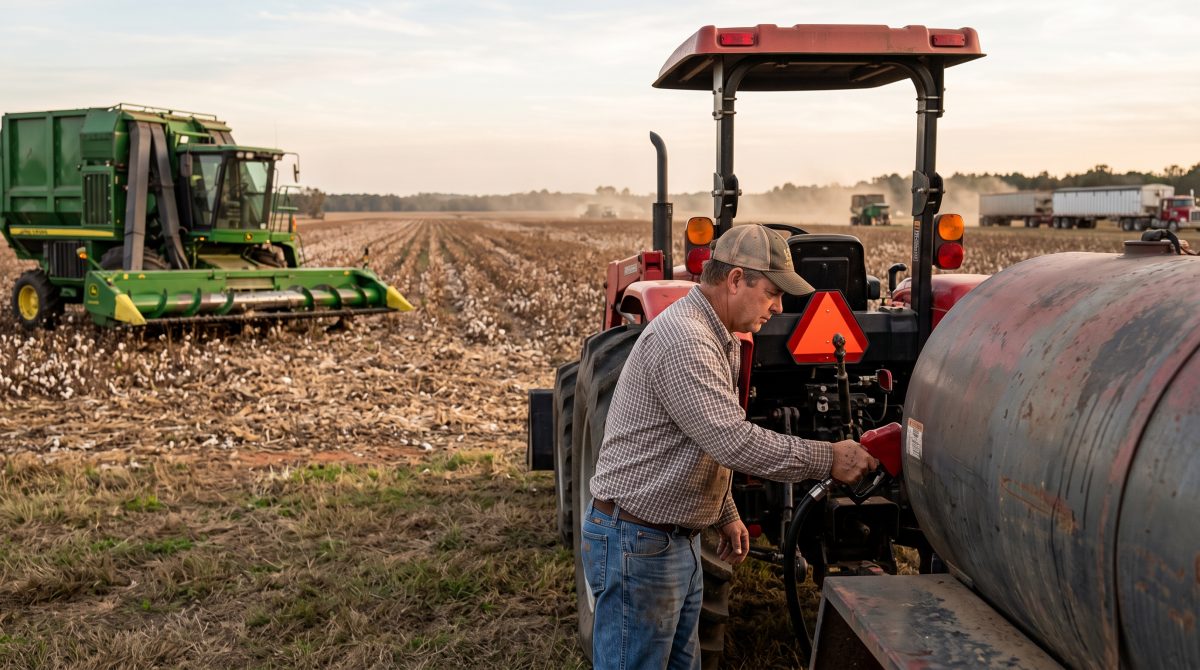
Illustration: AI-generated
With diesel prices near record highs in the middle of harvest season, President Trump signed an executive order Monday that lets farmers, truckers and other drivers use cheaper, untaxed "dyed" diesel on public highways through the end of the year.
The U.S. Department of Agriculture estimates the move will save about $640 million in combined federal and state fuel taxes across roughly 224.6 million acres of harvested farmland.
But there's a catch: the federal tax isn't being canceled, at least not yet. And Georgia and Alabama farmers face different rules on the state side.
What is dyed diesel?
Dyed diesel is the same fuel that goes into a pickup or tractor-trailer, but it's dyed red to show that it's meant for off-road use: tractors, combines, construction equipment and generators. Because it isn't burned on public roads, it's exempt from the federal highway fuel tax of 24.4 cents a gallon and from most state fuel taxes.
Normally, getting caught with red diesel in a vehicle on a public highway can bring steep federal and state penalties. That's what this order changes for the rest of 2026.
What the order does
The executive order, signed Oct. 5, covers dyed diesel sold or used on highways from Oct. 5 through Dec. 31, 2026. Under the order:
- No federal penalties. The Internal Revenue Service will announce that it won't penalize anyone for using dyed diesel on the road during that period.
- Federal tax deferred. The 24.4-cent federal excise tax on that fuel is deferred, not eliminated, with no penalties or interest. The order tells the Treasury secretary to "explore pathways," including legislation, to erase the deferred tax permanently. That hasn't happened yet.
- More fuel where it's needed. The Agriculture Department will work with farm co-ops and fuel distributors to make sure dyed diesel is available in high-demand farm areas.
- States are encouraged to follow. Each state controls its own fuel taxes and roadside enforcement, so the order asks states to adopt matching policies.
The order cites "restricted global diesel supply" as the reason prices have climbed.
"Energy dominance is at the core of putting farmers and ranchers first," Agriculture Secretary Brooke Rollins said in a statement. She said the order "will better enable our farmers to deliver America's harvest during this critical time."
Why now: diesel prices have nearly doubled
The national average price of diesel hit $6.38 a gallon in late September, according to the U.S. Energy Information Administration. That's up from an average of about $3.68 in October 2025.
Farmers have been hit even harder at the worst possible time. The American Farm Bureau Federation reports that farm diesel cost an average of $5.61 a gallon in September, up $2.60 from a year earlier. It estimates the increase adds about $5.28 per acre to the cost of harvesting cotton, or nearly $2,900 for an average-size cotton farm, just for harvest fuel.
Fall is when Georgia's two biggest row crops, peanuts and cotton, come out of the ground and get hauled to buying points and gins. That means a lot of diesel on rural roads.
What it means in Georgia
Georgia has taken a different route than many states.
Gov. Brian Kemp suspended the state's motor fuel tax from Sept. 29 through Oct. 29, which saves drivers 37.3 cents a gallon on regular diesel and 33.3 cents on gasoline.
"This announcement means immediate relief for Georgia families struggling to afford gas and groceries and Georgia farmers facing diesel prices that have more than doubled in recent weeks," state Agriculture Commissioner Tyler Harper said when the suspension was announced.
But Georgia's suspension doesn't change anything for dyed diesel. Dyed diesel was already exempt from the state tax, according to the Georgia Department of Revenue. As of Oct. 6, Georgia had not announced a policy matching the federal order on using dyed diesel on state highways. Georgia farmers should check with the Department of Revenue or their county Extension office before running red diesel on the road, since the federal order alone doesn't cover state rules.
What it means in Alabama
Across the river, Alabama acted earlier. On Sept. 24, Gov. Kay Ivey directed the Alabama Law Enforcement Agency to stop enforcement related to dyed diesel for 120 days to help farmers and timber haulers. She also asked the state revenue department to seek federal penalty relief, which the new order now provides.
Under Ivey's directive, state troopers are focusing commercial vehicle inspections on real safety threats instead of checking fuel tanks for red dye. Alabama's peak harvest runs through Nov. 15.
Alabama is one of at least 10 states, along with Texas, Arkansas, Missouri, Indiana and North Carolina, that loosened dyed-diesel rules in the two weeks before the federal order.
What farmers and truckers should know
- Keep good records. Because the federal tax is deferred rather than canceled, it could still be owed later unless Congress or the Treasury eliminates it. Save receipts showing how much dyed diesel you bought and used on the road.
- State rules still apply. The federal order protects you from IRS penalties, but your state decides its own taxes and roadside enforcement. Alabama has relaxed enforcement. Georgia hadn't as of Oct. 6.
- The relief is temporary. The federal window closes Dec. 31. Georgia's fuel tax suspension ends Oct. 29 unless the governor extends it.
- Watch for IRS guidance. The order gave the Treasury Department five days to issue an announcement on penalties and more detailed guidance on who qualifies.
Questions? Georgia farmers can contact the Georgia Department of Revenue's Motor Fuel Unit or their local UGA Extension office. Alabama farmers can contact the Alabama Department of Revenue or the Alabama Farmers Federation.

News organizations may republish this story with credit. See our guidelines.
Know someone who'd want to read this? Email it to a friend.
Own a Columbus business? 60,000+ page views a month. Ads from $125/month. See ad options Follow Columbus Times on FacebookLocal news, events and people, in your feed every day.Most read this week
- Georgia Spent $165.7 Million on Medicaid Work Requirement Program, but Only 18,527 Were Enrolled After 3 Years
- 8 Columbus Restaurants Got a C on Their Health Inspection in 2026, the Most of Any Year Since 2022. Here's Every One
- The Night Fight on the Chattahoochee: How Columbus Became the Site of What Many Call the Last Battle of the Civil War
- The 10 Best Mexican Restaurants in Columbus, Ga., Ranked by Diners
- Columbus' Top-Rated Barbecue: 12 BBQ Joints Ranked by Google Stars and Health Scores
More stories
 Business Columbus Commercial Properties That Sat Vacant for Years: What Happened to Them?
 Business The 7 Columbus-Area Industries That Could Create the Most Jobs by 2031
 Business USDA Awards $3.3 Billion Loan for Georgia Power Plant to Meet Rising Electricity Demand
 Business 10 of the Best Businesses to Start in Columbus, Georgia
Comments
Be respectful. No personal attacks, hate speech, spam or anyone's private information. Every comment is reviewed before it appears. Comment rules
No comments yet. Be the first to share your thoughts.